
The Labor Market Just Sent Its Clearest Signal Yet
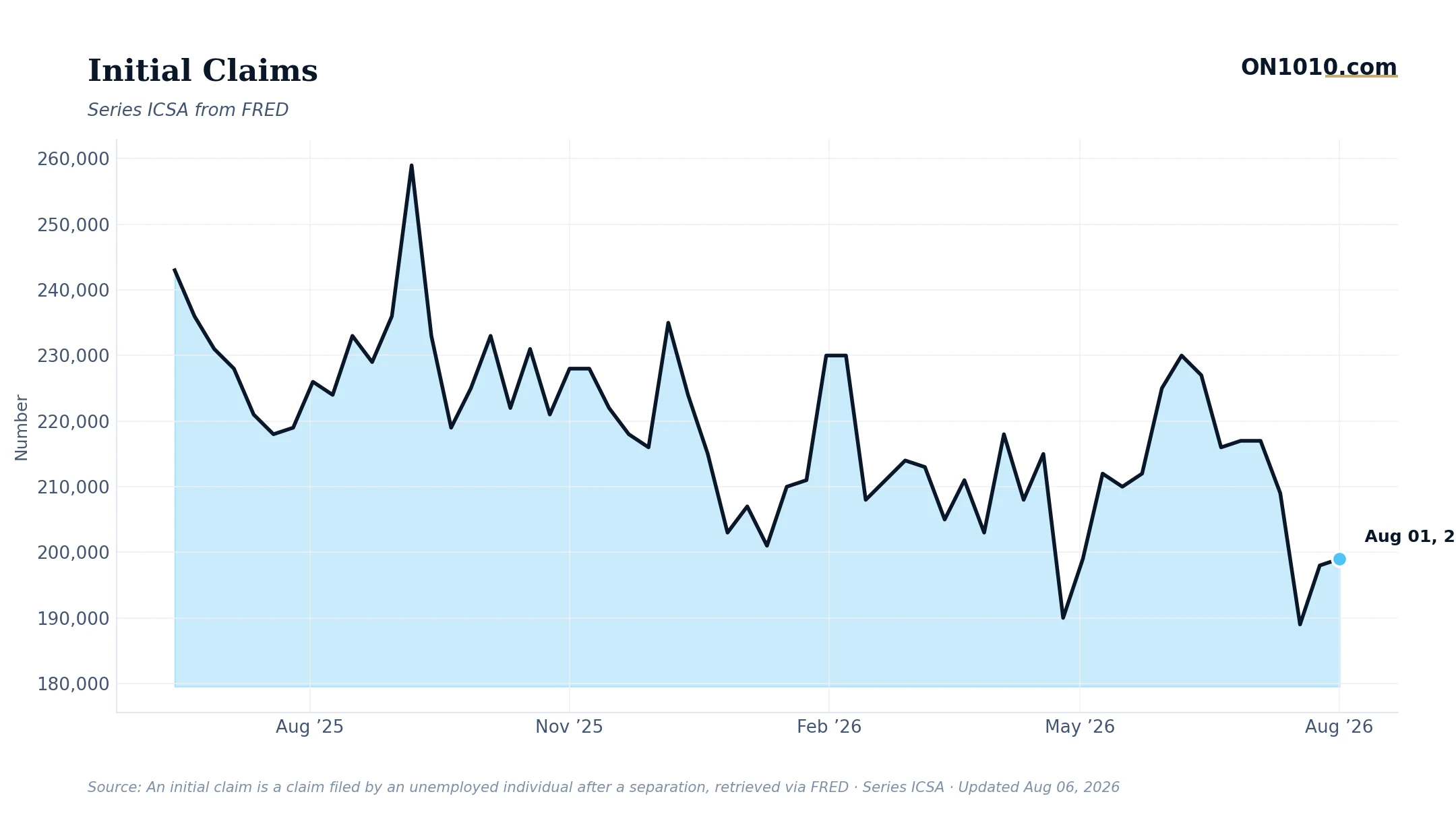
Jobless claims came in at 199,000 last week, up just 1,000 from the prior week’s 198,000. The real story isn’t the weekly tick. It’s where we’ve landed after weeks of choppiness: the labor market is tighter than almost anyone expected at this point in the cycle.
Six weeks ago, claims were running at 217,000. The steady drift lower since then, with last week’s 189,000 briefly touching levels not seen in years, tells you something the monthly jobs reports are slower to capture. Employers are not cutting. When businesses see healthy margins and uncertain hiring pipelines ahead, they hold onto workers. That’s exactly what this data is showing.
Set this against the broader backdrop and the picture sharpens. Growth is near its historical midpoint and edging lower. Inflation is running well above its long-run norm. And long-term interest rates remain elevated by historical standards, a genuine cost friction for businesses making capital commitments. The fact that layoffs haven’t risen in this environment is notable. It suggests profit margins at the firm level are still healthy enough to absorb higher borrowing costs without forcing workforce reductions.
Historically, when claims have held in the sub-200,000 range during a period of elevated rates and sticky inflation, the economy has tended to run hotter for longer than consensus expected. That doesn’t make a soft landing certain, but it does raise the cost of betting heavily on one. In past cycles, business owners and capital allocators have used sustained tightness in layoff data as a prompt to revisit assumptions about timing: when does the squeeze from rates actually show up in employment decisions?
Bottom Line: Sub-200,000 claims, month after month, is not a soft-landing whisper. It’s the labor market saying the squeeze hasn’t arrived yet. The question worth sitting with is whether high rates eventually break that or whether productivity gains and margin discipline keep employers holding on longer than the models say they should.
Source: Federal Reserve Economic Data (FRED)
ON1010 Research is an independent publisher of economic education and is not a registered investment adviser, broker-dealer, or investment company. This content is for educational and informational purposes only and is not investment advice or a recommendation to buy, sell, or hold any security. Published under the publisher exemption recognized by Section 202(a)(11)(D) of the Investment Advisers Act of 1940 (Lowe v. SEC). Always consult a qualified financial professional before making any financial decision.
Free Research
The economy moves fast. We make sure you move faster.
Economic data, policy shifts, and market signals — delivered to your inbox.
Subscribe Free