
The Yield Curve Just Crossed Back Into Positive Territory. Here’s What the Bond Market Is Telling You.
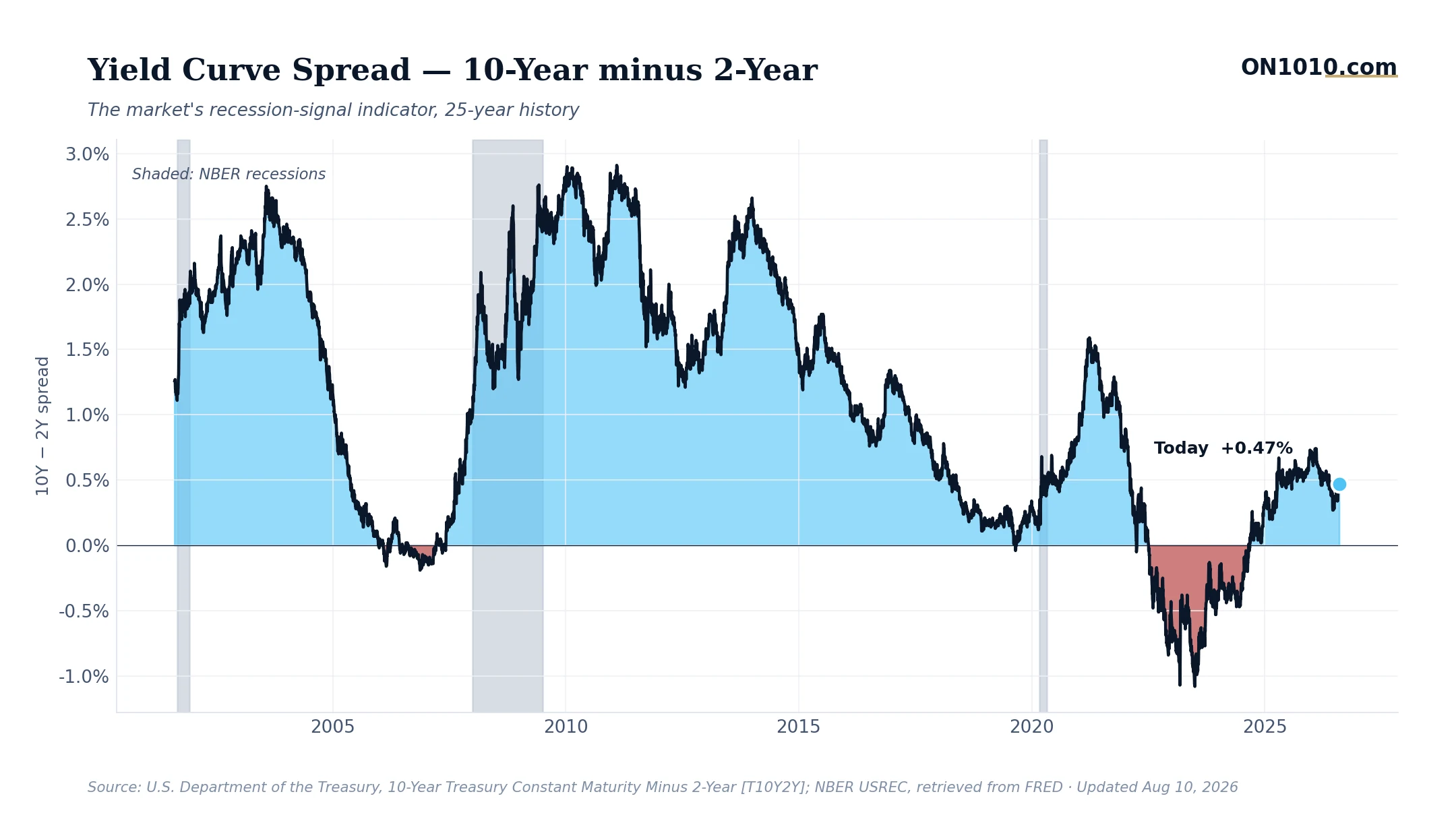
The 10-year minus 2-year Treasury spread sits at 0.47% as of August 10, up from 0.43% just a week ago. That might sound like a rounding error, but the direction matters as much as the level. The curve has been steadily steepening, and that shift carries real meaning.
For context: this spread spent most of 2022 through 2024 inverted, meaning short-term rates were higher than long-term rates. That inversion was the bond market’s loudest warning signal in decades. A return to positive and rising territory is the curve taking that warning back, at least partially.
The bigger picture is genuinely mixed. Credit spreads are historically tight, VIX is calm, and the equity market is trading above both its 50-day and 200-day moving averages. That’s a constructive setup by most measures. But long-term interest rates remain elevated by historical standards, core inflation is still running hot relative to history, and consumer sentiment is near the bottom of its historical range. The economy is growing, but with friction underneath the surface.
Historically, a steepening curve coming out of an inversion has signaled two very different things depending on what’s driving it. If long rates rise because growth expectations improve, that’s healthy. If long rates rise because markets are demanding more compensation to hold long-duration debt (a so-called “bear steepener”), it adds cost pressure to businesses refinancing debt and to households carrying variable-rate loans. The distinction matters enormously for capital allocation decisions. In past cycles, business operators and investors have watched which end of the curve is moving faster as a way to tell those two stories apart.
Bottom Line: The yield curve’s return to positive ground is a signal worth watching, but the real question is why it’s steepening. Growth optimism and inflation anxiety can look identical in the headline number, and only one of them is good news for the economy.
Source: Federal Reserve Economic Data (FRED)
ON1010 Research is an independent publisher of economic education and is not a registered investment adviser, broker-dealer, or investment company. This content is for educational and informational purposes only and is not investment advice or a recommendation to buy, sell, or hold any security. Published under the publisher exemption recognized by Section 202(a)(11)(D) of the Investment Advisers Act of 1940 (Lowe v. SEC). Always consult a qualified financial professional before making any financial decision.
Free Research
The economy moves fast. We make sure you move faster.
Economic data, policy shifts, and market signals — delivered to your inbox.
Subscribe Free