
Inflation’s Quiet Summer: The 2.6% Number That Means More Than It Looks
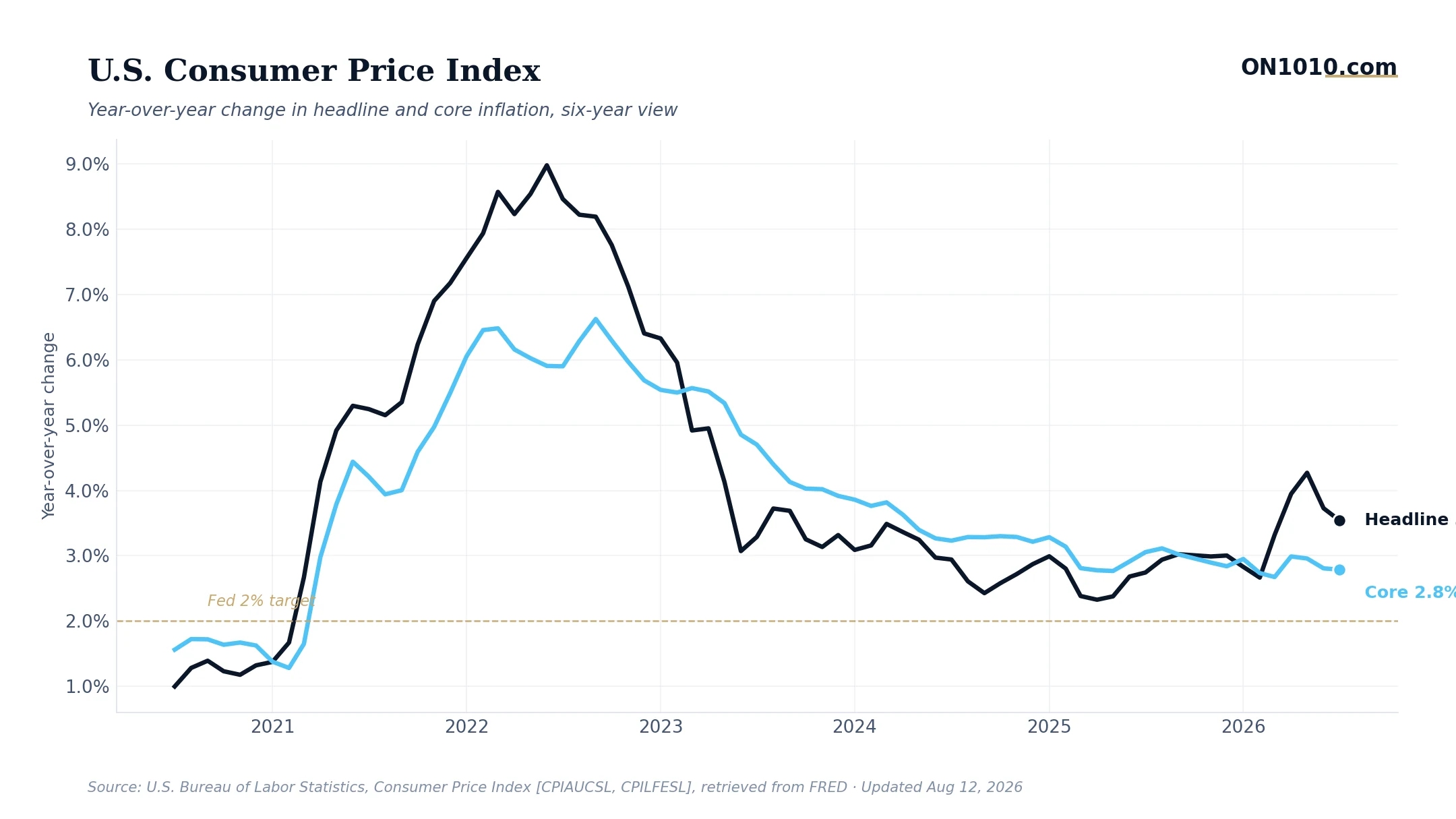
Prices barely moved in July. The Consumer Price Index ticked up just 0.07% from June, one of the softest monthly readings in recent memory. But the year-over-year number, 2.64%, is where the real story lives.
That 2.64% sounds almost tame after everything the past few years threw at consumers. And in isolation, it is. The problem is the context around it.
Inflation is running hotter than roughly nine out of every ten months in the historical record. Not because the monthly pace is alarming, it isn’t, but because prices never fully retreated. Look at the index level: from 327.46 in February to 332.81 in July. Prices climbed, stalled briefly in May, then crept back up. There is no clean downtrend here, just a plateau at elevated levels.
That matters enormously for the real economy math. If wages are rising at 3.5% and inflation is running at 2.64%, real purchasing power gains are thin. Businesses are still facing input costs that are structurally higher than pre-2022, which creates ongoing pressure on margins, especially for companies that can’t pass costs through to customers anymore.
Here is where the broader picture gets interesting. Credit spreads are historically tight, suggesting the bond market sees little near-term default risk. Long-term interest rates, however, are historically elevated, meaning the cost of capital remains a genuine constraint on investment. Consumer sentiment is near historic lows despite that market calm. That combination, loose credit conditions alongside weak consumer confidence and sticky inflation, is unusual. Historically, when inflation stayed elevated after an initial shock, the question that mattered most for business operators was whether their pricing power could outrun their cost structure. That question is still very much open.
Bottom Line: The inflation story in 2026 isn’t about a crisis, it’s about persistence. Prices aren’t surging, but they aren’t retreating either, and the gap between where inflation sits today and where the Fed wants it is the friction point every capital allocation decision has to run through right now.
Source: Federal Reserve Economic Data (FRED)
ON1010 Research is an independent publisher of economic education and is not a registered investment adviser, broker-dealer, or investment company. This content is for educational and informational purposes only and is not investment advice or a recommendation to buy, sell, or hold any security. Published under the publisher exemption recognized by Section 202(a)(11)(D) of the Investment Advisers Act of 1940 (Lowe v. SEC). Always consult a qualified financial professional before making any financial decision.
Free Research
The economy moves fast. We make sure you move faster.
Economic data, policy shifts, and market signals — delivered to your inbox.
Subscribe Free