
Core Inflation Just Broke 2%. The Bond Market Is Not Celebrating Yet.
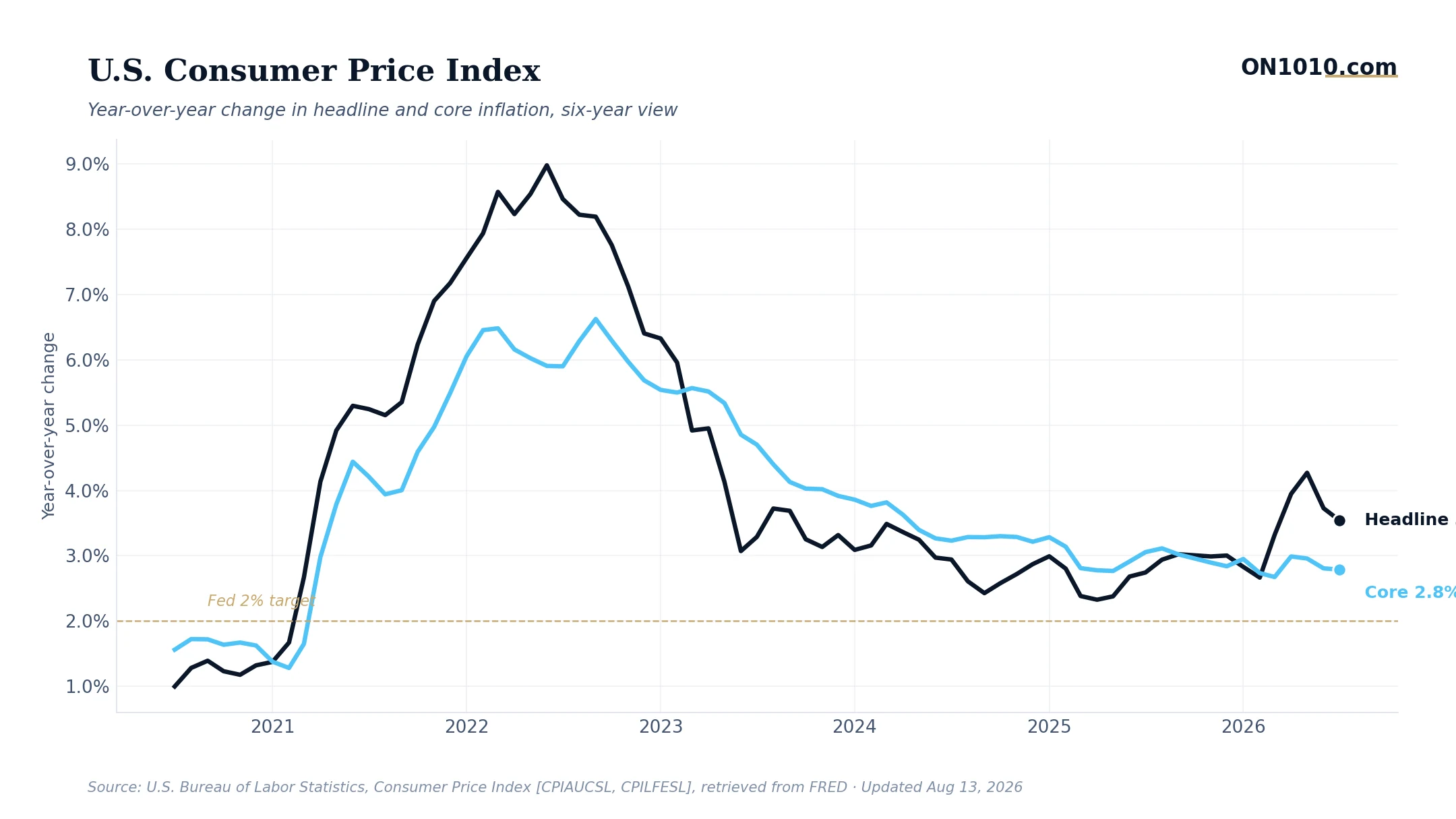
Yesterday’s CPI report delivered something genuinely unusual: annual core inflation fell to 1.93%, the first time it has printed below 2% in years, according to the Data Wire. That should be a clean win for the Fed.
So why is the 10-year Treasury still sitting at 4.7%, roughly 95 basis points above the top of the Fed funds target range?
What moved: Equities took the inflation data in stride. The S&P 500 closed at 7,748.50, up 0.26%, with the Nasdaq leading at +0.54%. Smaller companies joined in, with the Russell 2000 gaining 0.61%. The VIX eased to 14.66, below its 20-day average of 16.86. Core CPI rose just 0.22% in July, and the year-over-year rate dipped to 1.93%. Stocks liked the print. Bonds did not move much.
On deck today: Weekly jobless claims print this morning. After a soft inflation read, the labor market data becomes the swing factor for how the Fed reads the next few months.
Why it matters: The bond market is telling a different story than the CPI print. With the 10-year at 4.7% and breakeven inflation at 2.26%, real rates are still elevated. Historically, that kind of spread keeps pressure on business borrowing costs even when goods inflation cools.
The deeper look at what the bond market is signaling, and what it means for the broader economy, lands Sunday in The Long View. It is free.
ON1010 Research is an independent publisher of economic education and is not a registered investment adviser, broker-dealer, or investment company. This content is for educational and informational purposes only and is not investment advice or a recommendation to buy, sell, or hold any security. Published under the publisher exemption recognized by Section 202(a)(11)(D) of the Investment Advisers Act of 1940 (Lowe v. SEC). Always consult a qualified financial professional before making any financial decision.
Free Research
The economy moves fast. We make sure you move faster.
Economic data, policy shifts, and market signals — delivered to your inbox.
Subscribe Free