
The Recession Alarm Has Gone Quiet. Here’s What the Yield Curve Is Saying Now.
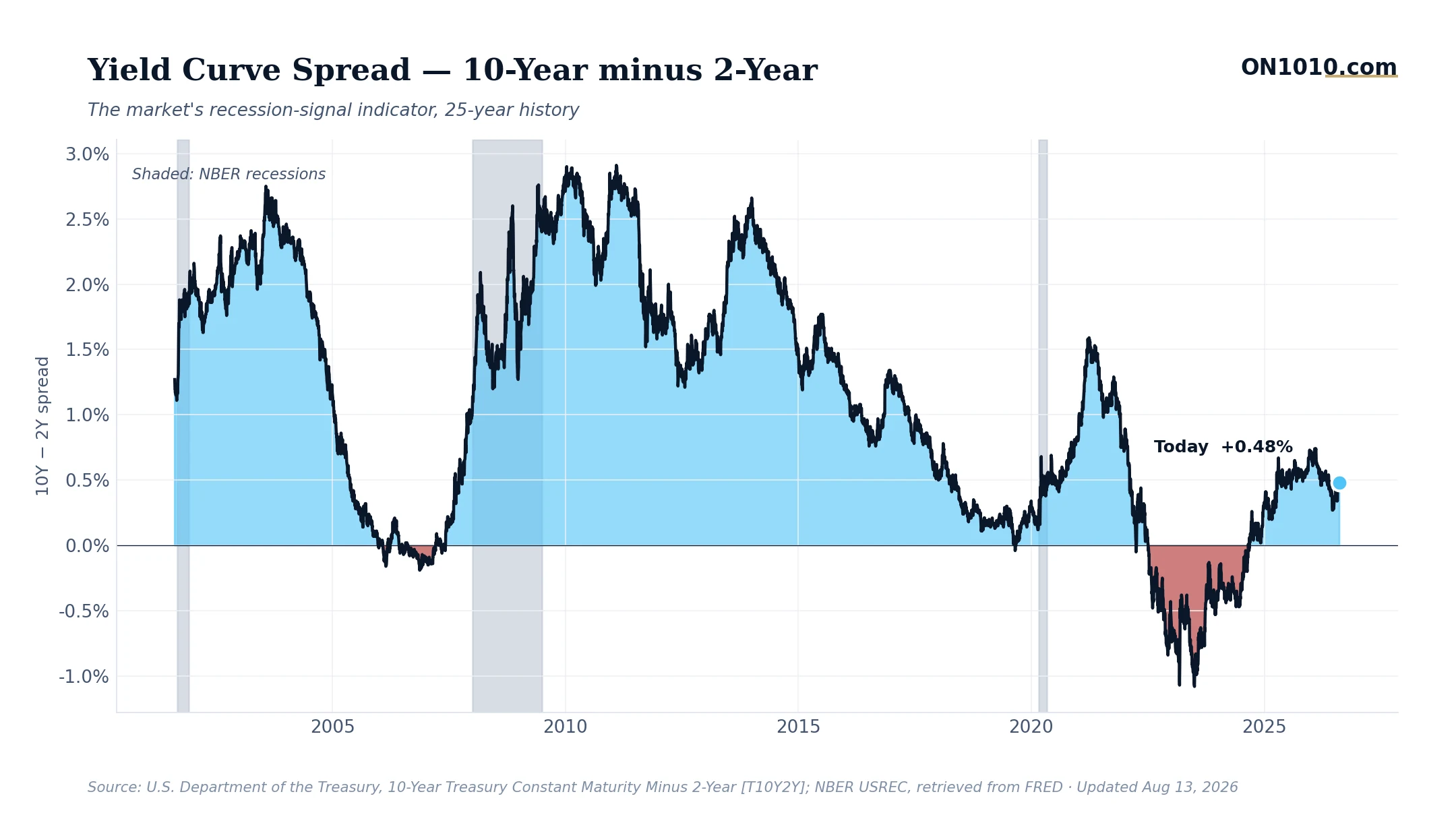
The 10-year minus 2-year Treasury spread held at 0.48% on August 13, exactly where it sat the day before and the day before that. Three consecutive identical readings. That kind of stillness in the yield curve is worth paying attention to, because this spread was deeply negative for most of 2022 and 2023, screaming recession warnings that never quite materialized the way history suggested they should.
The journey back matters as much as where we are today. The curve inverted in mid-2022, bottomed near negative 1.0%, and spent more than two years in negative territory. The fact that it has now climbed to positive 0.48% and stabilized there tells a story: bond markets are no longer pricing in an imminent growth collapse. Long-term rates sitting above short-term rates means investors are demanding more yield to lock up money for a decade, which typically reflects confidence that the economy keeps moving forward.
That said, the broader picture is not uniformly calm. Long-term interest rates remain high by historical standards, which creates real friction for businesses financing equipment, inventory, or expansion. At the same time, credit spreads are near the bottom of their historical range, meaning corporate bond markets are pricing in very little default risk. Those two readings can coexist in a mid-cycle environment where growth continues but borrowing costs gradually squeeze margins at the edges.
Historically, when the yield curve has re-steepened after a prolonged inversion, outcomes have varied widely. Sometimes it marked genuine economic recovery. Other times, it reflected the Fed cutting rates in response to deteriorating growth, which pulled short-term yields down before the slowdown became obvious in jobs data. Which path this is tends to become clearer in the months following the re-steepening. In past cycles, business operators and capital allocators have used the curve’s slope as one input in timing long-duration commitments, aware that the underlying reason for the steepening matters as much as the direction.
Bottom Line: The yield curve’s return to positive territory is a meaningful shift from where we were two years ago, but the real question is what drove the move. Bond markets are pricing in calm. Whether that calm is earned or just comfortable becomes the thing worth watching.
Source: Federal Reserve Economic Data (FRED)
ON1010 Research is an independent publisher of economic education and is not a registered investment adviser, broker-dealer, or investment company. This content is for educational and informational purposes only and is not investment advice or a recommendation to buy, sell, or hold any security. Published under the publisher exemption recognized by Section 202(a)(11)(D) of the Investment Advisers Act of 1940 (Lowe v. SEC). Always consult a qualified financial professional before making any financial decision.
Free Research
The economy moves fast. We make sure you move faster.
Economic data, policy shifts, and market signals — delivered to your inbox.
Subscribe Free