
The Yield Curve Just Flashed Its Cleanest “All Clear” Since the Inversion Era Ended
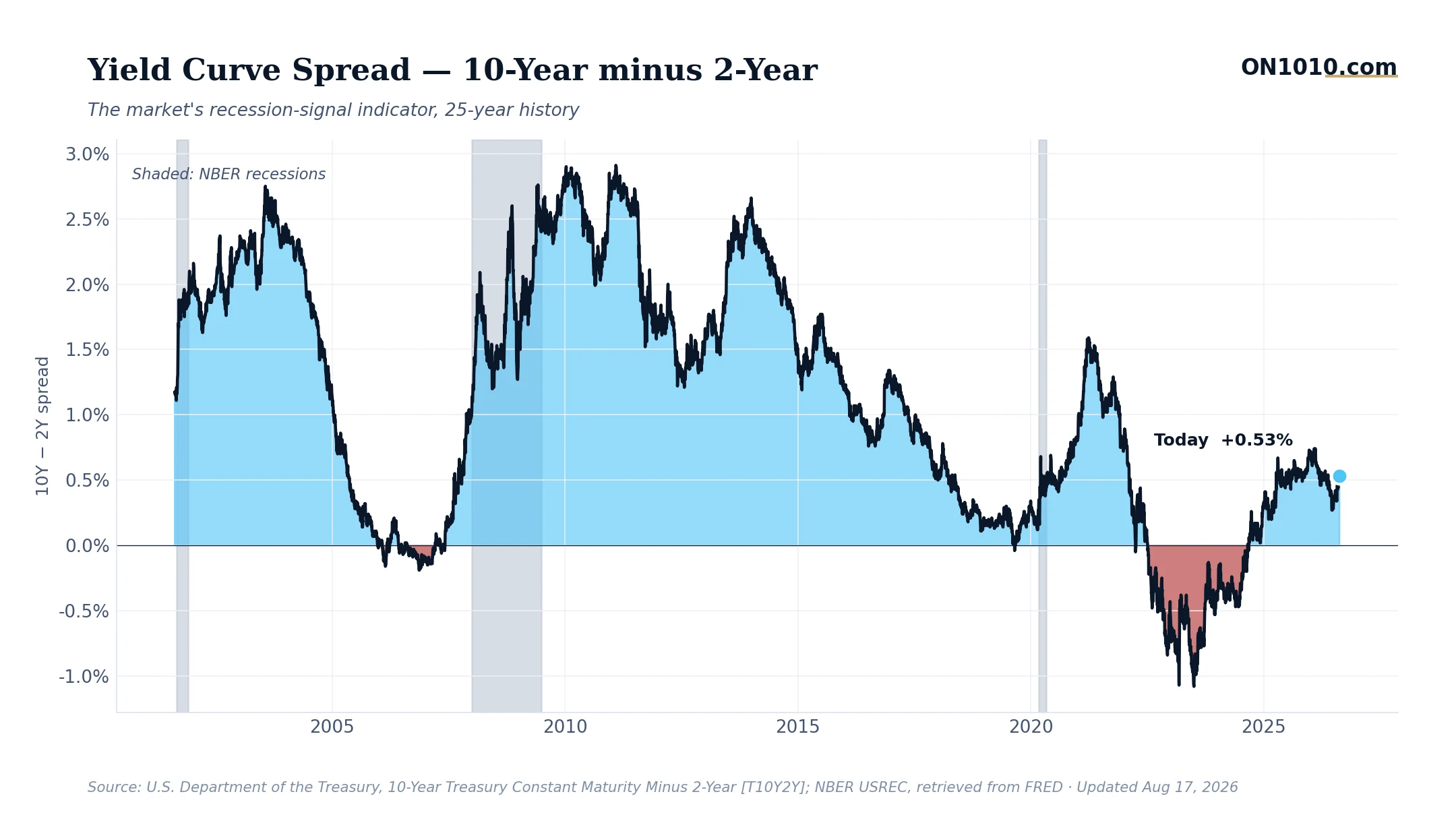
The spread between 10-year and 2-year Treasury yields has quietly crept to +0.53% as of August 17, up from +0.47% just a week ago. That’s a small move in absolute terms. In context, it’s a meaningful signal.
The yield curve spent most of 2022 through 2024 deeply inverted, with short-term rates sitting above long-term rates. That inversion was one of the most widely watched recession warnings in market history. The fact that we’re now sitting at +0.53% and climbing means the bond market has completed a full re-normalization.
The Bigger Picture
The curve’s return to positive territory reflects two things happening at once: long-term investors pricing in a more stable inflation path, and short-term rates gradually easing as monetary policy moves toward neutral. Combine that with credit spreads sitting near historically tight levels (signaling calm in corporate debt markets) and a VIX at 14.97 against a 20-day average of 16.45, and the fixed-income complex is painting a picture of confidence, not alarm. That said, inflation is still running historically hot, and long-term rates remain elevated versus their own history. The normalization is real. The job isn’t finished.
Why It Matters
Historically, when the yield curve re-steepens after a deep inversion, it has coincided with the reopening of capital market access for businesses. Borrowing costs for longer-duration projects start to make sense again relative to expected returns. In past cycles, investors and business operators have watched this transition closely because it often precedes a pickup in investment spending, though the lag can be long and uneven. The important caveat: a re-steepening driven by falling short rates can sometimes reflect growth fears rather than optimism, so the mechanism matters as much as the direction. Here, the backdrop of tight credit spreads and rising equity markets suggests the constructive interpretation is earning more weight than the fearful one.
Bottom Line: The yield curve spent years telling a cautionary tale. Right now, it’s telling a different one. The question worth sitting with is whether the real economy, where growth gauges sit near their historical midpoints and consumer sentiment remains historically weak, is ready to confirm what the bond market is starting to price in.
Source: Federal Reserve Economic Data (FRED)
ON1010 Research is an independent publisher of economic education and is not a registered investment adviser, broker-dealer, or investment company. This content is for educational and informational purposes only and is not investment advice or a recommendation to buy, sell, or hold any security. Published under the publisher exemption recognized by Section 202(a)(11)(D) of the Investment Advisers Act of 1940 (Lowe v. SEC). Always consult a qualified financial professional before making any financial decision.
Free Research
The economy moves fast. We make sure you move faster.
Economic data, policy shifts, and market signals — delivered to your inbox.
Subscribe Free