
The Yield Curve Healed. Now What?
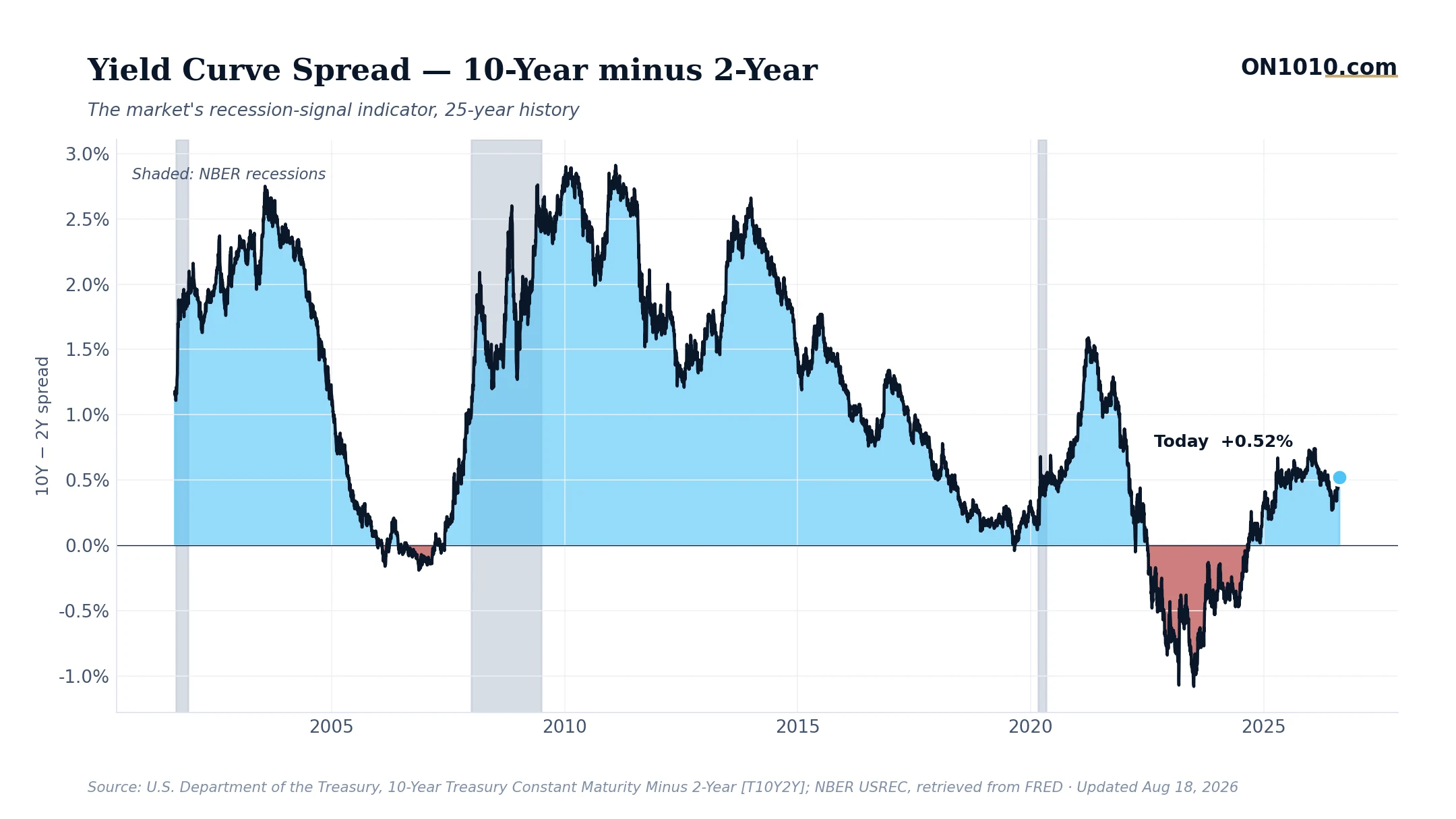
The 10-year/2-year Treasury spread sits at 0.52% as of August 18, holding steady in positive territory after a week that has ranged from 0.48% to 0.53%. That’s a small number that carries a big story: less than two years ago, this spread was deeply negative, and its inversion was one of the most discussed recession signals in decades.
The curve is no longer inverted. That part of the story resolved. But here’s what most people miss: the return to positive territory is historically its own warning, not a relief signal.
In past cycles, the yield curve’s inversion played the role of predictor, but the un-inversion has often marked the moment when recession risk became most acute, not least acute. The logic: long rates rising relative to short rates can reflect the bond market pricing in growth and inflation ahead, which is healthy. But sometimes the spread re-steepens because the Fed starts cutting short-term rates in response to a weakening economy. Those two stories look identical in the spread, but they have very different implications. Right now, with core inflation still running near the top of its historical range, long-term rates elevated versus history, and credit spreads near their tightest levels on record, the backdrop does not look like an economy in distress. The economic gauges are sending a mostly constructive signal. That matters when interpreting the curve.
Historically, when the spread returned to positive territory after a prolonged inversion, a recession began within the following year roughly 60% to 70% of the time in post-WWII cycles. That is a base rate worth knowing. That is not to say it will happen this time, because every cycle has its own character, and a structurally different economy (reshoring, AI-driven productivity, a tighter labor market than pre-2020 baselines would suggest) may shift those odds. But the pattern has appeared often enough that dismissing the re-steepening as purely good news is a mistake.
The question worth sitting with is whether this spread is widening because the economy is genuinely accelerating, or because the front end of the curve is about to fall. Those two paths lead to very different places for anyone making long-duration financing decisions or thinking about where capital earns its best return over the next two to three years.
Bottom Line: The yield curve’s healing is real, but the chapter most investors remember from past cycles starts after the inversion ends, not before it. Watch what drives the next move in the spread.
Source: Federal Reserve Economic Data (FRED)
ON1010 Research is an independent publisher of economic education and is not a registered investment adviser, broker-dealer, or investment company. This content is for educational and informational purposes only and is not investment advice or a recommendation to buy, sell, or hold any security. Published under the publisher exemption recognized by Section 202(a)(11)(D) of the Investment Advisers Act of 1940 (Lowe v. SEC). Always consult a qualified financial professional before making any financial decision.
Free Research
The economy moves fast. We make sure you move faster.
Economic data, policy shifts, and market signals — delivered to your inbox.
Subscribe Free