
The Yield Curve Is Back in Positive Territory. The Question Is Whether It Stays There.
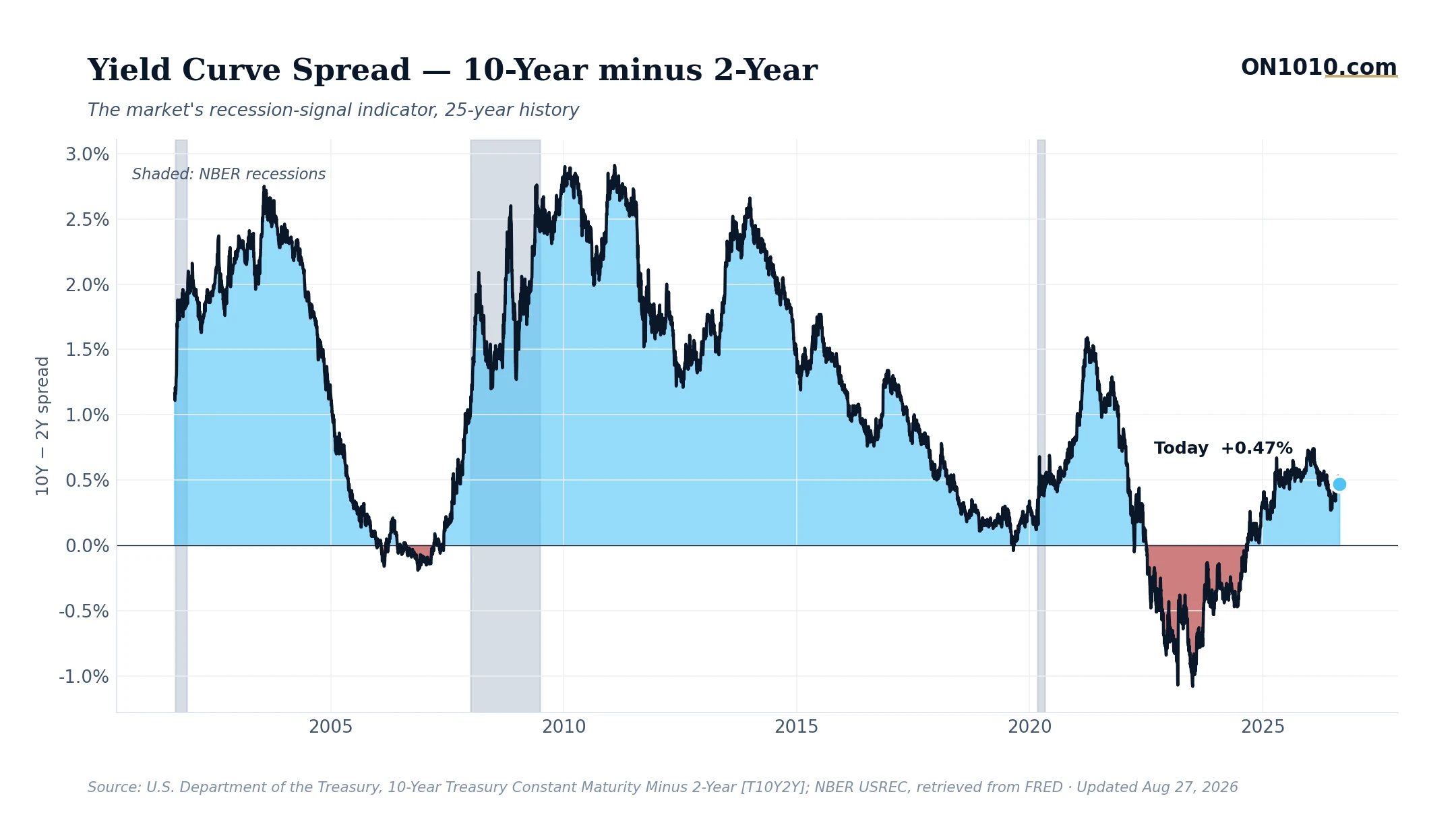
The 10-year Treasury yield is sitting 0.47% above the 2-year yield as of August 27, and it has barely moved in days. That stillness is actually the story. After one of the most prolonged yield curve inversions in modern history, the spread has re-steepened into positive territory and appears to be consolidating rather than reversing.
The curve inverted in mid-2022 and stayed that way for roughly two years, the longest stretch on record. Every modern recession in the U.S. has been preceded by an inversion, which made that stretch genuinely alarming. The re-steepening that followed is historically normal: the curve tends to return to positive slope as a recession either arrives or the market decides it won’t. The 2024-2026 re-steepening has so far accompanied slower growth rather than outright contraction. Growth sits near its historical midpoint, recession odds from similar readings have historically been low (around 7% over the following year), and credit spreads are near their tightest in the historical record, meaning bond markets are pricing very little default risk right now.
That last point matters. When the curve re-steepens AND credit spreads stay tight, it generally reflects the market expecting a soft landing rather than repricing for economic trouble. Historically, in past cycles, investors and business operators have watched for the spread to keep widening as confirmation that the re-steepening is real, rather than a pause before another dip. A spread stuck below 1.0% with inflation still running historically hot (as it is today, higher than roughly nine of every ten months on record) raises a legitimate question about how much room the Fed actually has.
The wrinkle worth watching: long-term rates remain historically elevated, core inflation is sticky, and consumer sentiment is near its weakest readings on record. That combination doesn’t match the calm picture that tight credit spreads are painting. Something in that mix will resolve. The yield curve, historically, is one of the first places that resolution shows up.
Bottom Line: A positively sloped curve is genuinely better than an inverted one, and the credit market is backing that up with tight spreads. The question still sitting on the table is whether 0.47% is a stable resting point or a waystation on the way to something wider or narrower.
Source: Federal Reserve Economic Data (FRED)
ON1010 Research is an independent publisher of economic education and is not a registered investment adviser, broker-dealer, or investment company. This content is for educational and informational purposes only and is not investment advice or a recommendation to buy, sell, or hold any security. Published under the publisher exemption recognized by Section 202(a)(11)(D) of the Investment Advisers Act of 1940 (Lowe v. SEC). Always consult a qualified financial professional before making any financial decision.
Free Research
The economy moves fast. We make sure you move faster.
Economic data, policy shifts, and market signals — delivered to your inbox.
Subscribe Free