
Before Friday’s Jobs Number Hits, Here’s What the Market Is Already Pricing In
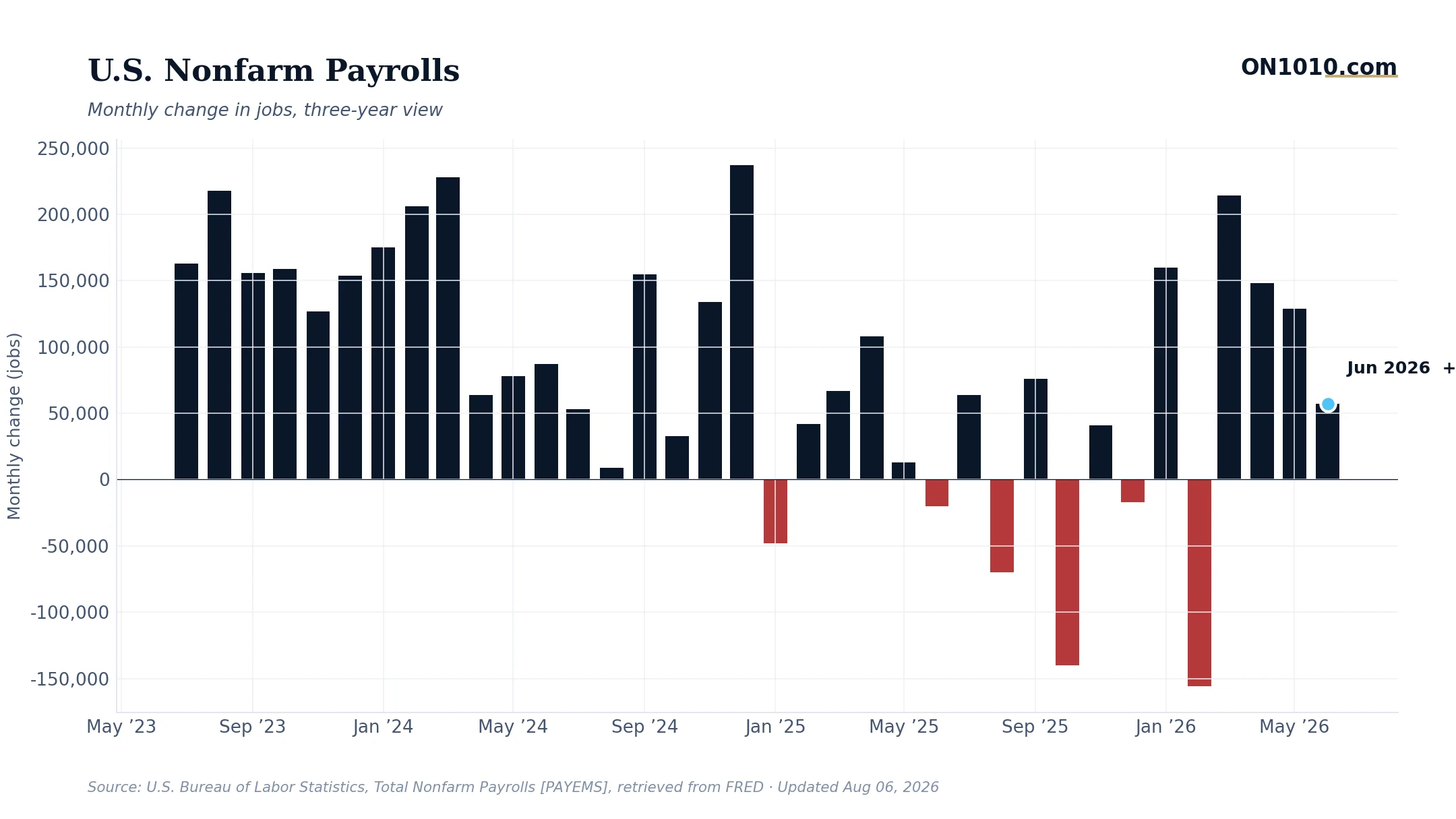
According to CNBC, economists expect July nonfarm payrolls to show a gain of just 83,000, with the unemployment rate holding at 4.2%. That forecast deserves a closer look, because 83,000 is not a soft landing number. That’s the kind of print that starts conversations about something more serious.
To put it in context: the US economy currently employs roughly 159 million people on nonfarm payrolls. Adding 83,000 jobs in a month means the economy is barely treading water. For comparison, the economy needs somewhere around 100,000 to 150,000 new jobs per month just to absorb new workers entering the labor force. A print below that range means the job market is slowly shrinking relative to the people looking for work, even if the headline unemployment rate doesn’t move.
Here’s the tension worth sitting with. Core inflation is running historically hot. That keeps pressure on the Fed to hold rates high. But high interest rates raise the cost of borrowing, which squeezes business margins, which eventually slows hiring. A weak jobs report doesn’t change that math overnight. It may even complicate the Fed’s decision, because a softening labor market alongside sticky inflation is the uncomfortable middle ground where monetary policy has the fewest good options. And long-term rates are still elevated by historical standards, meaning the refinancing and capital allocation pressure on businesses hasn’t let up.
Historically, investors have watched for the moment when labor market weakness becomes broad enough to compress profit margins economy-wide, because that’s when cutbacks tend to feed on themselves. Consumer sentiment is already near the bottom of its historical range, which ordinarily would be a concern. The historical base rate, though, shows that recessions have rarely followed from that setup alone. For now, credit spreads are tight, markets are calm, and money continues flowing toward technology and financials. The market, at least, hasn’t decided this is a breaking point yet.
Bottom Line: One weak jobs number is noise. Two in a row becomes a trend. Friday’s print matters most for what it tells us about whether the labor market is decelerating or cracking.
Read more: CNBC Economy
ON1010 Research is an independent publisher of economic education and is not a registered investment adviser, broker-dealer, or investment company. This content is for educational and informational purposes only and is not investment advice or a recommendation to buy, sell, or hold any security. Published under the publisher exemption recognized by Section 202(a)(11)(D) of the Investment Advisers Act of 1940 (Lowe v. SEC). Always consult a qualified financial professional before making any financial decision.
Free Research
The economy moves fast. We make sure you move faster.
Economic data, policy shifts, and market signals — delivered to your inbox.
Subscribe Free