
Consumer Mood Bounces. But It’s Still at Its Worst Level in Decades.
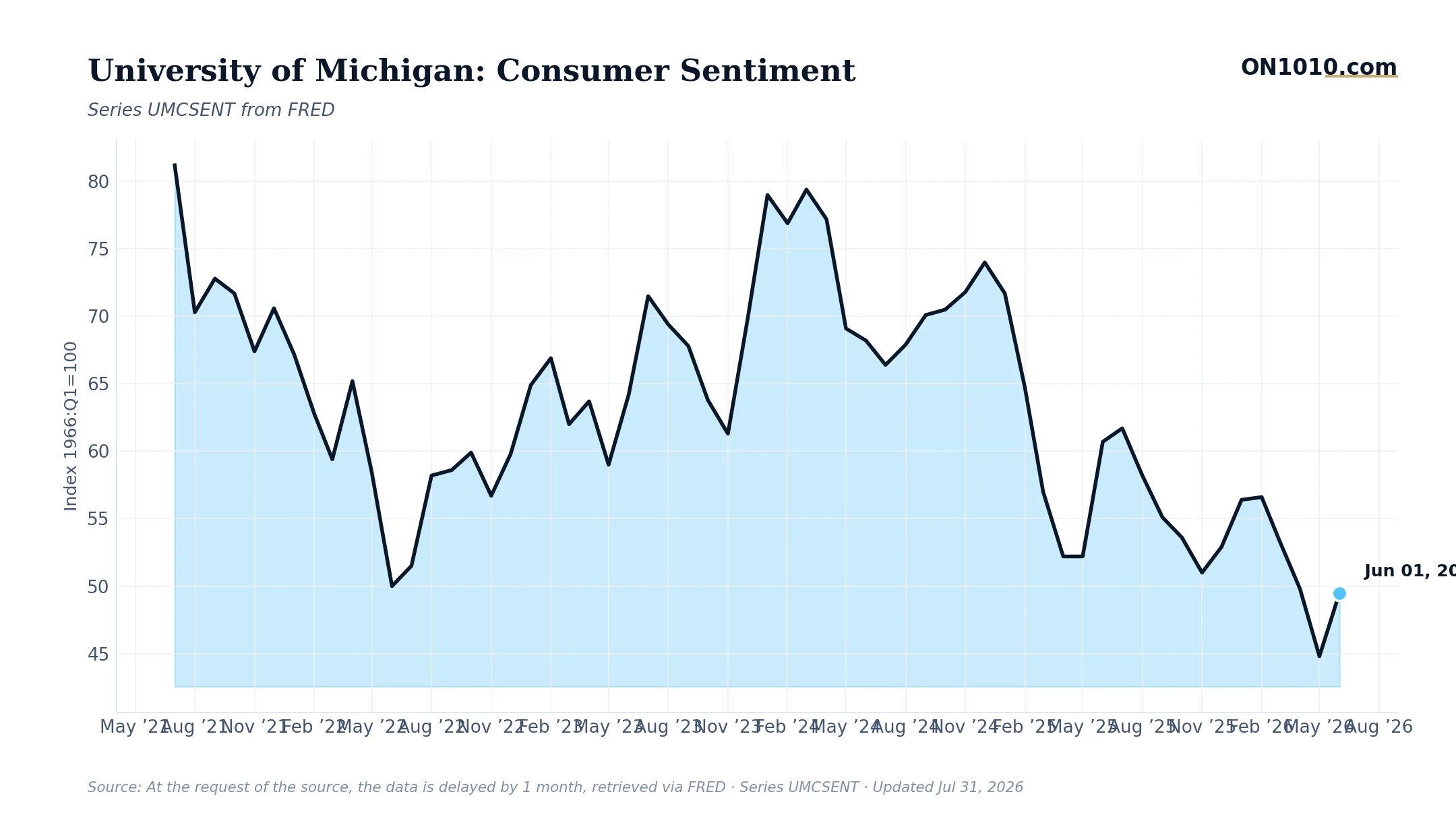
The University of Michigan’s Consumer Sentiment Index rose 4.7 points in June, from 44.8 to 49.5. On the surface, that looks like a rebound. Dig one layer deeper and a different story emerges: sentiment is sitting at the 0th percentile versus its own history, and it is still down 14.95% from a year ago. One month’s bounce doesn’t erase five months of freefall.
Since January, sentiment has dropped from 56.4 to 49.5, a slow bleed of pessimism across six consecutive months. That trajectory matters more than the one-month uptick. When consumers spend five months revising their view of the economy downward, they tend to pull back on discretionary spending, delay big purchases, and rebuild savings as a buffer against uncertainty. The mechanism is simple: spending follows confidence, with a lag.
Here’s the puzzle worth sitting with. Credit spreads remain tight, sitting at the 31st percentile, which means corporate bond markets are calm and not pricing in significant stress. That is a meaningful disconnect. Consumer sentiment is screaming caution while credit markets are essentially shrugging. Historically, when these two signals have diverged this sharply, one of them has eventually moved toward the other. Which direction that resolves is the question worth watching.
Historically, when sentiment has sat at readings this depressed, a recession within the following 12 months has actually been rare, occurring only about 0% of the time in the historical record. Historically, similar readings were followed by sentiment being roughly 4.25 points higher a year later. That is base rate information, not a forecast. In past cycles, business operators and capital allocators have used depressed sentiment readings as a check on demand assumptions, particularly for consumer-facing businesses where revenue forecasts depend on people feeling good enough to open their wallets.
Bottom Line: The bounce in June is real, but it doesn’t change the dominant trend: consumers are more pessimistic than at almost any point in modern history, even as credit markets stay calm. The question for anyone with exposure to the U.S. consumer is whether sentiment is leading spending lower, or whether this is a sentiment-spending divergence that eventually closes on the optimistic side.
Source: Federal Reserve Economic Data (FRED)
ON1010 Research is an independent publisher of economic education and is not a registered investment adviser, broker-dealer, or investment company. This content is for educational and informational purposes only and is not investment advice or a recommendation to buy, sell, or hold any security. Published under the publisher exemption recognized by Section 202(a)(11)(D) of the Investment Advisers Act of 1940 (Lowe v. SEC). Always consult a qualified financial professional before making any financial decision.
Free Research
The economy moves fast. We make sure you move faster.
Economic data, policy shifts, and market signals — delivered to your inbox.
Subscribe Free