
Economic Wire: U.S. economy slowed to 1.5% growth rate in Q2; June core inf
Slow Growth, Sticky Prices: The Squeeze Getting Harder to Ignore
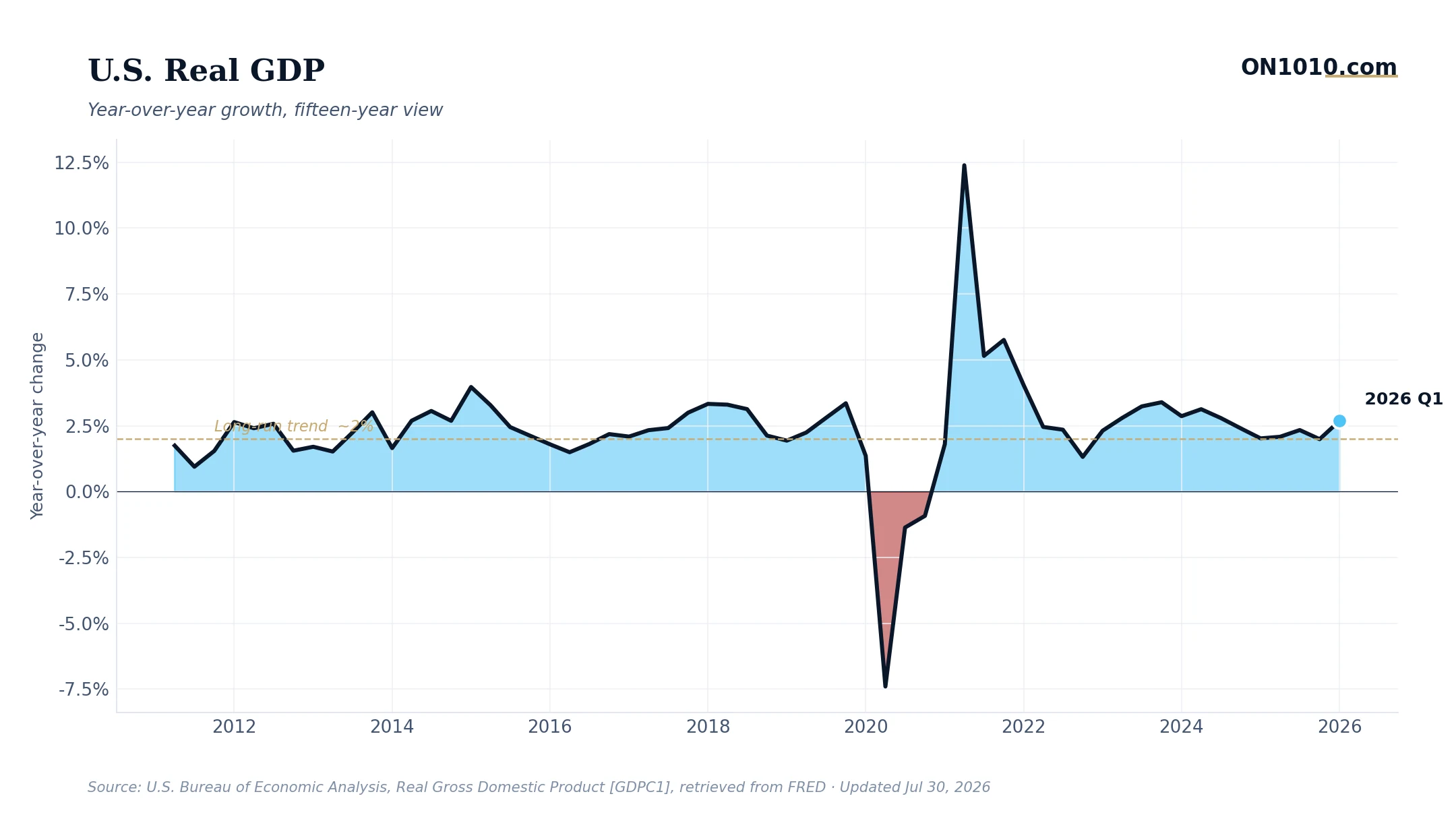
According to CNBC, the U.S. economy grew at a 1.5% annual rate in Q2 2026, while core inflation held at 3.3% in June. The headline reads like a slowdown story. The real story is what happens when those two numbers occupy the same room at the same time.
Here is the problem. When growth slows but inflation stays elevated, the room for policy maneuver shrinks fast. The Fed cannot cut aggressively without risking a fresh inflation flare. It cannot stay put without adding more pressure to an economy already losing momentum. That tension is not new, but this data release makes it harder to dismiss. Our inflation gauge sits at the 92nd percentile of its historical range, rising. Growth sits at the 47th percentile, falling. That combination, nominal growth cooling while real prices stay hot, is exactly the setup where profit margins get caught in the crossfire. Costs stay elevated; pricing power erodes as demand softens. Margins compress. And margins, not GDP headlines, are what drive hiring and investment decisions down the road.
The consumer sentiment gauge adds another layer. It is sitting at the 0th percentile of its historical range, the weakest reading in the data set, yet historically that extreme pessimism has not been a reliable recession predictor. In fact, from similar sentiment readings, no recession began within the following 12 months in the historical record. That is a surprising base rate worth sitting with. The market’s own positioning tells a different story from the macro doom, with credit spreads tight and the long-term trend structure technically intact, even as technology names lag and defensive sectors lead by more than 3 percentage points over the past month.
Historically, investors and business operators have treated the combination of decelerating real growth and above-trend inflation as a moment to scrutinize duration and debt. Capital allocation decisions made when margins are compressing tend to look very different 12 months later than those made when margins are expanding. The question worth sitting with is whether 1.5% real growth can survive 3.3% core inflation without one of them eventually breaking.
Bottom Line: The economy is not in freefall, but it is caught between a growth rate that wants to slow and an inflation rate that refuses to cooperate, and that squeeze tends to show up in margins before it shows up anywhere else.
Read more: CNBC Economy
ON1010 Research is an independent publisher of economic education and is not a registered investment adviser, broker-dealer, or investment company. This content is for educational and informational purposes only and is not investment advice or a recommendation to buy, sell, or hold any security. Published under the publisher exemption recognized by Section 202(a)(11)(D) of the Investment Advisers Act of 1940 (Lowe v. SEC). Always consult a qualified financial professional before making any financial decision.
Free Research
The economy moves fast. We make sure you move faster.
Economic data, policy shifts, and market signals — delivered to your inbox.
Subscribe Free