
The 10-Year Is Quiet. That Itself Is the Story.
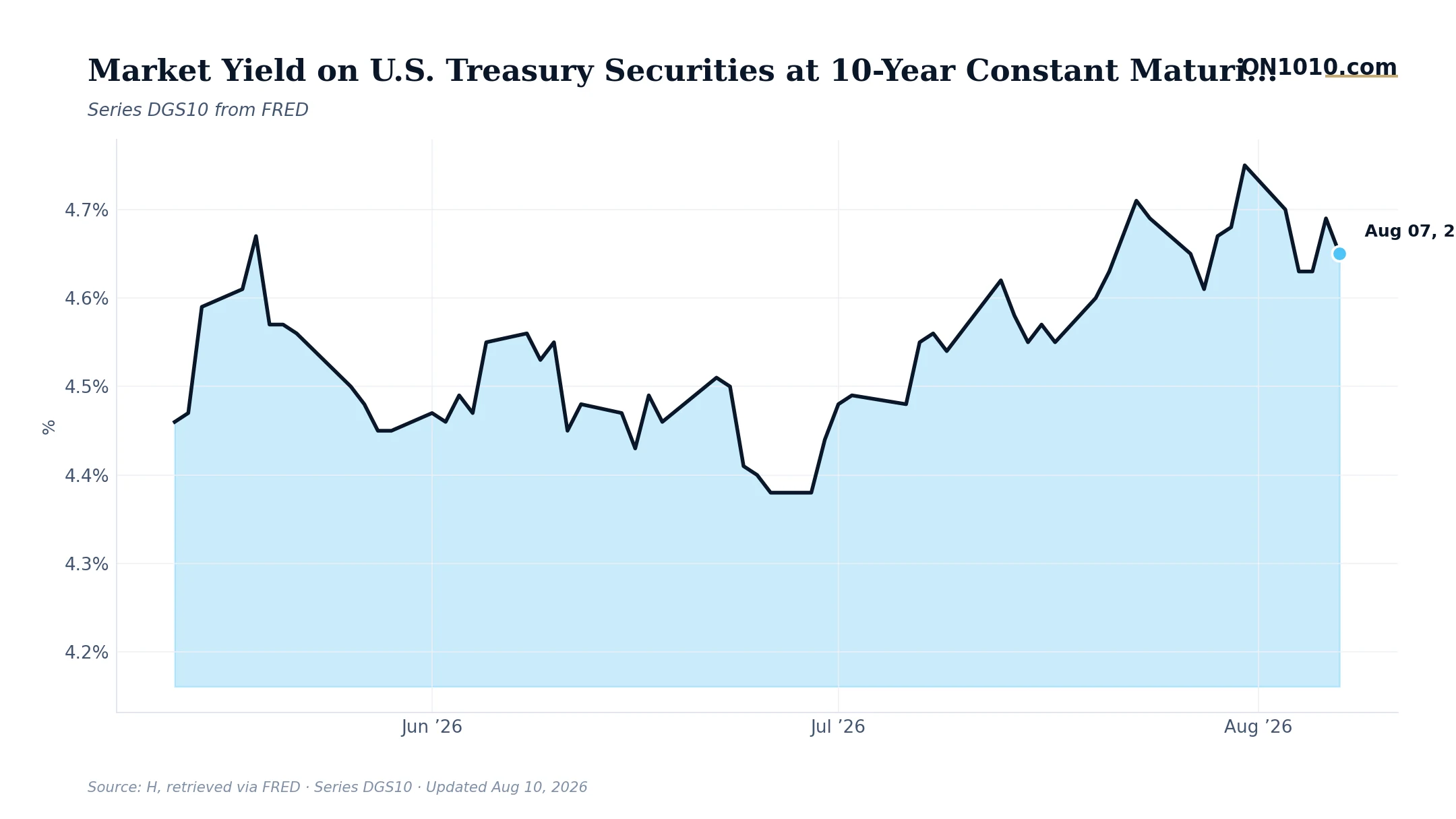
The 10-year Treasury yield slipped to 4.65% on Thursday, down from 4.69% the day before, continuing a gentle pull back from 4.75% at the end of July. A four-basis-point move in a day barely registers as news. But zoom out, and the pattern is worth paying attention to.
Long-term rates are historically elevated, sitting above most of the readings we’ve seen over the past several decades. That means the economy is operating with a higher-than-normal cost of money baked into nearly every financial decision being made right now: mortgages, corporate debt refinancing, capital project hurdle rates, commercial real estate loans. The yield didn’t spike here. It climbed gradually, which is actually harder to solve. There’s no single catalyst to reverse.
What makes this moment interesting is the contradiction sitting inside the dashboard. Credit spreads are unusually tight, meaning corporate bond markets are pricing calm, not crisis. The VIX, at 15.43, is below its long-run average. Equity markets sit above both their 50-day and 200-day moving averages. By most short-term signals, the financial system looks relaxed. But that relaxation is happening against a backdrop of inflation that remains historically hot and long-term rates that historically, in similar periods, have seen a new recession begin within the following year about 19% of the time. That’s not high enough to bet on, but it’s too high to ignore.
Historically, when long-term rates stay elevated while credit spreads stay tight, the economy tends to function until something on the balance sheet cracks: a refinancing cycle turns expensive, a marginal borrower can’t roll over debt, or capital allocation quietly slows. The question worth sitting with is whether calm markets and high rates can coexist indefinitely, or whether one is simply running ahead of the other.
Bottom Line: The 10-year holding above 4.6% while credit markets shrug is one of the more interesting tensions in the economy right now. Calm today doesn’t settle the question of whether the cost of money is quietly slowing what gets built, hired, or financed next.
Source: Federal Reserve Economic Data (FRED), Series DGS10
ON1010 Research is an independent publisher of economic education and is not a registered investment adviser, broker-dealer, or investment company. This content is for educational and informational purposes only and is not investment advice or a recommendation to buy, sell, or hold any security. Published under the publisher exemption recognized by Section 202(a)(11)(D) of the Investment Advisers Act of 1940 (Lowe v. SEC). Always consult a qualified financial professional before making any financial decision.
Free Research
The economy moves fast. We make sure you move faster.
Economic data, policy shifts, and market signals — delivered to your inbox.
Subscribe Free