
The 10-Year Won’t Sit Still: What the Bond Market Is Telling You Right Now
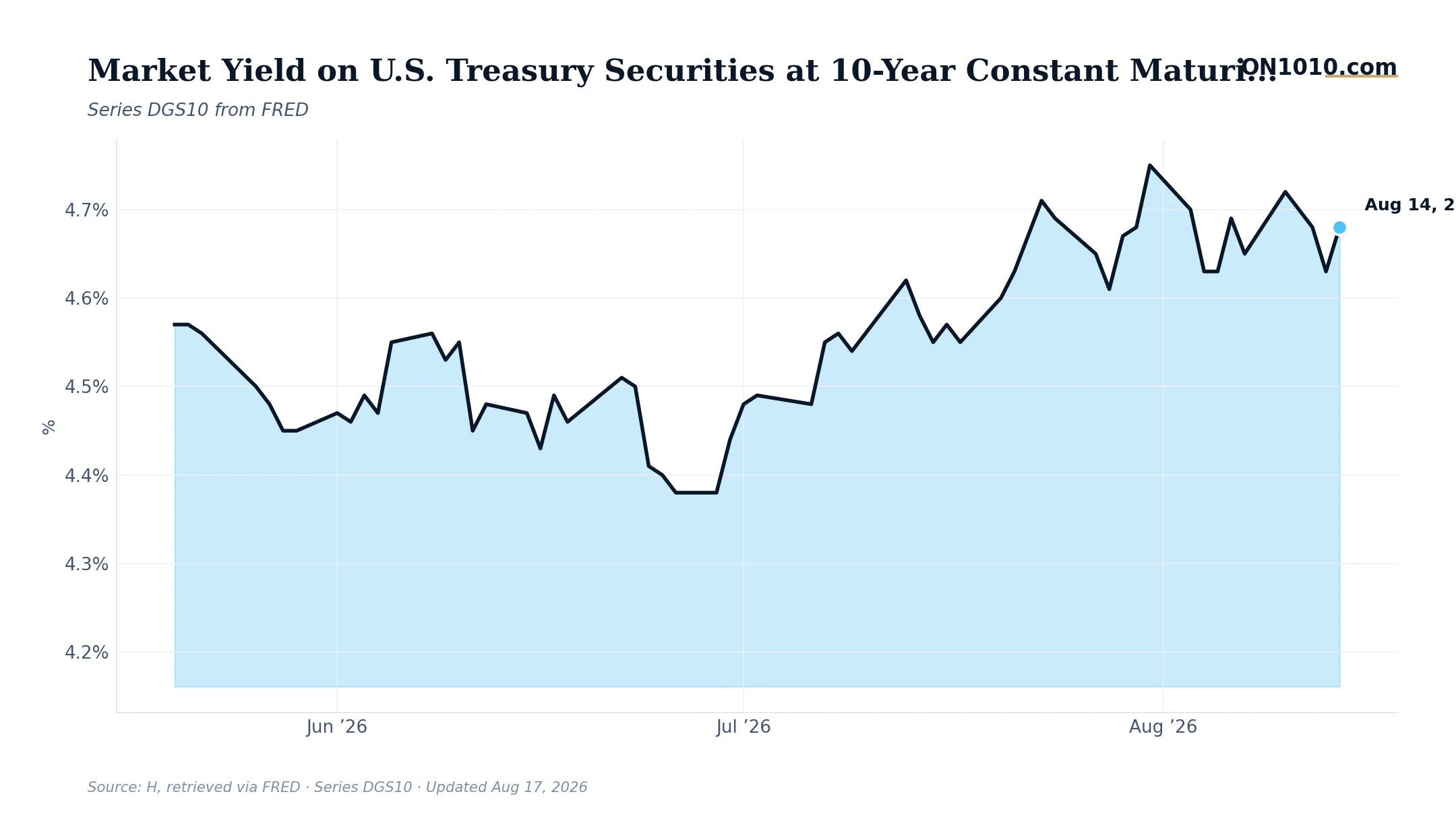
The 10-year Treasury yield ticked back up to 4.68% on Thursday after dipping to 4.63% the day before. That’s a small daily move, but zoom out and the picture gets more interesting: yields have been stuck in a tight range between 4.63% and 4.72% all week. The bond market isn’t panicking, and it isn’t celebrating. It’s waiting.
That kind of sideways action at elevated levels tells a story. Long-term rates are sitting well above their historical norm, and they’ve been there for a while. The reason matters: when investors expect inflation to stay hot, they demand higher yields to compensate for the slow erosion of their purchasing power. Right now, core inflation is running higher than roughly nine out of every ten months on record. The bond market is pricing that reality in, and it isn’t in a hurry to let go of it.
Here’s where the contradiction lives. Credit spreads, the extra yield corporate borrowers pay above Treasuries, are about as tight as they get. That signals calm in the credit markets, not stress. Equity markets are stretched above their long-term trend, volatility is low, and money is rotating into technology and growth. By most short-term readings, the financial system looks comfortable. Yet the 10-year yield, which acts as the economy’s base cost of capital, is sitting at a level that adds real friction to every mortgage, corporate bond, and capital investment decision made today.
Historically, when rates have held in this elevated zone, businesses have faced a genuine question about the hurdle rate for new investment: does the return on a project clear the cost of the money needed to fund it? In past cycles, periods where rates stayed high even as credit spreads stayed tight have eventually resolved one of two ways, either inflation cooled and rates followed, or the cost of capital eventually won and credit conditions tightened from the corporate side. Watching which way credit spreads move from here is one of the more useful signals worth tracking alongside the yield itself.
Bottom Line: A 10-year yield near 4.68% with inflation still running hot is a slow-moving pressure on every long-duration decision in the economy. The market looks calm on the surface, which is exactly when it pays to ask what the bond market might be seeing that equity traders aren’t.
Source: Federal Reserve Economic Data (FRED)
ON1010 Research is an independent publisher of economic education and is not a registered investment adviser, broker-dealer, or investment company. This content is for educational and informational purposes only and is not investment advice or a recommendation to buy, sell, or hold any security. Published under the publisher exemption recognized by Section 202(a)(11)(D) of the Investment Advisers Act of 1940 (Lowe v. SEC). Always consult a qualified financial professional before making any financial decision.
Free Research
The economy moves fast. We make sure you move faster.
Economic data, policy shifts, and market signals — delivered to your inbox.
Subscribe Free