
The Economy Grew Without Breaking a Sweat. That’s the Whole Story.
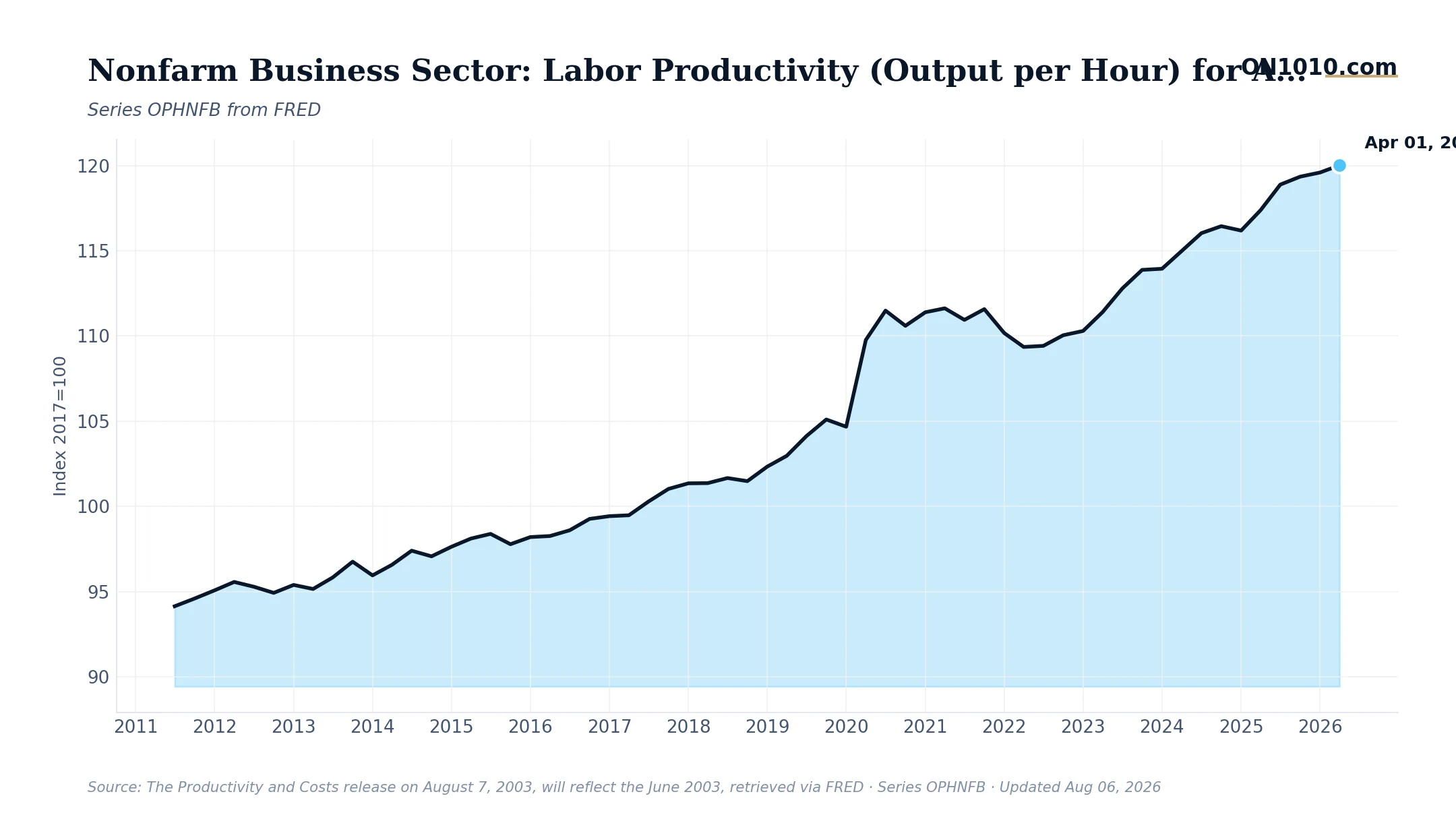
Productivity rose 2.24% over the past year, sitting at an index level of 120.017, and the quiet consistency of that number is exactly what makes it interesting. In an economy where inflation is running hot versus history and long-term interest rates remain elevated, the fact that output per hour worked keeps climbing is one of the most important things nobody is talking about.
Here’s why it matters. Productivity growth is the economy’s pressure valve. When workers produce more output for every hour they put in, companies can absorb higher wages without squeezing margins. That keeps unit labor costs in check, which in turn takes pressure off prices. Right now, with core inflation still historically high, sustained productivity gains are doing real work behind the scenes, giving the Fed breathing room it wouldn’t otherwise have.
Zoom out and the trend looks durable. The productivity index has climbed from 116.187 in early 2025 to 120.017 today, a run of about 3.3% in just five quarters. That kind of steady improvement doesn’t happen by accident. It typically reflects capital investment paying off: better tools, smarter processes, and in today’s context, early returns from AI and automation adoption showing up in how much work actually gets done per hour.
Historically, sustained productivity gains in the 2% to 3% annual range have created favorable conditions for corporate margin expansion, because firms can pay workers more without raising prices proportionally. In past cycles, investors and business operators have watched this series closely alongside unit labor cost data for exactly that reason. The question worth sitting with is whether this pace can hold if business investment softens under the weight of elevated borrowing costs and trade policy uncertainty.
Bottom Line: The economy is quietly producing more with the same number of hours worked, and that’s the structural foundation that lets growth continue without reigniting inflation. Whether the AI investment wave is already showing up in this data, or whether that dividend is still ahead, is one of the more consequential open questions in economics right now.
Source: Federal Reserve Economic Data (FRED), Series OPHNFB
ON1010 Research is an independent publisher of economic education and is not a registered investment adviser, broker-dealer, or investment company. This content is for educational and informational purposes only and is not investment advice or a recommendation to buy, sell, or hold any security. Published under the publisher exemption recognized by Section 202(a)(11)(D) of the Investment Advisers Act of 1940 (Lowe v. SEC). Always consult a qualified financial professional before making any financial decision.
Free Research
The economy moves fast. We make sure you move faster.
Economic data, policy shifts, and market signals — delivered to your inbox.
Subscribe Free