
The Fed’s Rate Is on Autopilot. That’s Actually the Story.
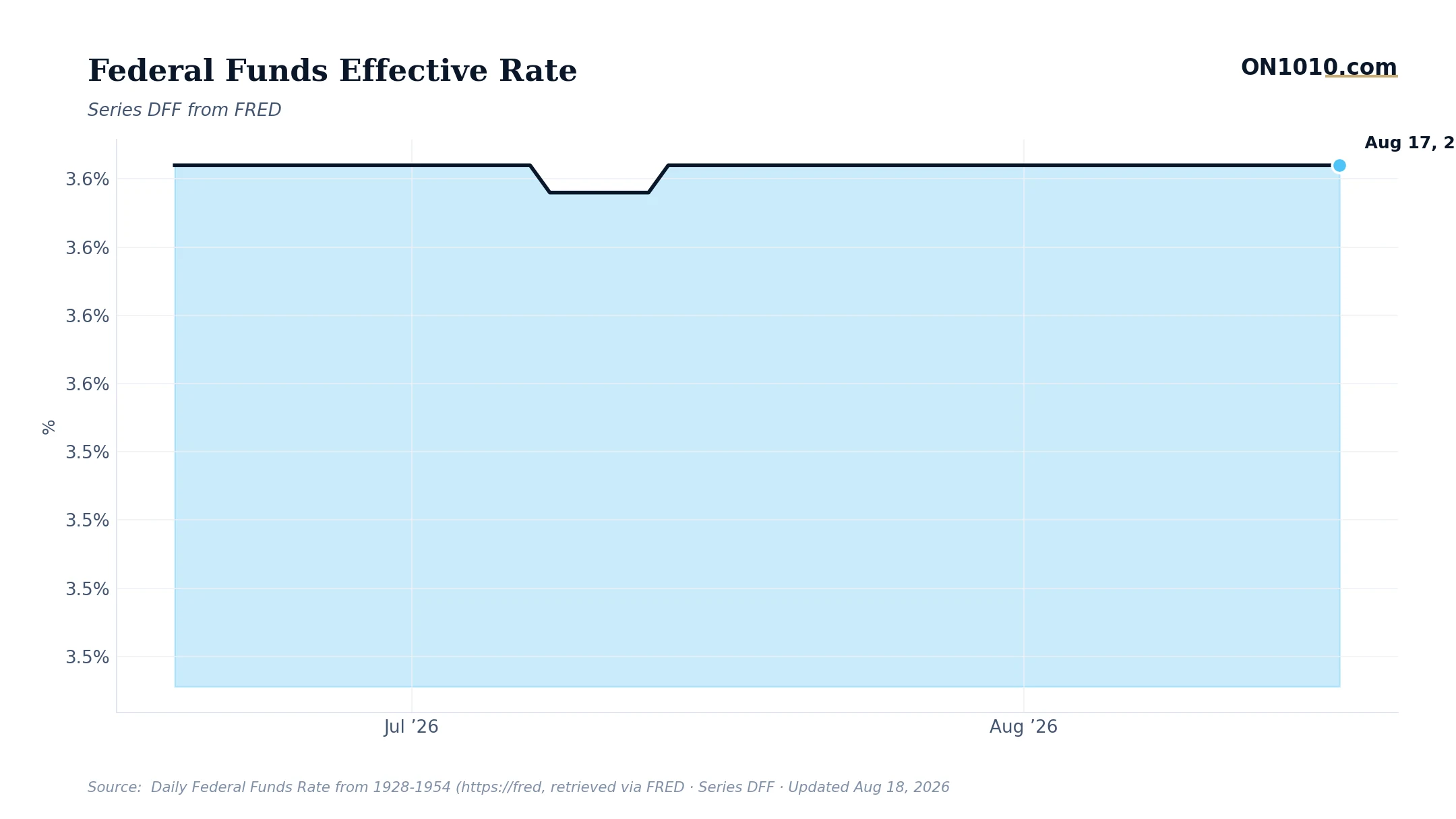
The effective federal funds rate has held at 3.63% for six consecutive days. No movement. No drift. The overnight lending market is doing exactly what the Fed wants it to do, and that kind of quiet precision tells you something important about where monetary policy stands right now.
Here’s what makes this interesting: 3.63% isn’t a random resting spot. It sits right in the middle of the Fed’s current target range, which means banks are borrowing from each other at essentially the exact rate the Fed intended. The plumbing works. But the bigger question isn’t whether the rate is stable. It’s whether 3.63% is the right rate for this economy.
Look at the broader picture and you get a genuinely mixed signal. Core inflation is running hotter than roughly nine of every ten months in the modern record. That’s not mild overshoot. At the same time, long-term interest rates remain elevated by historical standards, credit spreads are unusually tight (meaning lenders aren’t particularly worried about defaults), and consumer sentiment is sitting near historic lows. You have financial markets pricing calm, a real economy where consumers are feeling stretched, and a Fed rate that sits right in the middle of its historical range. That’s an unusual combination, and it’s the tension worth watching.
In past cycles, when short-term rates held steady while long-term rates stayed elevated, businesses with floating-rate debt felt the squeeze on margins even without any additional Fed action. The rate doesn’t have to move to create pressure. Holding it higher for longer is its own form of tightening.
The question for anyone running a business or thinking about capital allocation: if the Fed doesn’t move before year-end, what does 3.63% do to refinancing costs, hiring plans, and investment decisions in 2027? That’s the real conversation, and the answer depends heavily on whether inflation drifts lower from here.
Bottom Line: A Fed rate that doesn’t move is still a policy decision. At 3.63%, the Fed is telling the economy it can handle this level of restraint. Whether the economy agrees is the question the next several months will answer.
Source: Federal Reserve Economic Data (FRED)
ON1010 Research is an independent publisher of economic education and is not a registered investment adviser, broker-dealer, or investment company. This content is for educational and informational purposes only and is not investment advice or a recommendation to buy, sell, or hold any security. Published under the publisher exemption recognized by Section 202(a)(11)(D) of the Investment Advisers Act of 1940 (Lowe v. SEC). Always consult a qualified financial professional before making any financial decision.
Free Research
The economy moves fast. We make sure you move faster.
Economic data, policy shifts, and market signals — delivered to your inbox.
Subscribe Free