
The Job Market’s Calm Is Holding. But the Market Knows Something.
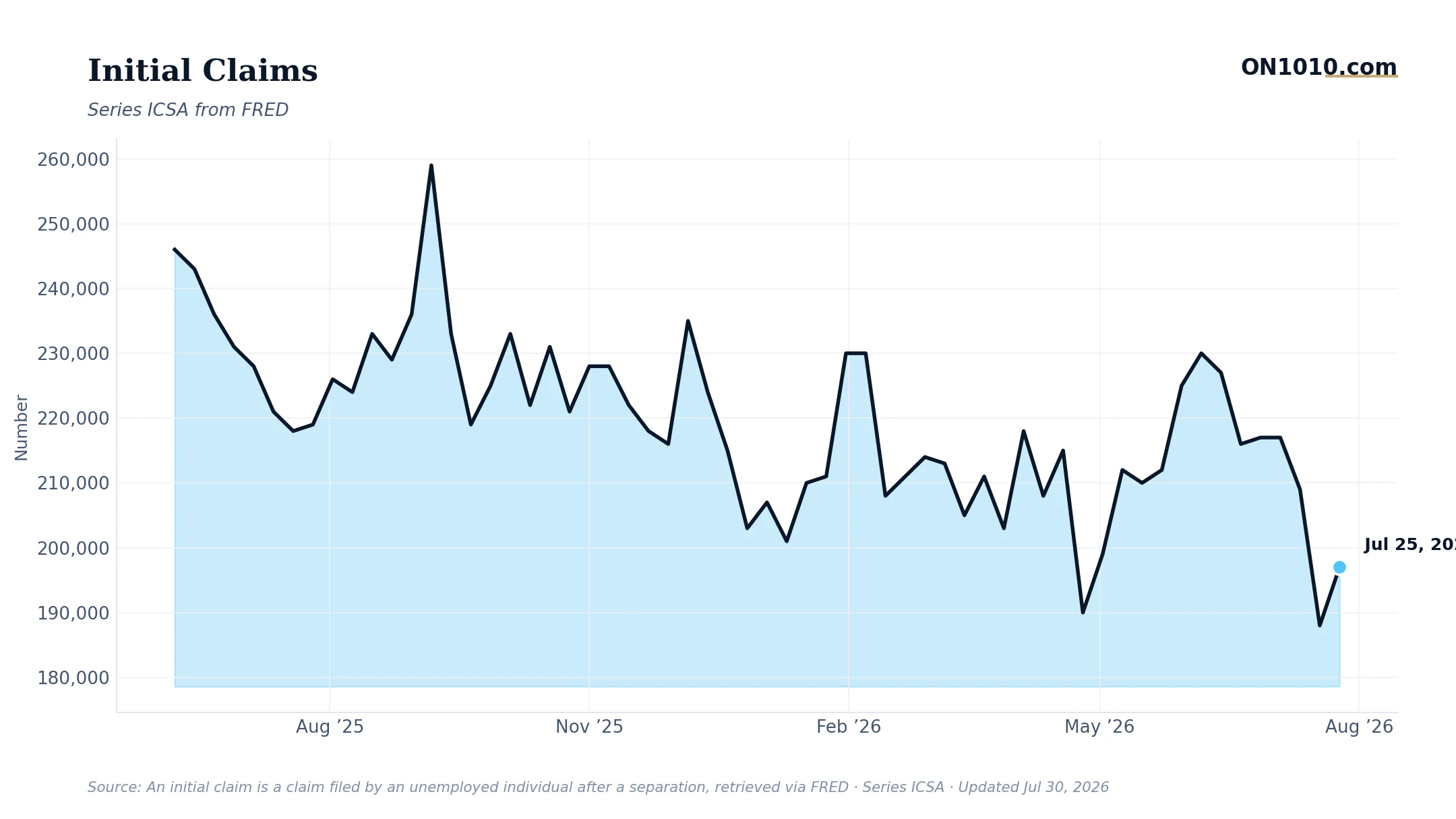
Claims ticked up to 197,000 for the week ending July 25, rising 9,000 from the prior week’s 188,000. The headline sounds like deterioration. The context says otherwise.
Zoom out one month. Claims have fallen from 217,000 in late June to 197,000 today, a steady improvement that cuts through the week-to-week noise. The four-week trend is a story of a labor market that has quietly gotten tighter, not looser.
Sub-200,000 claims is historically a very strong reading. For context, the pre-pandemic average ran closer to 220,000. When firing activity is this low, it tells you that businesses are holding onto their workers, a signal that employers still see value in their current headcount. That calculus matters: companies don’t hoard labor when they expect margins to fall. The fact that layoffs remain scarce, even with interest rates sitting at the 71st percentile of their historical range and inflation still running hot, suggests corporate balance sheets are absorbing the pressure better than the bears expected.
Here is the tension worth sitting with: the labor market signal is constructive, but money is moving defensively. Consumer staples and health care have been leading the market for the past month, while technology is lagging by 8.6%. Historically, when claims run this low, it has not been the labor market that breaks first. Something else usually cracks: credit, sentiment, or margins. Consumer sentiment is sitting at its weakest reading in the entire historical record, which is a jarring contrast against a job market this tight. In past cycles, extreme sentiment weakness with a still-healthy labor market has often meant the worry was premature rather than prescient.
Bottom Line: The labor market is telling one story; sentiment and sector rotation are telling another. The question for the months ahead is which one is reading the economy correctly.
Source: Federal Reserve Economic Data (FRED)
ON1010 Research is an independent publisher of economic education and is not a registered investment adviser, broker-dealer, or investment company. This content is for educational and informational purposes only and is not investment advice or a recommendation to buy, sell, or hold any security. Published under the publisher exemption recognized by Section 202(a)(11)(D) of the Investment Advisers Act of 1940 (Lowe v. SEC). Always consult a qualified financial professional before making any financial decision.
Free Research
The economy moves fast. We make sure you move faster.
Economic data, policy shifts, and market signals — delivered to your inbox.
Subscribe Free