
The Jobs Market Is Doing Something It Almost Never Does
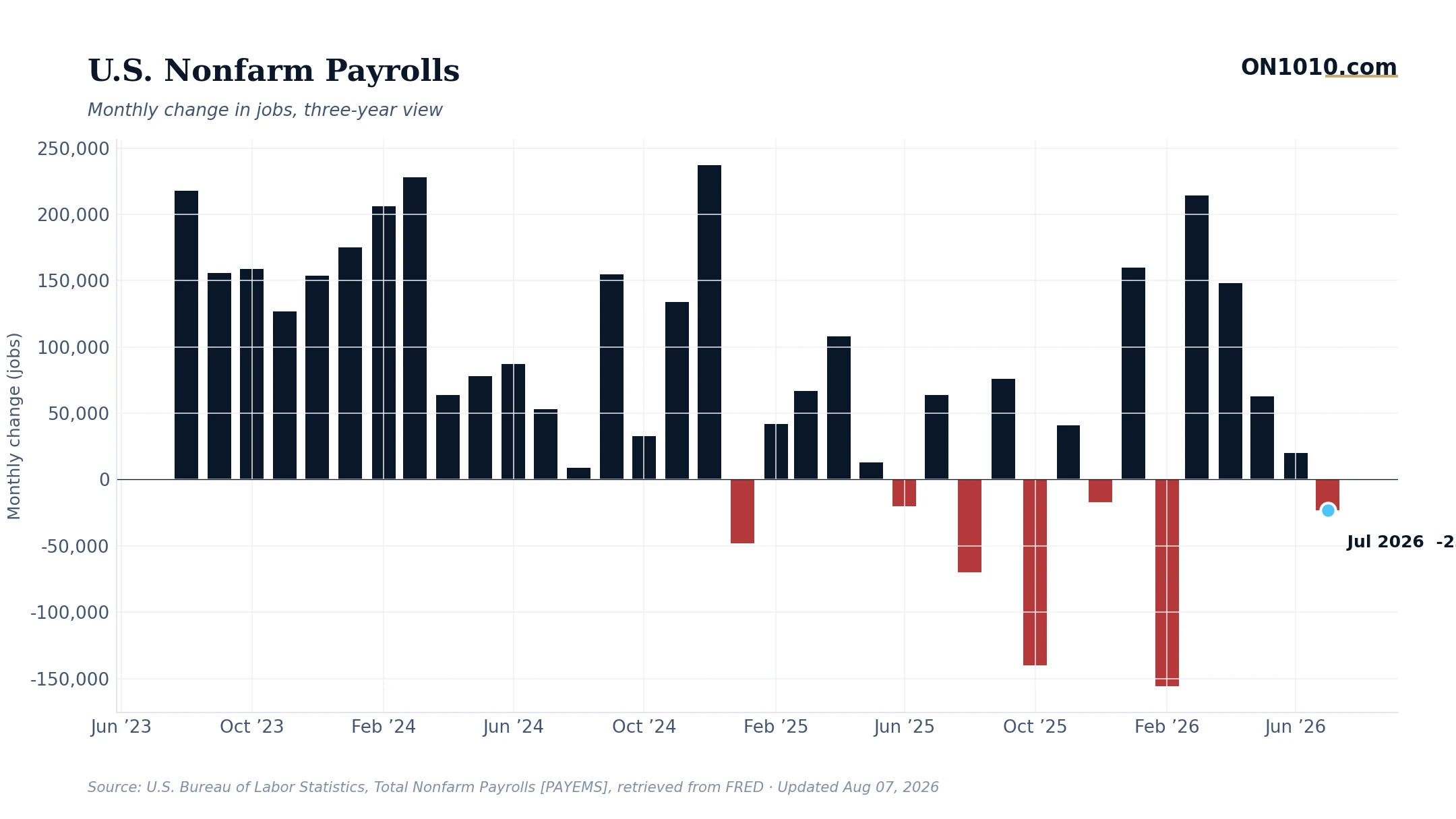
The U.S. economy actually lost 23,000 jobs in July, the first monthly decline in total nonfarm payrolls in several years. That single print wiped out more jobs than were added in any one of the prior three months combined.
But here’s the puzzle worth sitting with: the year-over-year gain is still positive at 310,000 jobs, and the six-month trend shows a labor market that had been grinding steadily higher before this stumble. One month does not a trend make. However, one month that breaks a clean streak earns a second look.
Zoom out and the broader picture gets interesting fast. Growth is sitting near its historical midpoint and has been drifting lower. Core inflation remains elevated relative to most of the post-war record. Long-term interest rates are still high by historical standards, which means the cost of capital is working against business investment decisions. Credit spreads are tight, which signals the bond market is not panicking. But consumer sentiment is near its historical floor, and historically, that kind of pessimism tends to suppress the spending that eventually shows up in payrolls. These gauges are pointing in different directions at once, which is exactly when a single data point like today’s can get over-interpreted.
The mechanism worth understanding here is the margin-to-hiring chain. Businesses don’t add headcount because they feel optimistic. They add headcount because margins justify it. When borrowing costs stay high and demand softens, the math on hiring shifts. In past cycles, soft payroll prints that arrived alongside elevated rates and weakening growth gauges sometimes marked early inflection points, but they also sometimes turned out to be statistical noise, revised away in subsequent months. Historically, a one-month negative print has not been a reliable standalone recession signal.
The question worth asking is whether this is a data quirk or the first month of a new direction. The next two payroll releases will tell that story more clearly than this one can.
Bottom Line: One negative jobs print inside a constructive macro backdrop is a yellow flag, not a red one, but in a market already stretching above trend and with consumer sentiment at historic lows, it’s exactly the kind of data that deserves a patient second read rather than a quick conclusion.
Source: Federal Reserve Economic Data (FRED)
ON1010 Research is an independent publisher of economic education and is not a registered investment adviser, broker-dealer, or investment company. This content is for educational and informational purposes only and is not investment advice or a recommendation to buy, sell, or hold any security. Published under the publisher exemption recognized by Section 202(a)(11)(D) of the Investment Advisers Act of 1940 (Lowe v. SEC). Always consult a qualified financial professional before making any financial decision.
Free Research
The economy moves fast. We make sure you move faster.
Economic data, policy shifts, and market signals — delivered to your inbox.
Subscribe Free