
The Monthly Dip That Isn’t Really a Dip
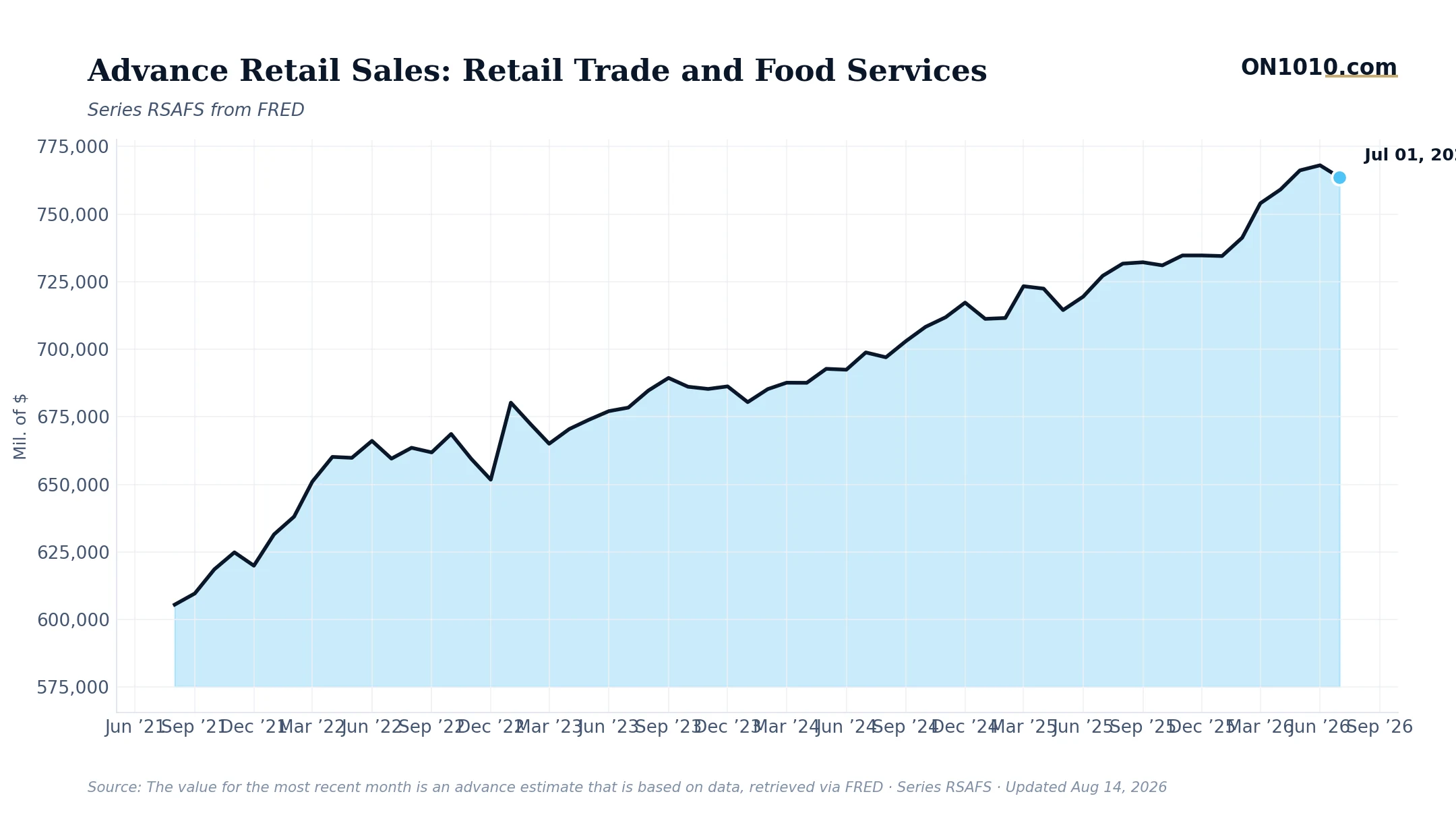
Retail sales fell 0.58% in July to $763.6 billion, but before you read that as a warning sign, zoom out. Sales are up 4.29% from a year ago, and the six-month trend tells a clearer story: consumer spending has climbed steadily from $741 billion in February to the mid-$760s range, with July’s pullback barely a wrinkle on that line.
The bigger picture here is a consumer who is still spending, just not accelerating. Six months of data show a gradual upward drift with a modest monthly ebb, the kind of pattern that looks like a healthy plateau rather than a crack. With core inflation still running hot relative to history, that 4.29% year-over-year gain in nominal spending almost certainly overstates what consumers are actually getting for their money. Strip out price increases and real spending growth is more modest. That gap between the headline number and the real story is exactly where most coverage stops paying attention.
What makes this reading interesting in context is the contradiction sitting underneath it. Consumer sentiment is near the lowest readings on record, yet spending keeps growing. Historically, that kind of divergence between what people say and what they do has resolved itself one of two ways: sentiment recovers as conditions improve, or spending eventually catches down to where sentiment already is. In past cycles, business leaders and capital allocators have watched this gap closely, because when it closes in the wrong direction, discretionary categories tend to feel it first.
Long-term interest rates remain elevated versus history and are now rising again, a headwind for big-ticket purchases like autos and appliances. Credit spreads, meanwhile, are historically tight, suggesting credit markets are pricing in very little stress.
Bottom Line: The consumer is still in the game, but they are playing defense with their wallet even if the scoreboard says otherwise. The question worth sitting with: how long can spending hold at this level if real purchasing power stays compressed and rates stay high?
Source: Federal Reserve Economic Data (FRED)
ON1010 Research is an independent publisher of economic education and is not a registered investment adviser, broker-dealer, or investment company. This content is for educational and informational purposes only and is not investment advice or a recommendation to buy, sell, or hold any security. Published under the publisher exemption recognized by Section 202(a)(11)(D) of the Investment Advisers Act of 1940 (Lowe v. SEC). Always consult a qualified financial professional before making any financial decision.
Free Research
The economy moves fast. We make sure you move faster.
Economic data, policy shifts, and market signals — delivered to your inbox.
Subscribe Free