
The Recession Alarm That Keeps Not Going Off
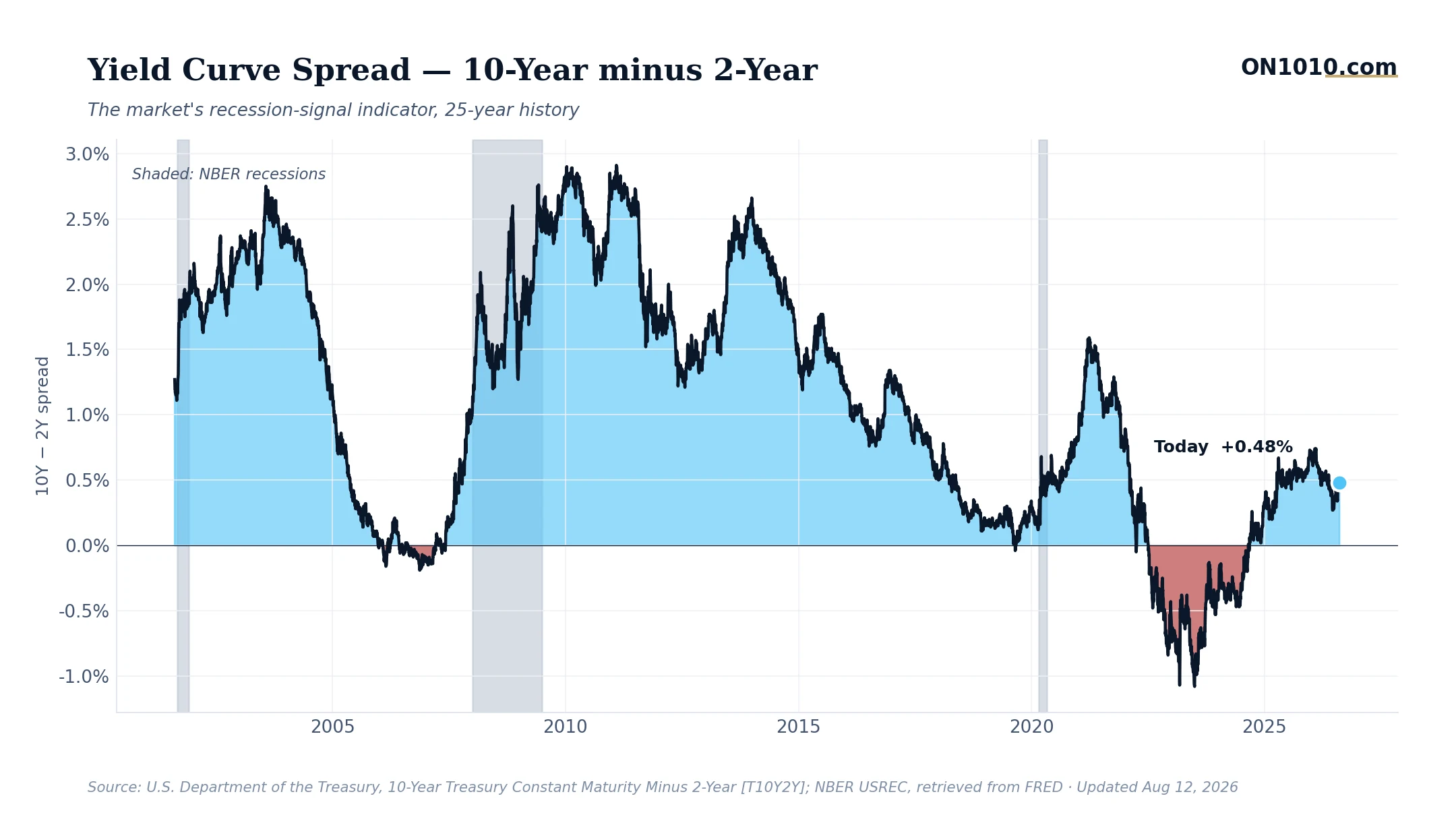
The yield curve has been positive for months now, and this week it barely moved, holding at 0.48% on both Monday and Tuesday after a quiet climb from 0.44% just a week ago. That stability is the story.
For two years, the 10-year minus 2-year Treasury spread sat deep in negative territory, flashing the most reliable recession signal in modern economic history. Then it un-inverted. And the recession never came.
The Bigger Picture
The spread’s steady climb back into positive territory tells us that bond markets have largely stopped pricing in economic collapse. Long-term rates are sitting high relative to history (a sign that the bond market expects either persistent growth or sticky inflation), while short-term rates have come down as the Fed has eased. That gap between the two is what drives this reading wider. The historical anchor is worth knowing here: with growth near its long-run midpoint and credit spreads near the tightest levels on record, the bond market’s calm reads as consistent with the broader macro picture. From past readings similar to where growth sits today, a new recession began within 12 months only about 7% of the time.
Why It Matters
The yield curve has preceded every U.S. recession since the 1970s. But the lead time is long and variable, often 12 to 24 months, and the un-inversion itself has historically been the more dangerous signal than the inversion. In past cycles, the spread widened sharply right as unemployment began to rise, because the Fed was cutting rates in response to real deterioration. This time, the widening happened without that deterioration materializing at scale. Whether that makes this cycle genuinely different, or just longer in the tooth, is the question worth sitting with. For business operators thinking about financing timelines or capital commitments, the shape of the curve matters as much as the level of any single rate.
Bottom Line: The yield curve is no longer screaming danger, but long-term rates are still elevated against history, and the curve’s behavior at turning points tends to tell the truth before the economic data catches up. Watch whether this spread continues to widen quietly, or stalls out.
Source: Federal Reserve Economic Data (FRED)
ON1010 Research is an independent publisher of economic education and is not a registered investment adviser, broker-dealer, or investment company. This content is for educational and informational purposes only and is not investment advice or a recommendation to buy, sell, or hold any security. Published under the publisher exemption recognized by Section 202(a)(11)(D) of the Investment Advisers Act of 1940 (Lowe v. SEC). Always consult a qualified financial professional before making any financial decision.
Free Research
The economy moves fast. We make sure you move faster.
Economic data, policy shifts, and market signals — delivered to your inbox.
Subscribe Free