
The US Economy Grew to $32.5 Trillion. Here’s the Part That Should Give You Pause.
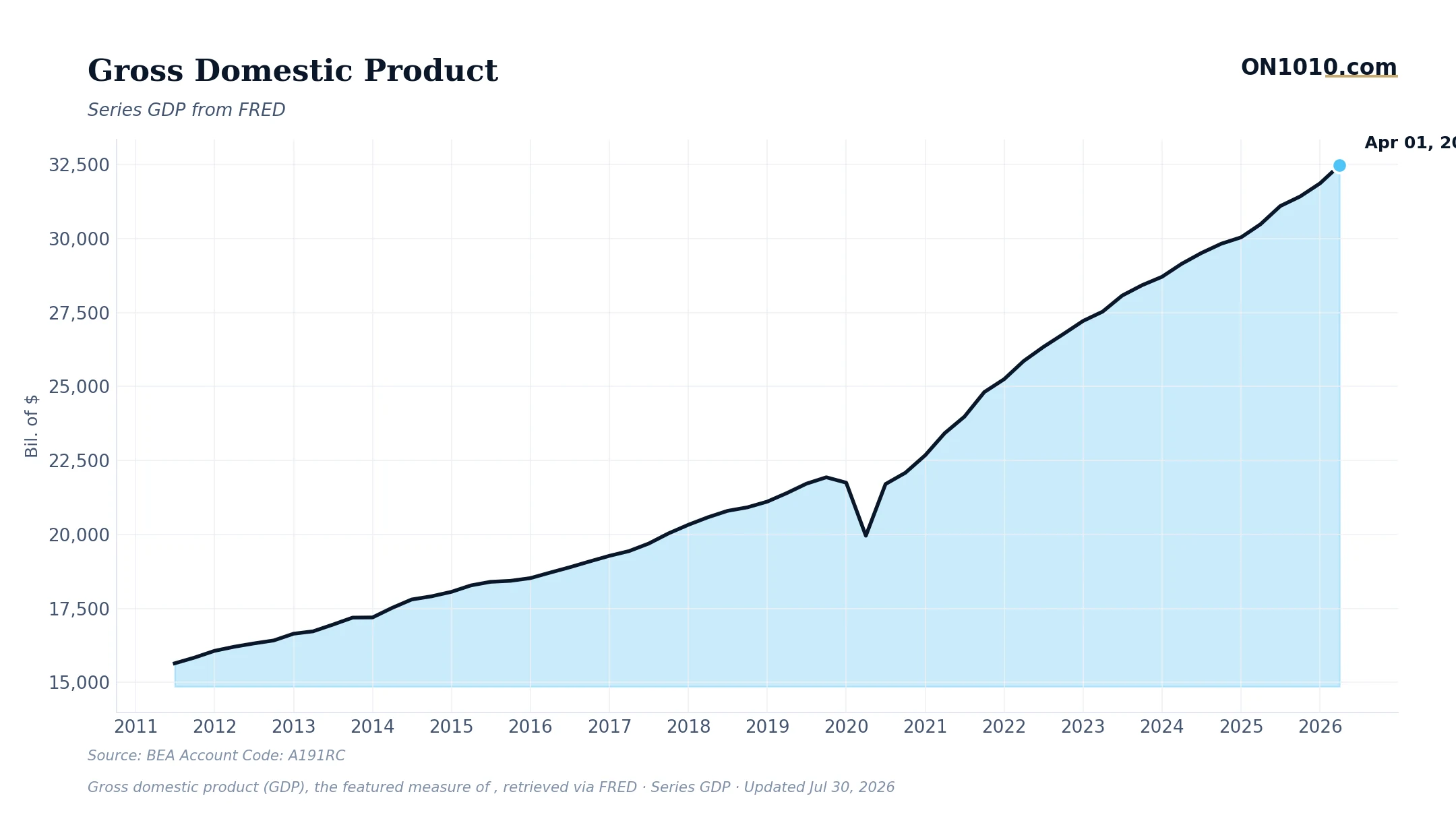
GDP hit $32.5 trillion in Q1 2026, up 1.91% from Q4 2025. That sounds like solid progress, and on the surface it is. But when you separate real growth from nominal growth, the story gets more complicated.
That 6.53% year-over-year gain looks impressive. With core inflation sitting at its 92nd percentile historically, a meaningful chunk of that dollar growth is prices rising, not actual output expanding. The economy is bigger in nominal terms. Whether it’s meaningfully bigger in real terms depends on how much of that $1.99 trillion annual gain came from producing more versus charging more.
This is the tension worth sitting with right now. The economy’s growth engine appears intact: the trend has run steadily upward for six straight quarters, from $30.0 trillion in Q1 2025 to $32.5 trillion today. That consistency matters. But the combination of high nominal growth and very high inflation is exactly the environment where productivity is the variable that determines whether businesses are actually winning or just keeping up.
Here’s what makes the current backdrop particularly interesting to think through. The economic gauges show growth near its historical norm (47th percentile) while consumer sentiment sits at its lowest point on record (0th percentile). Those two readings rarely coexist for long. Historically, when sentiment has been this depressed relative to actual output, sentiment has tended to recover over the following year rather than output declining to meet it. That’s not a guarantee, but it’s the base rate worth knowing. At the same time, credit spreads are tight, meaning bond markets are calm about default risk, even as equity markets have been rotating into defensive sectors, with healthcare, consumer staples, and real estate leading while technology lags. The economy and the market are telling slightly different stories right now.
In past cycles, the combination of above-trend nominal growth and elevated inflation has prompted businesses to sharpen their focus on margin protection, watching unit labor costs closely and scrutinizing capital investments for real returns rather than nominal ones. Anyone making longer-term commitments in this environment would want to work through those numbers carefully with a qualified financial professional.
Bottom Line: The US economy is nominally bigger than ever, but the real question is whether productivity is keeping pace with prices. If it is, the growth is durable. If it isn’t, the headlines look better than the fundamentals.
Source: Federal Reserve Economic Data (FRED)
ON1010 Research is an independent publisher of economic education and is not a registered investment adviser, broker-dealer, or investment company. This content is for educational and informational purposes only and is not investment advice or a recommendation to buy, sell, or hold any security. Published under the publisher exemption recognized by Section 202(a)(11)(D) of the Investment Advisers Act of 1940 (Lowe v. SEC). Always consult a qualified financial professional before making any financial decision.
Free Research
The economy moves fast. We make sure you move faster.
Economic data, policy shifts, and market signals — delivered to your inbox.
Subscribe Free