
When the Strait of Hormuz Becomes the World’s Most Expensive Tollbooth
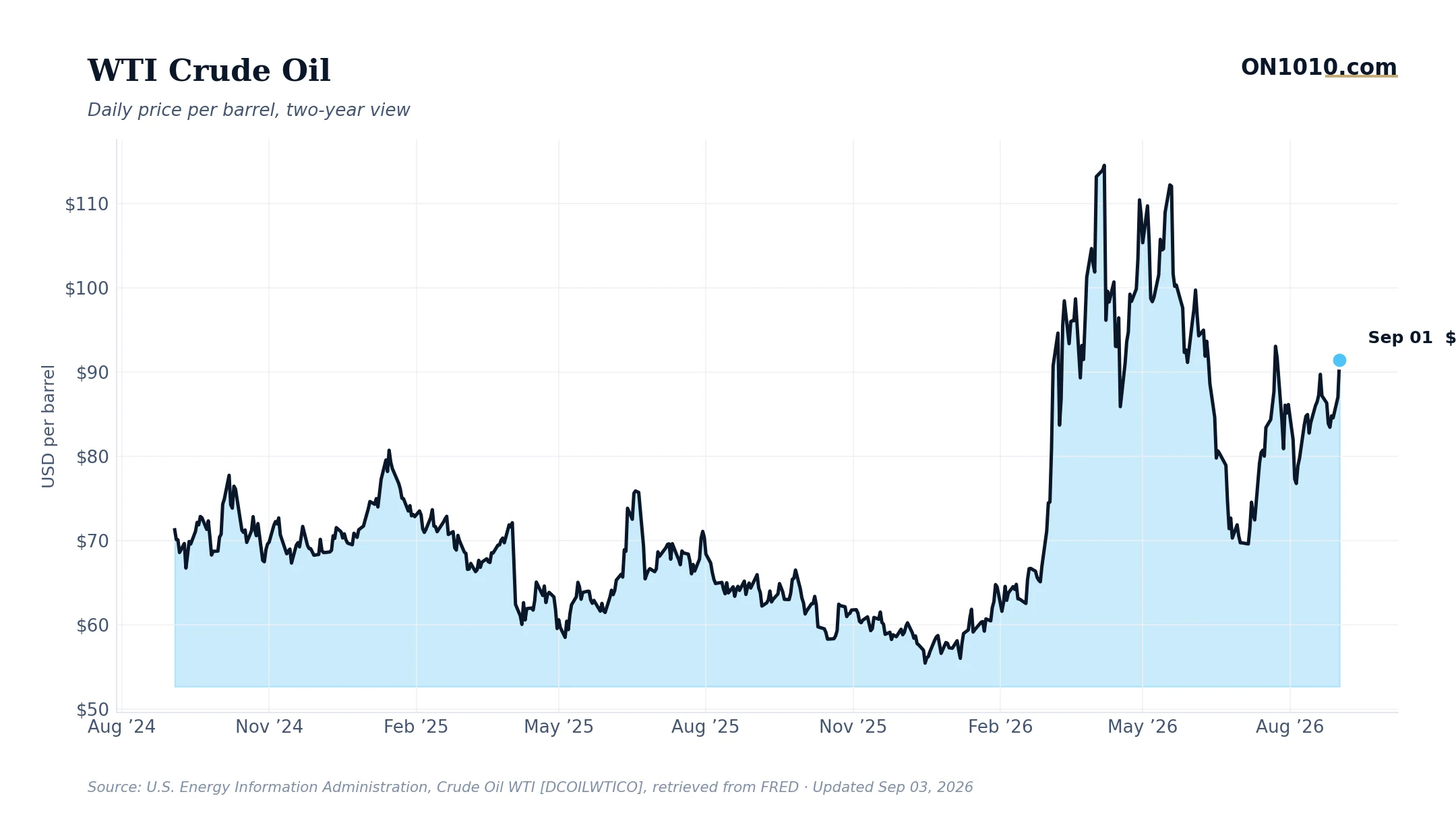
According to CNBC, Brent crude climbed above $96 a barrel after Iran fired missiles at Kuwait, with oil prices now up more than 7% this week as the U.S. and Iran exchanged military strikes for the first time since July. The headline tells you what happened. The more interesting question is what it does to an economy that was already running hot on inflation.
Here is the mechanism worth understanding. Oil is not just a commodity, it is an input cost that touches nearly every margin in the economy. When crude spikes 7% in a week, transportation costs rise, manufacturing costs rise, and eventually consumer prices rise. Companies that cannot pass those costs along eat them in their margins. Those that can pass them along keep inflation elevated longer than the Fed would like. Either way, somebody pays.
The timing is particularly awkward. Core inflation is already running well above its historical norm, and long-term interest rates are sitting in the upper quarter of their historical range. A sustained oil shock layered on top of that combination tightens financial conditions even without the Fed touching its policy rate. The bond market tends to notice that math quickly, and the early sector rotation this week, with health care leading and industrials lagging sharply, suggests institutional money is already adjusting.
The Strait of Hormuz is the world’s single most important oil chokepoint, with roughly 20% of global petroleum flowing through it daily. Historically, investors have treated Hormuz disruption risk as a short-duration spike unless physical supply actually gets constrained. The question worth sitting with now is whether this week’s military exchange stays contained or signals something more durable. If supply disruptions follow, the inflation math gets considerably harder. If the crisis de-escalates quickly, markets have shown they can shrug off geopolitical oil spikes within weeks.
Bottom Line: A 7% oil surge arriving on top of already-hot inflation and elevated long rates is a genuine friction, and the Strait of Hormuz is the one chokepoint where the world cannot easily route around the problem.
Read more: CNBC Top News
ON1010 Research is an independent publisher of economic education and is not a registered investment adviser, broker-dealer, or investment company. This content is for educational and informational purposes only and is not investment advice or a recommendation to buy, sell, or hold any security. Published under the publisher exemption recognized by Section 202(a)(11)(D) of the Investment Advisers Act of 1940 (Lowe v. SEC). Always consult a qualified financial professional before making any financial decision.
Free Research
The economy moves fast. We make sure you move faster.
Economic data, policy shifts, and market signals — delivered to your inbox.
Subscribe Free