
The Yield Curve Is Positive Again. The Bond Market Isn’t Exactly Celebrating.
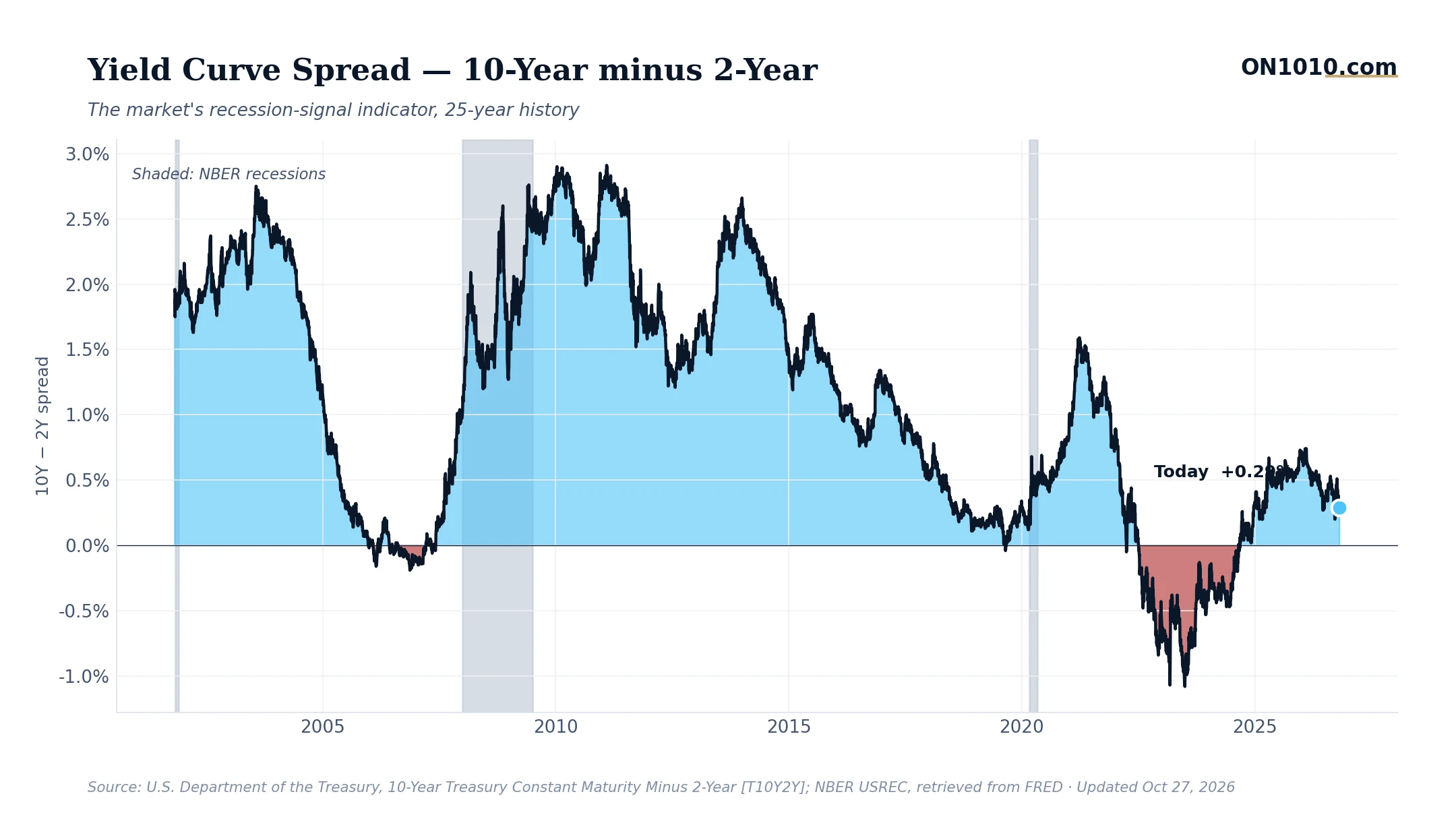
The 10-year/2-year Treasury spread ticked down to 0.29% on October 27, from 0.32% the day before. A positive spread sounds like good news after the brutal inversion the curve spent years stuck in. The catch: the margin is thin, and the environment surrounding it is getting more complicated.
The curve has been hovering in a narrow range between 0.29% and 0.33% for the past week. That’s not a confident steepening. It’s a curve that has barely escaped negative territory and keeps stalling near zero. At the same time, the broader economic backdrop shows real interest rates that are restrictive by historical standards, credit spreads that have widened into territory associated with stress, and consumer sentiment that is near the bottom of its historical range. Individually, any one of those might be noise. Together, they describe a system under pressure.
Historically, when monetary policy has been this restrictive relative to history, a recession has started within the following 12 months about 18% of the time. That is not a high probability, but it’s not trivial either, and it rises when you layer in wide credit spreads. What’s also worth noting: sector rotation data shows defensive sectors outperforming offensive ones by 9 percentage points over the past month, with utilities and consumer staples leading. Equity markets are often pricing something in before it shows up in the data.
In past cycles, investors and business operators have watched a freshly un-inverted curve closely for what happens next. A sustained steepening (longer-term rates rising above short-term rates as growth accelerates) is generally the healthier outcome. A curve that re-inverts after briefly going positive has, historically, been a more cautionary signal. Which direction it breaks from here is the question worth tracking.
Bottom Line: The yield curve is technically positive, but 0.29% is not a green light. With credit spreads wide, policy rates restrictive, and institutional money rotating hard into defensive sectors, the curve’s next move matters more than today’s number.
Source: Federal Reserve Economic Data (FRED)
ON1010 Research is an independent publisher of economic education and is not a registered investment adviser, broker-dealer, or investment company. This content is for educational and informational purposes only and is not investment advice or a recommendation to buy, sell, or hold any security. Published under the publisher exemption recognized by Section 202(a)(11)(D) of the Investment Advisers Act of 1940 (Lowe v. SEC). Always consult a qualified financial professional before making any financial decision.
Free Research
The economy moves fast. We make sure you move faster.
Economic data, policy shifts, and market signals — delivered to your inbox.
Subscribe Free