
The 2-Year Yield Just Dropped 13 Basis Points in a Day. The Market Is Sending a Message.
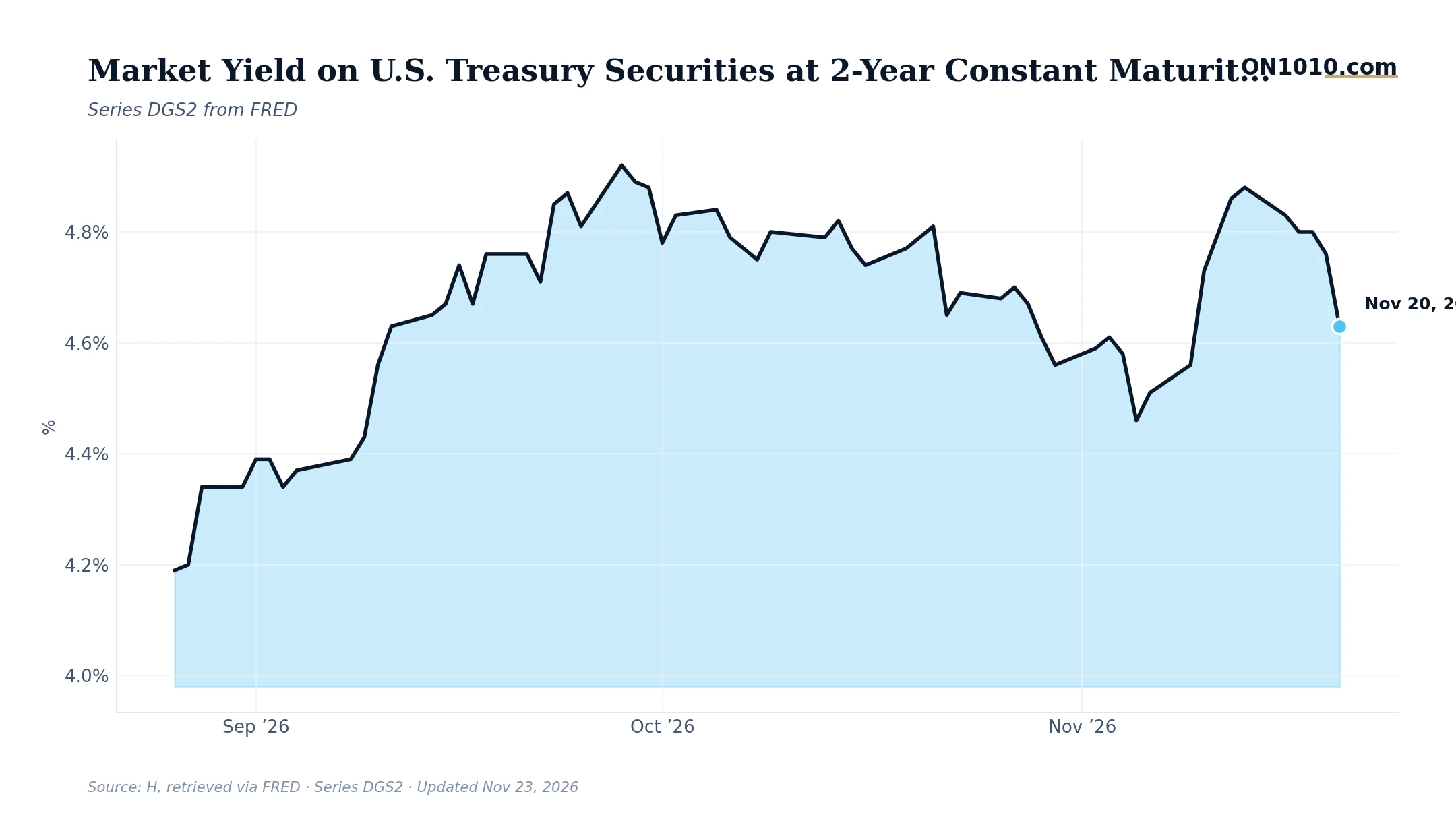
The 2-year Treasury yield fell from 4.76% to 4.63% in a single session, a 13 basis point drop that sounds small until you remember this yield doesn’t move that fast without a reason. Over the past week, it has slid from 4.88% to 4.63%, a cumulative 25 basis point move that suggests the bond market is quietly repricing what it expects the Fed to do next.
The 2-year yield is essentially the market’s best guess at the average Fed funds rate over the next two years. When it falls this sharply, bond investors are signaling they believe rate cuts are coming sooner, or going deeper, than they previously thought. That’s worth paying attention to, because the bond market tends to get this right before the Fed announces anything.
Here’s the tension: the economic gauges don’t obviously support a pivot. Core inflation is running near its highest level in decades of recorded data. Monetary policy is still restrictive relative to history. Credit spreads are extremely wide, near the top of their historical range and still rising. Meanwhile, the VIX is above 30 and climbing, consumer sentiment is near the floor of its historical range, and sector rotation shows defensive names (staples, utilities, healthcare, real estate) collectively outpacing technology by nearly 19 percentage points over the past month. That is not a soft-landing picture. That is a market pricing in something harder.
Historically, when the 2-year yield falls sharply while credit spreads are widening and monetary policy remains restrictive, it has often meant the market is pricing in a growth scare rather than a tidy Fed pivot. In past cycles, that combination, rates down, spreads wide, defensives leading, has shown up in the months before economic conditions visibly deteriorated. That is not a prediction. It is a pattern worth knowing, and business leaders watching refinancing timelines or capital deployment decisions have often treated that combination as a prompt to revisit their assumptions about the cost and availability of credit in the months ahead.
Bottom Line: The bond market is now telling a noticeably different story than the inflation data is. When those two disagree, the question every allocator and operator should be sitting with is: which one is leading, and which one is about to catch up?
Source: Federal Reserve Economic Data (FRED)
ON1010 Research is an independent publisher of economic education and is not a registered investment adviser, broker-dealer, or investment company. This content is for educational and informational purposes only and is not investment advice or a recommendation to buy, sell, or hold any security. Published under the publisher exemption recognized by Section 202(a)(11)(D) of the Investment Advisers Act of 1940 (Lowe v. SEC). Always consult a qualified financial professional before making any financial decision.
Free Research
The economy moves fast. We make sure you move faster.
Economic data, policy shifts, and market signals — delivered to your inbox.
Subscribe Free