
The 2-Year Yield Is Drifting Down. That’s Not the Reassuring Signal It Sounds Like.
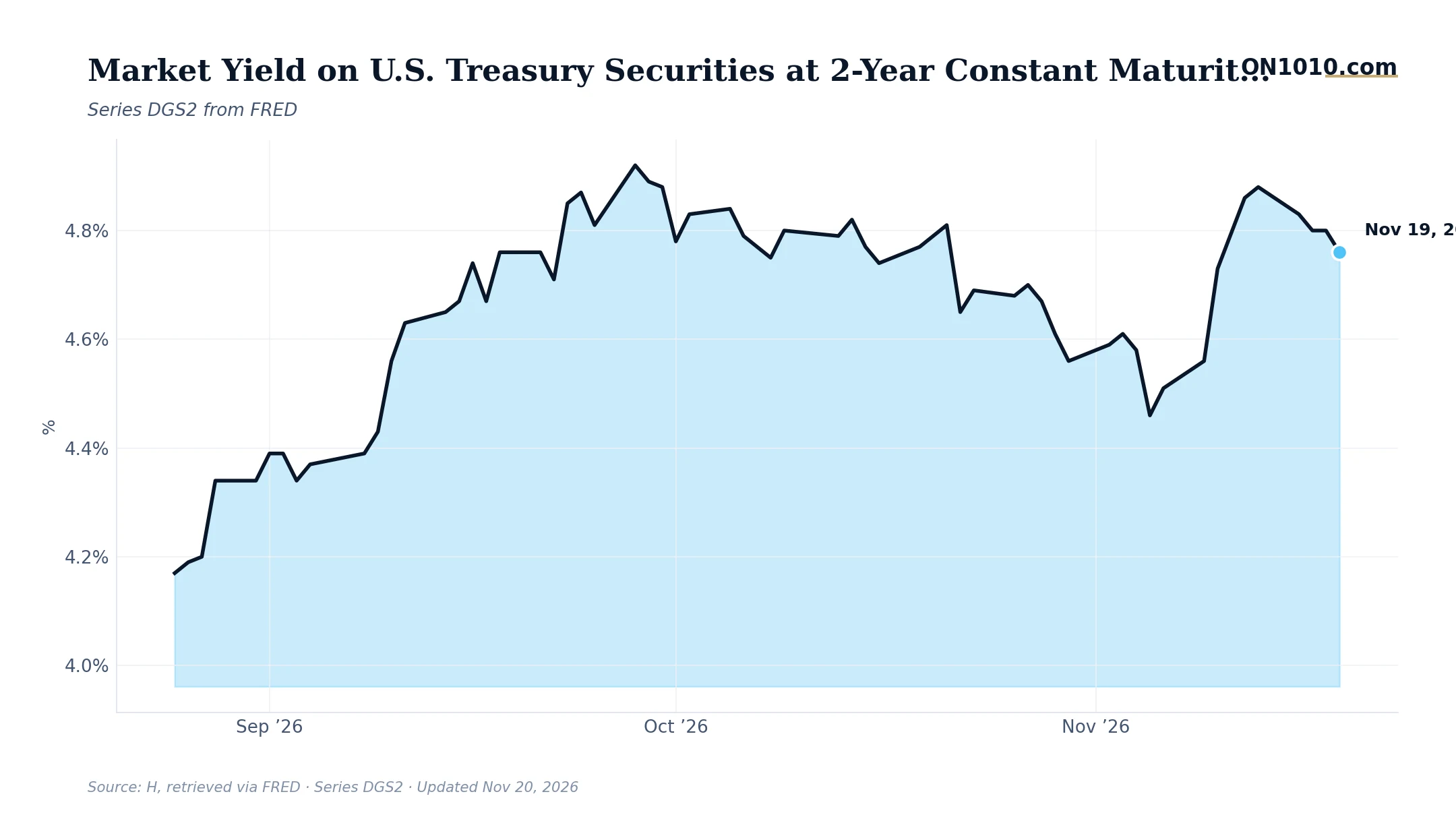
The 2-year Treasury yield slipped to 4.76% on November 19, down from 4.80% two days prior and from 4.88% just a week ago. That’s a small move in absolute terms. But the direction, combined with everything else happening in this economy right now, is worth reading carefully.
The 2-year yield is essentially the bond market’s best guess at where the Fed funds rate is headed over the next 24 months. When it falls, markets are pricing in either slower growth, lower inflation, or both. And here’s where the picture gets complicated: inflation right now is running hotter than roughly nine of every ten months in the historical record. The Fed’s real policy rate is still high by historical standards. Those two facts, taken together, don’t normally produce a falling 2-year yield unless something in the growth outlook is quietly shifting.
The broader environment reinforces that read. Credit spreads are wide and rising, a signal that lending conditions are tightening at the margins. Consumer sentiment is near the bottom of its historical range. The stock market is trading below its own moving averages, with money rotating hard into consumer staples, utilities, and healthcare over the past month, which is what institutional investors tend to do when they’re nervous about where growth is headed, not when they’re confident.
Historically, when long-term rates are elevated, monetary policy is restrictive, and credit conditions are under stress simultaneously, a recession began within the following year about 18-20% of the time. That is a minority outcome, not the base case. But it has happened before, and the combination of signals currently on the board is not one that tends to appear during the healthy middle of an expansion.
For businesses planning capital expenditures or refinancing decisions, the rate environment that shows up in the next 6-12 months may look quite different from today. That is not a prediction. It is a question worth asking your financial advisor: what does your plan look like under multiple rate scenarios, and which one hurts most?
Bottom Line: A falling 2-year yield in an environment of hot inflation and rising credit stress is the bond market quietly raising a flag. The question is whether rates are coming down because the Fed is winning, or because growth is starting to wobble.
Source: Federal Reserve Economic Data (FRED)
ON1010 Research is an independent publisher of economic education and is not a registered investment adviser, broker-dealer, or investment company. This content is for educational and informational purposes only and is not investment advice or a recommendation to buy, sell, or hold any security. Published under the publisher exemption recognized by Section 202(a)(11)(D) of the Investment Advisers Act of 1940 (Lowe v. SEC). Always consult a qualified financial professional before making any financial decision.
Free Research
The economy moves fast. We make sure you move faster.
Economic data, policy shifts, and market signals — delivered to your inbox.
Subscribe Free