
The Fed’s Inflation Gauge Just Picked Up Speed. That’s a Problem.
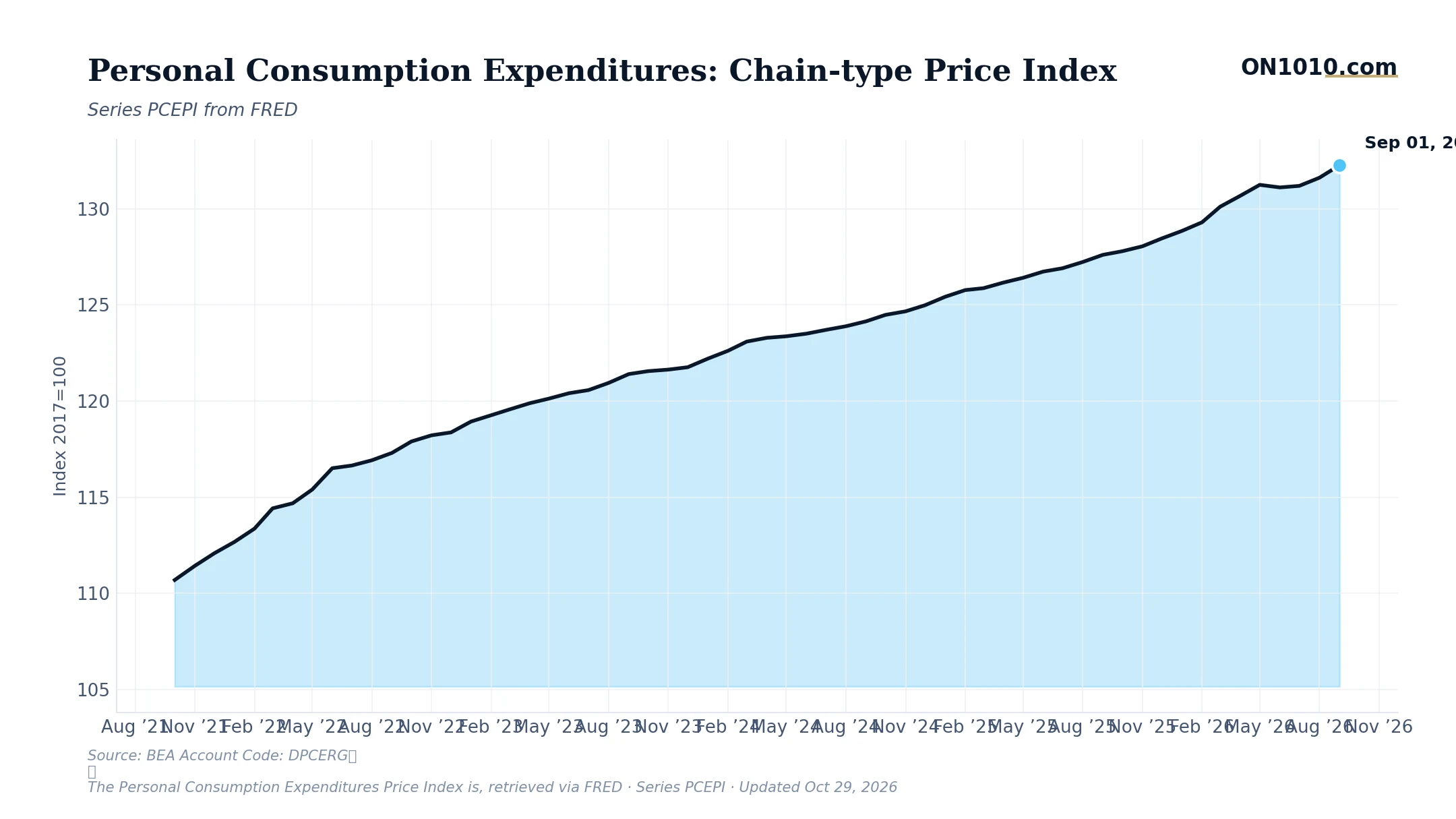
PCE inflation rose 0.49% in September, pushing the year-over-year rate to 3.29%. That’s not a rounding error above the Fed’s 2% target. It’s more than half again as high, and the recent trend suggests the path down isn’t as smooth as anyone hoped.
Look at the last six months. PCE bumped along near 131.1 to 131.2 from April through June, then accelerated through the summer: 131.187 in July, 131.611 in August, 132.257 in September. Three consecutive months of rising readings, with September’s 0.49% monthly gain the steepest in the sequence. When a trend reverses like this, one month can be noise. Three months starts to look like a story.
The broader picture makes September’s number harder to wave off. Monetary policy is sitting in restrictive territory by historical standards, yet inflation remains well above target. That combination has historically kept pressure on long-term rates, which are already in the upper range of their multi-decade history and, as of late October, rising again. Credit spreads remain wide. Consumer sentiment is near historic lows. And sector rotation over the past month shows institutional money moving out of growth and into staples, health care, and utilities, defensive positioning that tends to show up when markets are pricing in slower growth or a tighter-for-longer policy path.
In past cycles, inflation running above 3% while the policy rate remained restrictive has created a difficult environment for capital allocation decisions. Businesses weighing expansion, refinancing, or long-duration investment face borrowing costs that stay high longer. Historically, this kind of setup has resolved in one of two ways: inflation breaks lower on its own, or it stays stubborn long enough that something in the economy cracks. The question worth asking now is which of those paths the next few months will reveal.
Bottom Line: Inflation rose when it was supposed to be falling, and the acceleration came over multiple months, making September’s reading harder to dismiss as a blip. The Fed’s path forward just got narrower.
Source: Federal Reserve Economic Data (FRED)
ON1010 Research is an independent publisher of economic education and is not a registered investment adviser, broker-dealer, or investment company. This content is for educational and informational purposes only and is not investment advice or a recommendation to buy, sell, or hold any security. Published under the publisher exemption recognized by Section 202(a)(11)(D) of the Investment Advisers Act of 1940 (Lowe v. SEC). Always consult a qualified financial professional before making any financial decision.
Free Research
The economy moves fast. We make sure you move faster.
Economic data, policy shifts, and market signals — delivered to your inbox.
Subscribe Free