
Mortgage Rates Just Dipped. The Housing Market Barely Noticed.
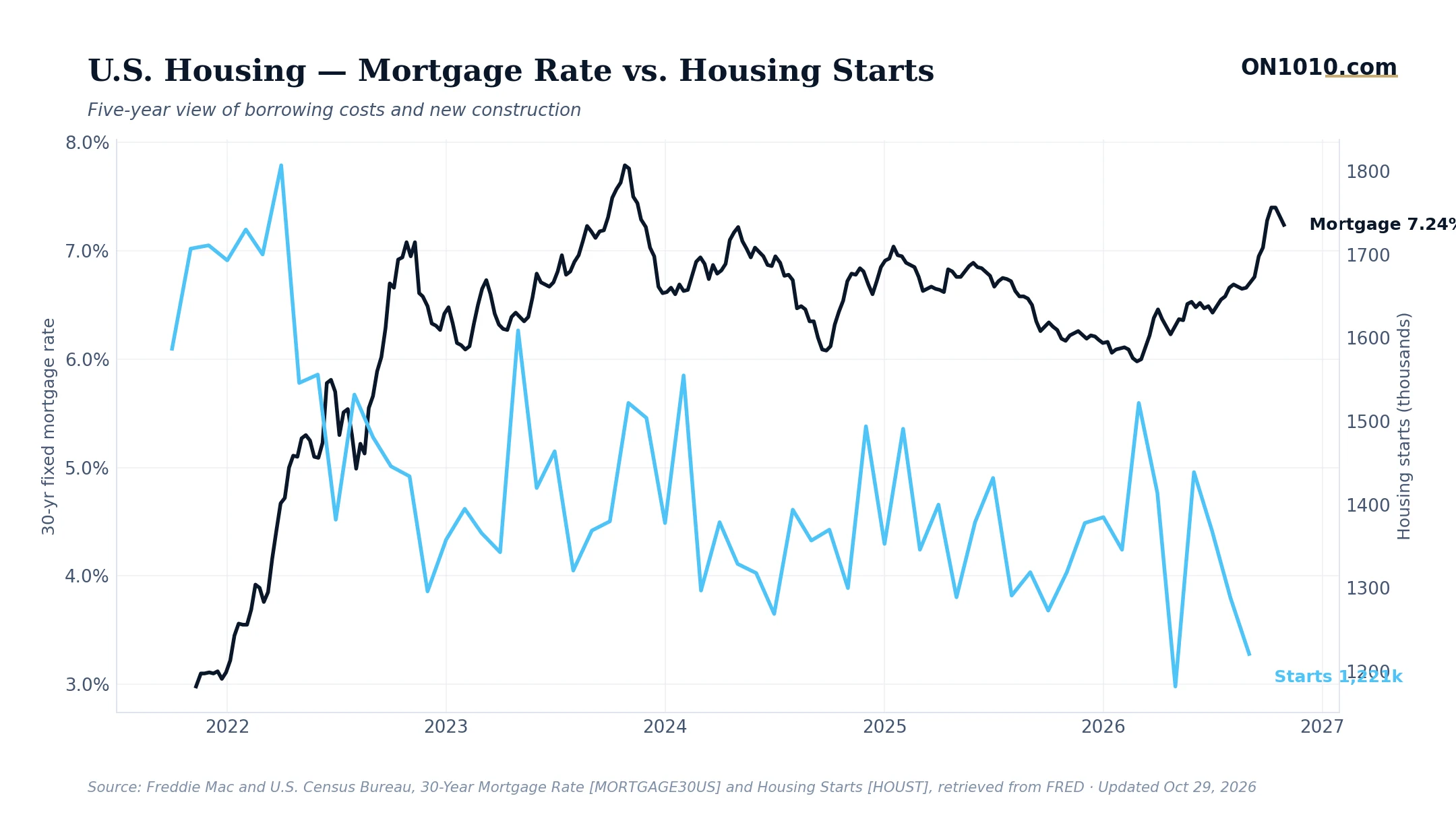
The 30-year mortgage rate slipped to 7.24% this week, down from 7.32% a week ago and a touch below the recent peak of 7.40% seen through most of October. Eight basis points of relief sounds promising. The problem is context.
Pull back to late September and rates were sitting at 7.03%. So after a month of climbing to multi-month highs, this week’s dip is a partial retreat, not a turning point. The housing market is still navigating the same wall it has been facing: rates that sit in the upper range of the last several decades, at a moment when affordability was already stretched before rates moved higher.
The bigger picture here is a balance sheet problem, not just an income problem. Existing homeowners locked in 3% mortgages and have little incentive to sell, which keeps supply off the market. That keeps prices elevated. Now add a 7.24% rate on top of those prices, and the monthly payment on a median-priced home has roughly doubled versus 2020. First-time buyers bear the full weight of that math. Sellers who need to move face the same rate as buyers. The result is a market with low volume, stubborn prices, and very little relief in sight from a single week’s data.
The broader economic gauges reinforce the caution here. Long-term interest rates remain historically elevated and, after falling briefly, have resumed rising. Credit spreads are wide. Consumer sentiment sits near the very bottom of its historical range. Defensive sectors are outperforming growth sectors sharply over the past month. Historically, when long-term rates have sat at levels this high, a new recession has begun within the following 12 months about 20% of the time. That is not a forecast. It is a base rate worth knowing before anyone declares that an 8 basis point dip changes the affordability equation.
In past cycles, investors and operators have watched mortgage rates as a proxy for the cost of leverage across the whole economy, because housing is the largest leveraged purchase most households make. When rates stay persistently high, spending that would otherwise flow from home equity, renovation, and household formation tends to compress.
Bottom Line: A dip to 7.24% is real, but it trims about $50 off the monthly payment on a $400,000 loan. The rate that would meaningfully reopen the housing market for most buyers is probably not 7.24%, which raises the question: how long can transaction volume stay this depressed before something in the market has to give?
Source: Federal Reserve Economic Data (FRED)
ON1010 Research is an independent publisher of economic education and is not a registered investment adviser, broker-dealer, or investment company. This content is for educational and informational purposes only and is not investment advice or a recommendation to buy, sell, or hold any security. Published under the publisher exemption recognized by Section 202(a)(11)(D) of the Investment Advisers Act of 1940 (Lowe v. SEC). Always consult a qualified financial professional before making any financial decision.
Free Research
The economy moves fast. We make sure you move faster.
Economic data, policy shifts, and market signals — delivered to your inbox.
Subscribe Free