
The Job Market Held Steady. The Rest of the Economy Didn’t Get the Memo.
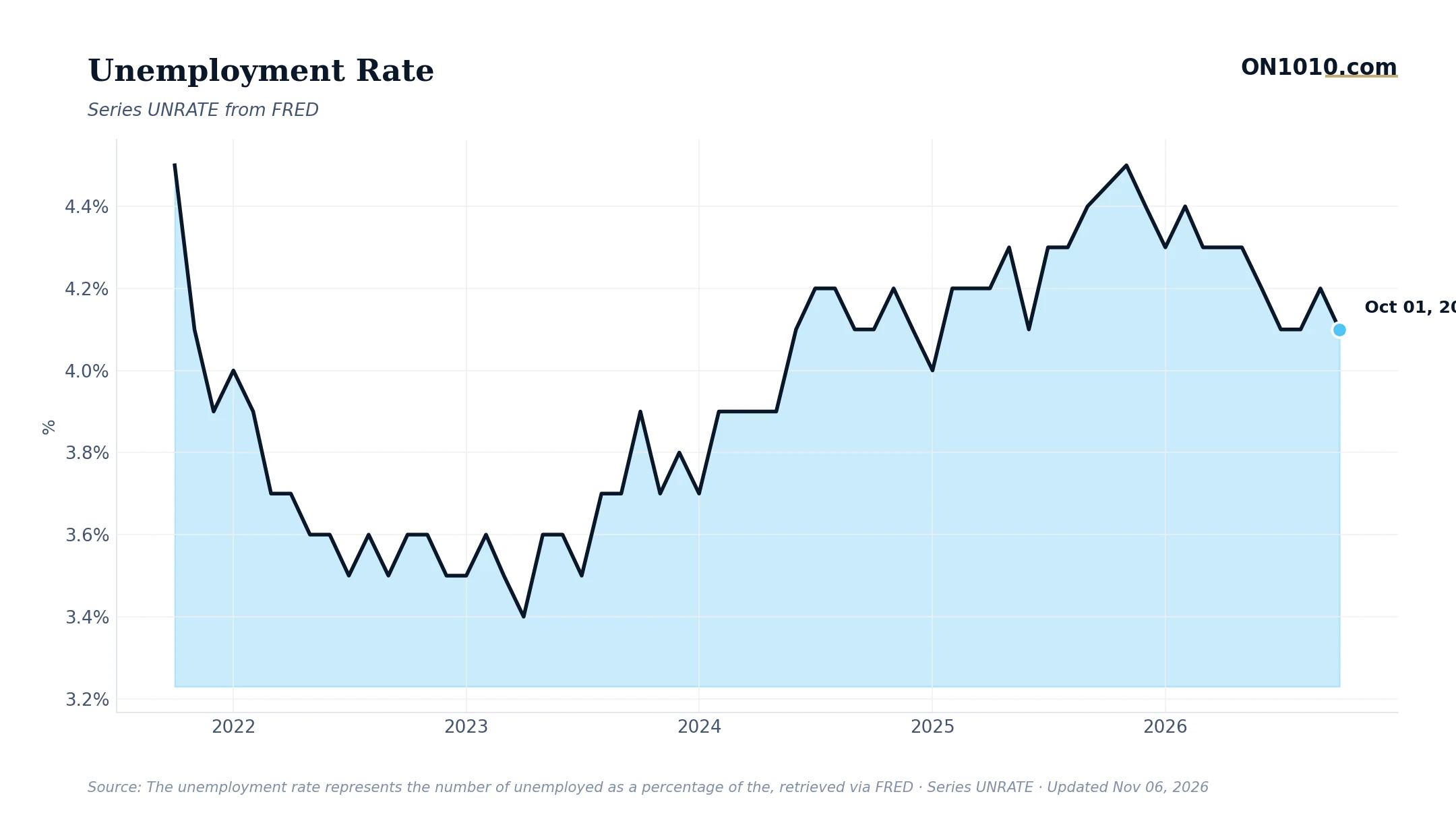
The October unemployment rate ticked down to 4.1%, reversing last month’s move to 4.2% and sitting right back where it spent most of the summer. On the surface, this looks like a stable labor market. The tension is that almost nothing else in the economic backdrop looks stable right now.
Zoom out six months and unemployment has barely moved, oscillating between 4.1% and 4.3% since May. That kind of sideways drift is actually meaningful. The labor market isn’t cracking, but it stopped improving. Meanwhile, inflation remains hot relative to its long-run history, the real policy rate is restrictive, long-term interest rates are sitting in their upper historical range, and credit spreads have widened into stress territory. The labor market is the last piece of the economy’s dashboard still showing green.
That gap between labor market resilience and broader financial stress is where the story gets interesting. Historically, unemployment is a lagging indicator. It stays low even as the cracks form elsewhere, then moves fast once conditions tip. In past cycles, businesses didn’t cut workers when rates first went up. They cut workers when cash flow, margins, and credit access finally forced their hand. The question isn’t whether 4.1% is a good number. The question is what it will look like six months after credit spreads have been this wide for this long.
For anyone running a business or thinking about capital allocation, the data worth watching alongside unemployment is unit labor cost growth relative to what companies can charge. If pricing power is eroding while wages hold firm, margins compress before the layoffs show up in this number.
Bottom Line: A 4.1% unemployment rate is objectively solid, but the labor market tends to be the last domino to fall, and the dominoes around it are wobbling.
Source: Federal Reserve Economic Data (FRED)
ON1010 Research is an independent publisher of economic education and is not a registered investment adviser, broker-dealer, or investment company. This content is for educational and informational purposes only and is not investment advice or a recommendation to buy, sell, or hold any security. Published under the publisher exemption recognized by Section 202(a)(11)(D) of the Investment Advisers Act of 1940 (Lowe v. SEC). Always consult a qualified financial professional before making any financial decision.
Free Research
The economy moves fast. We make sure you move faster.
Economic data, policy shifts, and market signals — delivered to your inbox.
Subscribe Free