
The Jobs Market Just Beat Expectations by Nearly 3-to-1. So Why Is the Market Telling a Different Story?
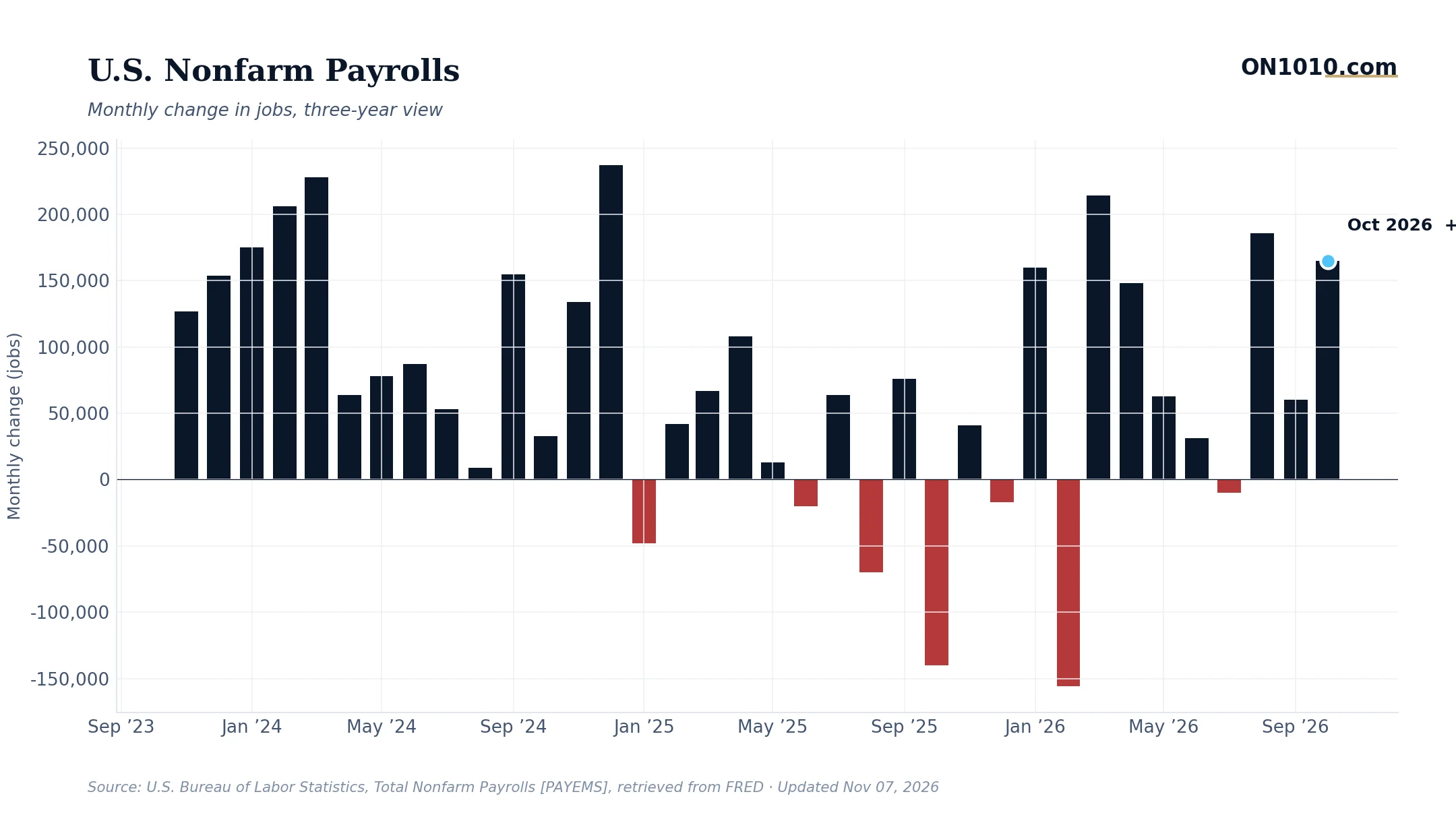
According to CNBC, the U.S. economy added 165,000 jobs in October, nearly triple the 59,000 economists had expected, while the unemployment rate slipped to 4.1%. On the surface, this looks like a blowout. But the bond market, the credit market, and institutional capital flows are all sending a quieter, more cautious signal, and that tension is worth understanding.
Here is the first thing to notice: a headline payroll number tells you where the economy was, not where it is going. The jobs report captures hiring that already happened. Margins, credit spreads, and equity positioning tell you what businesses and institutional investors expect to happen next. Right now, those forward-looking signals are flashing amber. Credit spreads are wide and rising, sitting near the highest levels in roughly a decade of history. Market volatility has spiked sharply, moving from a neutral reading to one of the most elevated in recent years. And sector rotation shows defensive industries, staples, health care, real estate, utilities, outpacing offensive sectors by more than 14 percentage points over the past month. That is a meaningful tilt. Money flows somewhere for a reason.
Layered on top of this: core inflation remains hot by historical standards, the real policy rate is restrictive, and long-term interest rates are sitting in the upper quarter of their historical range. That combination puts pressure on margins. When companies pay more to borrow and more for inputs, profits eventually feel it, and profits lead hiring, not the other way around.
Consumer sentiment also remains near its historical floor. Historically, when sentiment is this depressed, recessions within the following year have been rare. But weak sentiment does constrain spending in ways that matter to revenue, even without a formal recession.
Historically, investors have used moments of strong headline data alongside deteriorating credit and rising volatility as prompts to separate the aggregate story from the distributed one: the economy-wide number looks fine until the stress in specific sectors compounds into something broader. The question this raises is whether October’s strong hiring reflects momentum or a lag, and which one the credit market already knows the answer to.
Bottom Line: A jobs number that beats by this much normally reads as unambiguous good news. With credit spreads widening, volatility elevated, and defensive capital flows accelerating, the smarter question is what the forward-looking markets are seeing that the backward-looking data has not yet shown.
Read more: CNBC Economy
Source: CNBC Economy, Bureau of Labor Statistics (October 2026 Employment Situation Summary)
ON1010 Research is an independent publisher of economic education and is not a registered investment adviser, broker-dealer, or investment company. This content is for educational and informational purposes only and is not investment advice or a recommendation to buy, sell, or hold any security. Published under the publisher exemption recognized by Section 202(a)(11)(D) of the Investment Advisers Act of 1940 (Lowe v. SEC). Always consult a qualified financial professional before making any financial decision.
Free Research
The economy moves fast. We make sure you move faster.
Economic data, policy shifts, and market signals — delivered to your inbox.
Subscribe Free