
The 10-Year Yield Is Back Above 5%. The Bond Market Is Sending a Message.
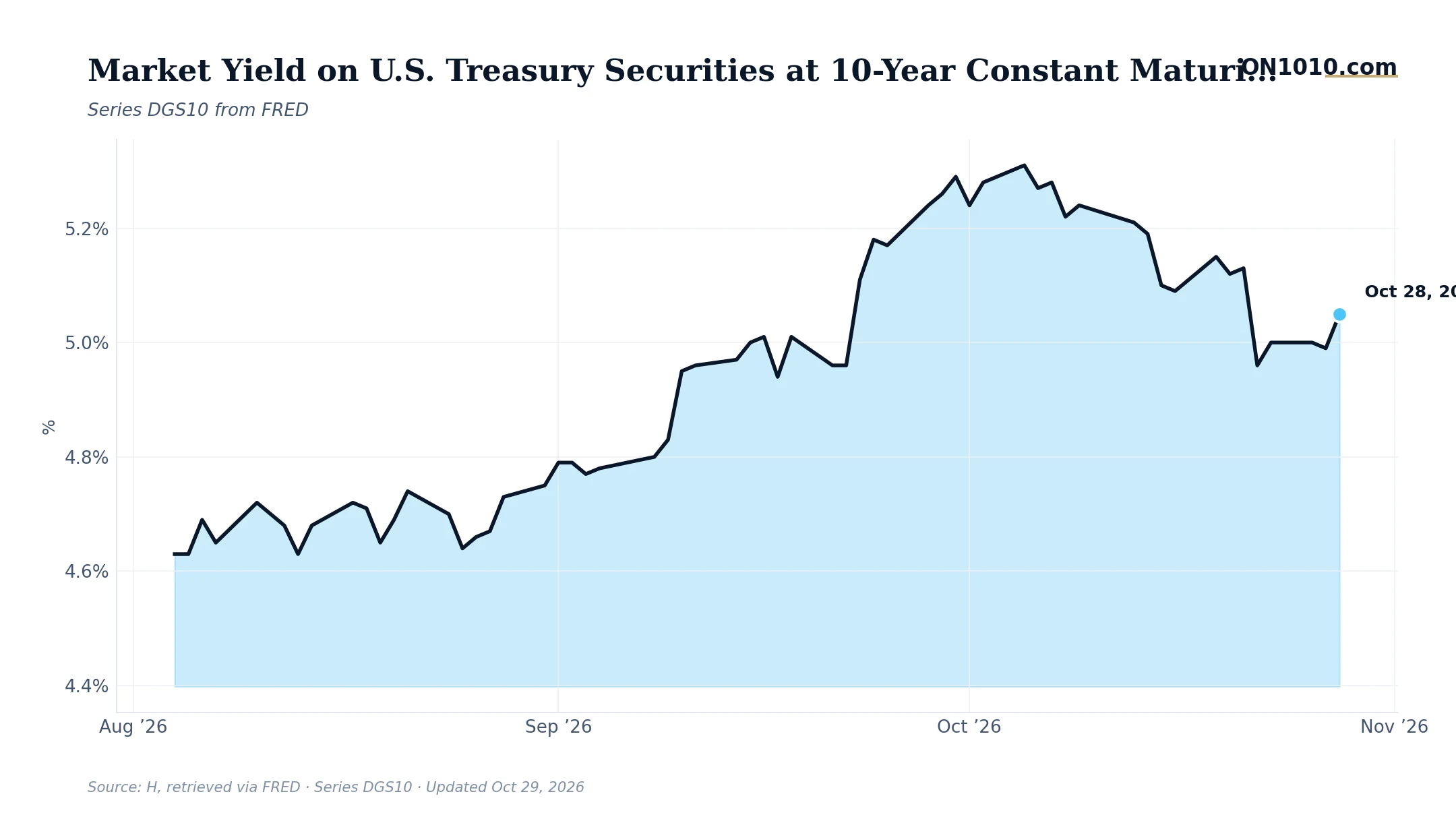
The 10-year Treasury yield climbed to 5.05% on October 28, crossing back above the 5% threshold after dipping to 4.96% just six days earlier. That 0.09 percentage point swing looks small on paper. In a $28 trillion bond market, it represents an enormous amount of money repricing in a very short window.
The bigger picture here is a convergence of pressures that doesn’t resolve easily. Inflation remains hot by historical standards, the Fed’s real policy rate is restrictive and rising, and long-term rates now sit in the upper range of their historical record. Historically, when long-term rates have been this elevated, a new recession began within the following 12 months about 20% of the time. That is not a forecast. It is a base rate worth knowing. What’s notable is that credit spreads are simultaneously wide, consumer sentiment is near historical lows, and sector rotation data shows defensive sectors outperforming growth by 6.5 percentage points over the past month. The bond market and the stock market are telling the same story.
Historically, sustained moves above 5% on the 10-year have acted as a gravitational brake on the economy. Mortgage rates follow the 10-year closely, corporate borrowing costs rise, and the discount rate used to value future earnings goes up. That last point is especially relevant for long-duration assets: when the risk-free rate climbs, every future dollar of profit is worth a little less today. In past cycles, investors and business operators have used this environment to reassess the cost of capital and the timeline on longer-horizon commitments.
The interest rate direction just shifted: the trend that was falling has turned rising again. That reversal, combined with tight credit conditions and weak consumer sentiment, raises a pointed question about who can actually absorb 5% borrowing costs and for how long.
Bottom Line: A 5% 10-year yield is not just a bond market statistic. It is the price of capital across the entire economy, and right now that price is near its highest level in a generation.
Source: Federal Reserve Economic Data (FRED)
ON1010 Research is an independent publisher of economic education and is not a registered investment adviser, broker-dealer, or investment company. This content is for educational and informational purposes only and is not investment advice or a recommendation to buy, sell, or hold any security. Published under the publisher exemption recognized by Section 202(a)(11)(D) of the Investment Advisers Act of 1940 (Lowe v. SEC). Always consult a qualified financial professional before making any financial decision.
Free Research
The economy moves fast. We make sure you move faster.
Economic data, policy shifts, and market signals — delivered to your inbox.
Subscribe Free