
The 30-Year Mortgage Rate Has Stalled at 7.4%. That’s a Problem for Housing.
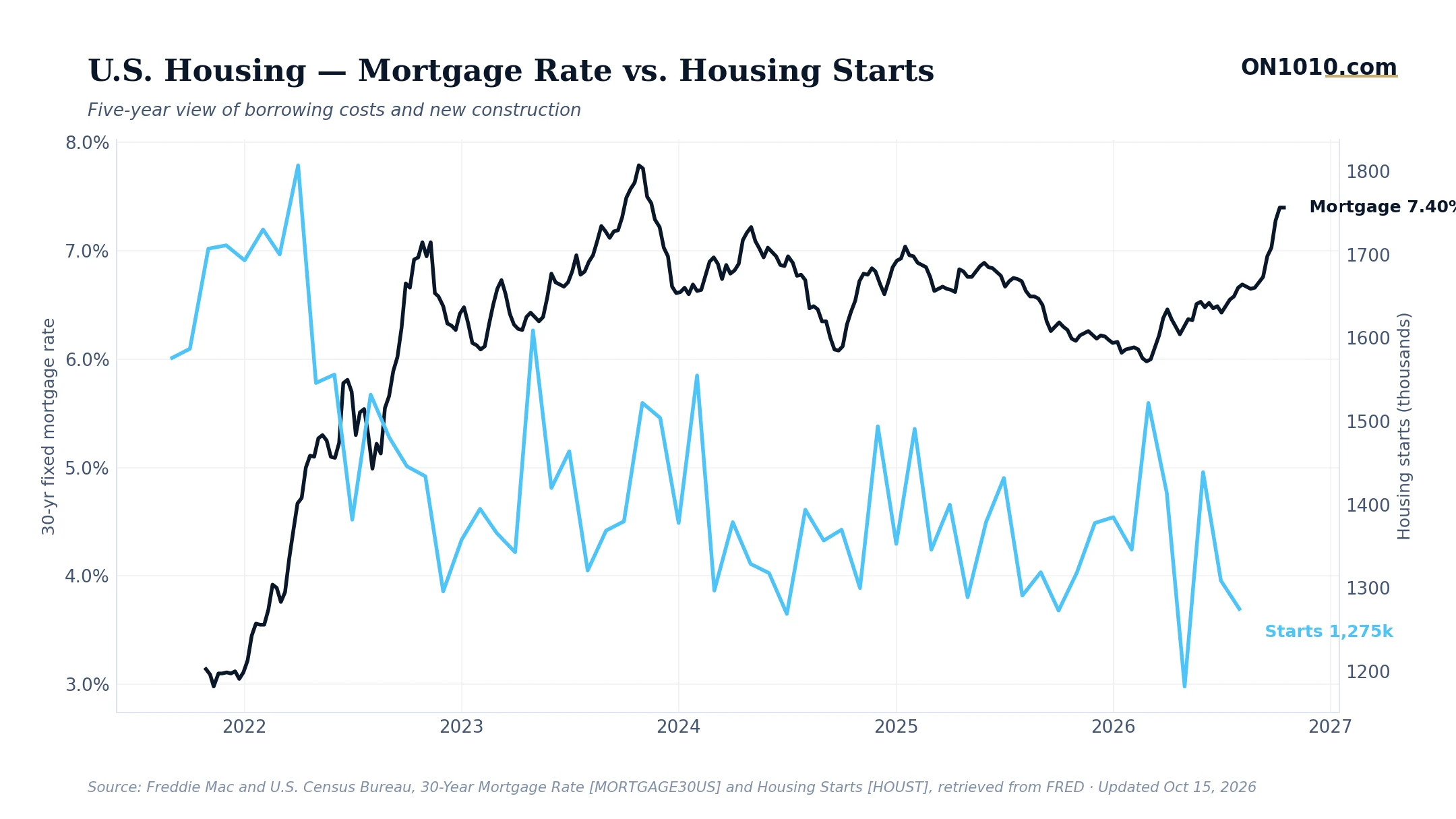
The 30-year fixed mortgage rate held at 7.4% for the second straight week, unchanged from October 8. The story isn’t that it didn’t move. The story is how far it has climbed since mid-September, when it sat at 6.76%. That’s a jump of 64 basis points in five weeks, and now it’s dug in.
Six weeks ago, there was genuine momentum building in the housing market. Rates dipping toward 6.75% had started to unlock some demand from buyers who’d been sitting on the sidelines. That window has now closed. At 7.4%, a $400,000 mortgage carries a monthly payment roughly $170 higher than it would have at 6.76%. For a lot of buyers, that’s the difference between qualifying and not qualifying.
The broader context matters here. Long-term interest rates are running near the upper end of their historical range, and they’ve only recently started to ease. At the same time, credit conditions have tightened, consumer sentiment remains near historical lows, and monetary policy is still restrictive by historical standards. Housing sits at the intersection of all three. It is among the most rate-sensitive sectors in the economy, and right now every one of those headwinds is pointing in the same direction.
Historically, when mortgage rates hold above 7% for extended periods, existing home sales tend to stay depressed because homeowners with 3% or 4% locked-in rates have almost no incentive to sell. That “lock-in effect” constrains inventory, which keeps prices from falling much even as affordability crumbles. It’s a frozen market, not a crashing one. The question worth watching is whether rates stabilize here or resume climbing, because another leg higher would push affordability to levels that historically have required either a meaningful price correction or a significant income jump to resolve.
Bottom Line: At 7.4%, mortgage rates aren’t just high. They’re high enough to keep the housing market in a holding pattern, which has ripple effects on everything from furniture sales to construction employment. Watch whether the recent easing in long-term rates finds its way back into mortgage pricing, or whether the 7% floor becomes a ceiling.
Source: Federal Reserve Economic Data (FRED)
ON1010 Research is an independent publisher of economic education and is not a registered investment adviser, broker-dealer, or investment company. This content is for educational and informational purposes only and is not investment advice or a recommendation to buy, sell, or hold any security. Published under the publisher exemption recognized by Section 202(a)(11)(D) of the Investment Advisers Act of 1940 (Lowe v. SEC). Always consult a qualified financial professional before making any financial decision.
Free Research
The economy moves fast. We make sure you move faster.
Economic data, policy shifts, and market signals — delivered to your inbox.
Subscribe Free