
The Yield Curve Is Flattening Again. Here’s What the Bond Market Might Be Telling Us.
THE HOOK
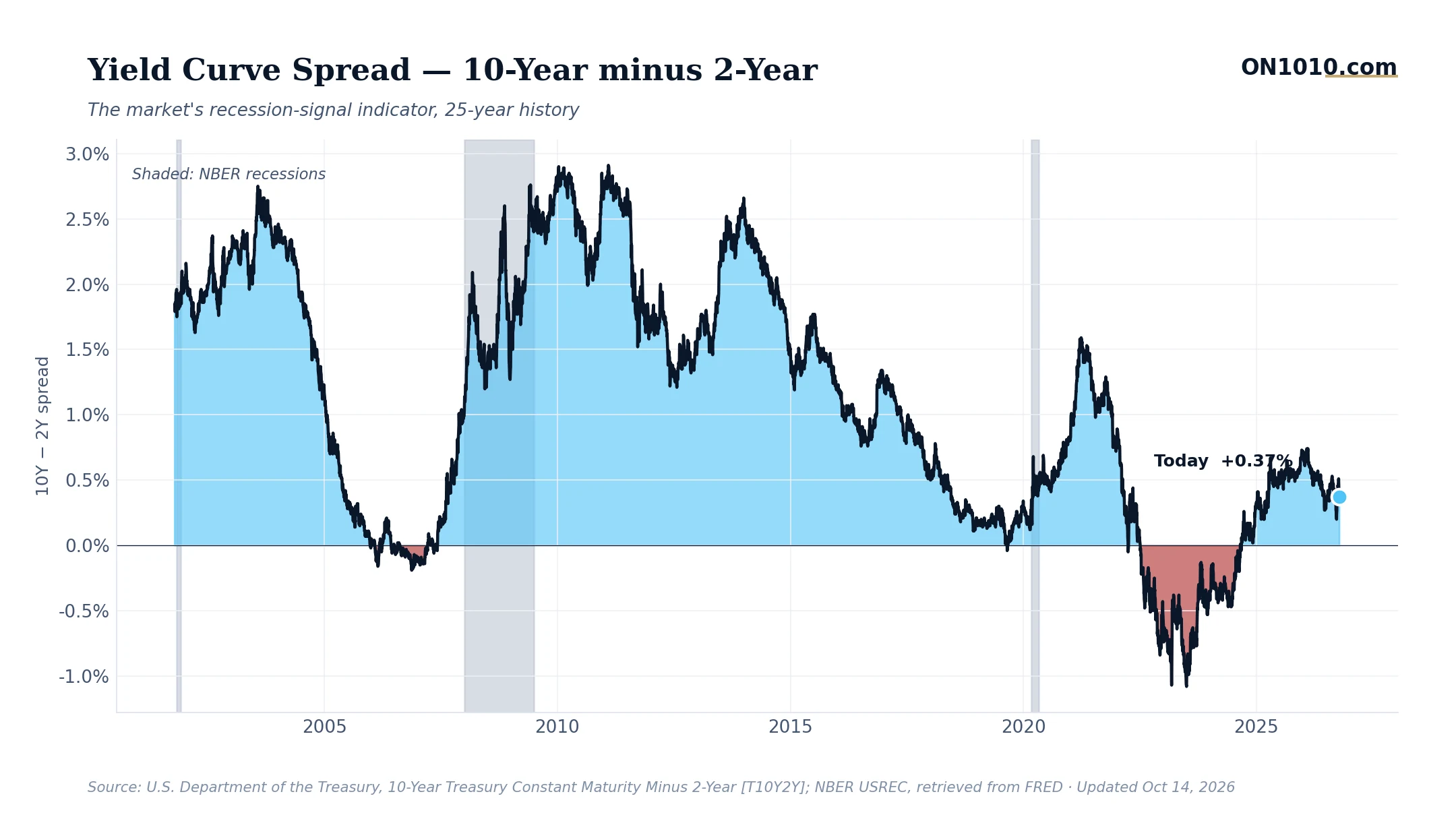
The 10-year/2-year Treasury spread dropped to 0.37% on October 14, down from 0.51% just one week ago. That’s a 27% compression in seven days. The bond market, which spent most of 2022-2024 screaming recession through a deeply inverted curve, normalized earlier this year. Now it’s quietly flattening again.
THE BIGGER PICTURE
The direction here matters as much as the level. A spread of 0.37% is still positive, meaning the curve hasn’t inverted. But the trend is pointed the wrong way at the wrong time. Monetary policy is sitting high versus history, long-term interest rates are elevated, and now the gap between short and long rates is narrowing. That combination historically means credit is getting more expensive for businesses that rely on borrowing to grow. The broader economic gauges paint a picture worth paying attention to: growth is near its historical midpoint, inflation is still running hot by historical standards, and consumer sentiment is near the bottom of its historical range. That’s a compression on both ends of the margin story.
WHY IT MATTERS
The yield curve earns its reputation as a leading indicator because it reflects what the bond market collectively expects about future growth and inflation. A flattening curve, especially when it follows a period of normalization, has historically prompted businesses to re-examine the cost of capital assumptions in long-horizon investments. In past cycles, lenders have also tightened standards when the spread compressed toward zero, because narrow spreads reduce the incentive to take duration risk. Worth noting: historically, when monetary policy was running this restrictive relative to history, a recession followed within 12 months about 18% of the time. That’s not a prediction, it’s a base rate, and it’s one that business decision-makers have found useful when stress-testing financing plans with their advisors.
Bottom Line: The yield curve normalized, then almost immediately started flattening again. The question for the weeks ahead: is this a temporary wobble, or is the bond market starting to price in something the equity market, with the VIX sitting calm and Technology outperforming by over 4%, hasn’t caught up to yet?
Source: Federal Reserve Economic Data (FRED)
ON1010 Research is an independent publisher of economic education and is not a registered investment adviser, broker-dealer, or investment company. This content is for educational and informational purposes only and is not investment advice or a recommendation to buy, sell, or hold any security. Published under the publisher exemption recognized by Section 202(a)(11)(D) of the Investment Advisers Act of 1940 (Lowe v. SEC). Always consult a qualified financial professional before making any financial decision.
Free Research
The economy moves fast. We make sure you move faster.
Economic data, policy shifts, and market signals — delivered to your inbox.
Subscribe Free