
The Bond Market’s Inflation Verdict Is Quietly Getting Calmer
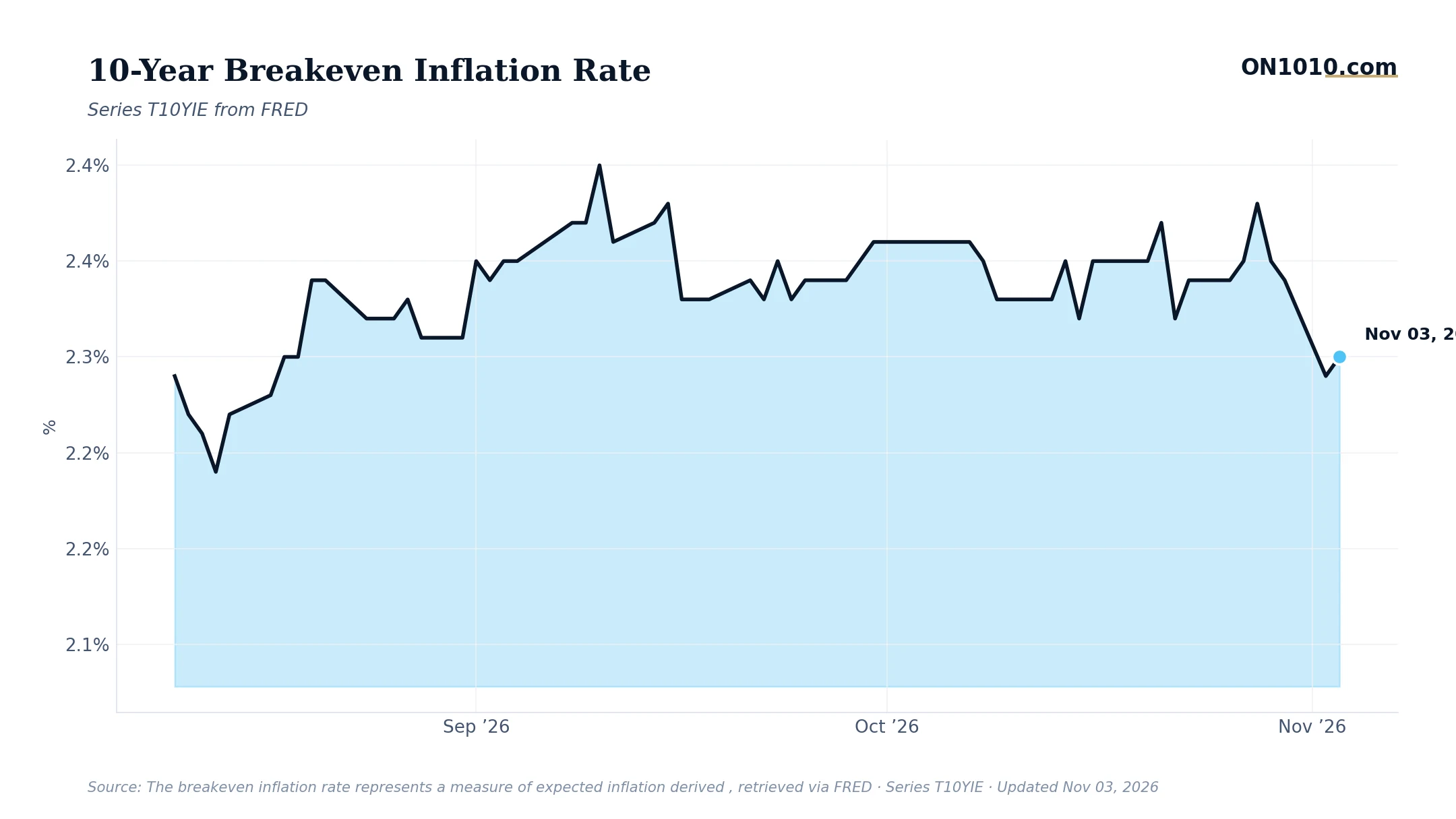
The 10-year breakeven inflation rate edged up to 2.3% on November 3, but zoom out even one week and the story runs the other direction. From 2.38% on October 28, the market’s inflation expectations have drifted down about 8 basis points in a week. Bond investors, as a group, are not panicking about inflation right now.
That deserves attention, because almost everything else in the economic backdrop suggests they should be more worried. Core inflation sits in territory higher than roughly nine out of every ten months on record. The Fed’s policy rate is still well above its historical midpoint, meaning monetary conditions remain meaningfully restrictive. Credit spreads have widened into stress territory. And consumer sentiment is at the low end of its historical range. Against that backdrop, inflation expectations quietly drifting toward 2.3% is a data point worth taking seriously.
The breakeven rate is derived by subtracting the yield on inflation-protected Treasuries (TIPS) from the nominal Treasury yield. When that spread narrows, it means bond investors are pricing in less inflation risk over the coming decade, not because they are optimistic exactly, but because they are embedding less of a premium for uncertainty. Historically, when breakeven rates have held in the 2.0% to 2.5% zone while the Fed holds rates elevated, it has reflected a market betting that tight policy is working. In past cycles, that setup has drawn attention from anyone pricing long-duration assets, since lower long-run inflation expectations tend to anchor the discount rate used to value everything from real estate to growth stocks.
The complication here is the broader market backdrop. Defensive sectors are pulling sharply ahead of offensive ones, credit stress is rising, and equity markets are trading below their short-term trend line. That is an unusual combination to pair with calm inflation expectations. The question worth asking: is the bond market reading disinflationary slowdown, or is it simply behind the curve on risks that credit markets are already pricing in?
Bottom Line: Inflation expectations are easing toward the Fed’s comfort zone even as credit stress rises and growth sentiment cools. The divergence between what bond markets expect on inflation and what credit markets are signaling about risk is the tension to watch in the weeks ahead.
Source: Federal Reserve Economic Data (FRED)
ON1010 Research is an independent publisher of economic education and is not a registered investment adviser, broker-dealer, or investment company. This content is for educational and informational purposes only and is not investment advice or a recommendation to buy, sell, or hold any security. Published under the publisher exemption recognized by Section 202(a)(11)(D) of the Investment Advisers Act of 1940 (Lowe v. SEC). Always consult a qualified financial professional before making any financial decision.
Free Research
The economy moves fast. We make sure you move faster.
Economic data, policy shifts, and market signals — delivered to your inbox.
Subscribe Free