
The Jobs Machine Is Still Running. It’s Just Running Slower.
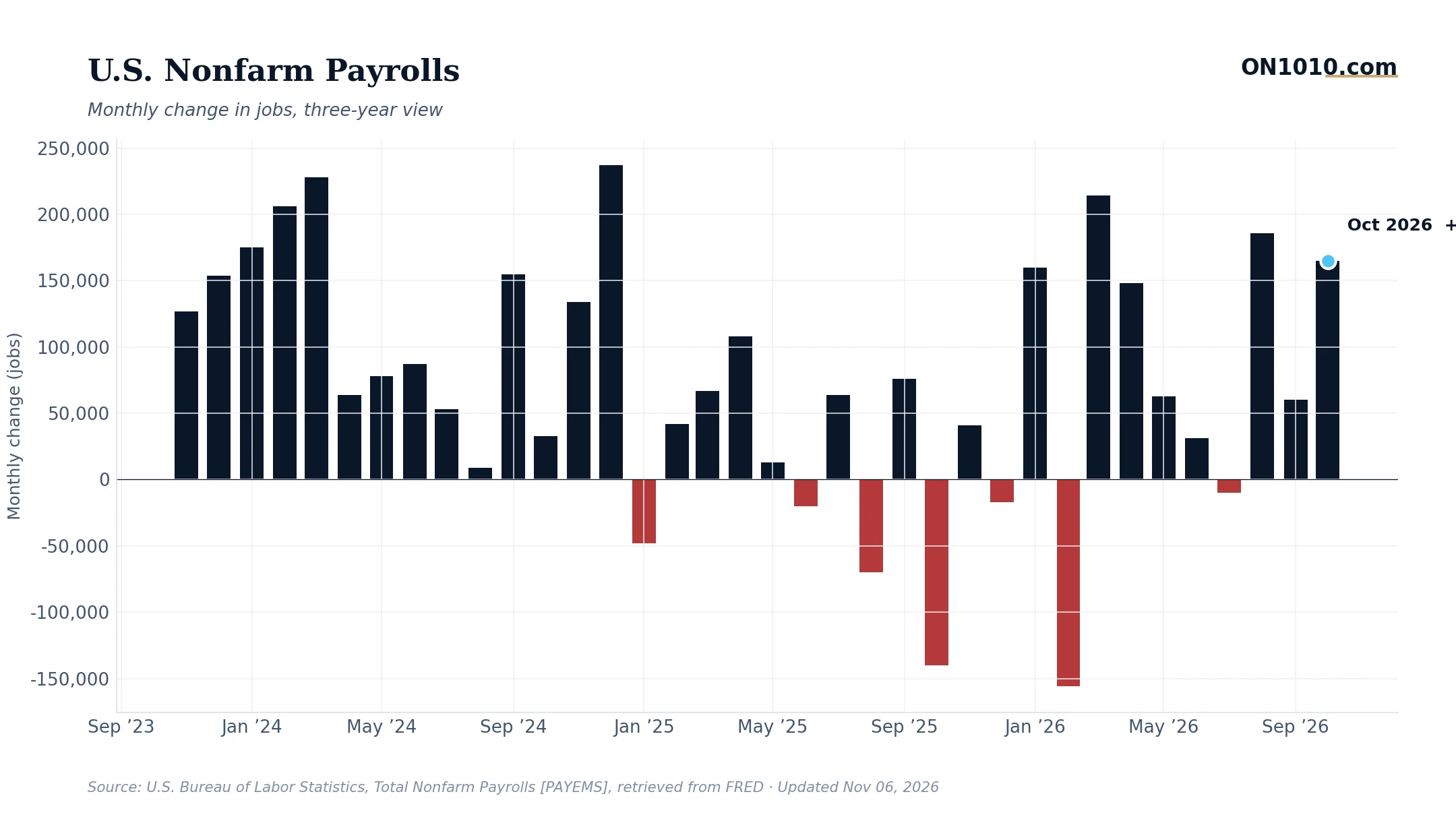
The U.S. economy added 165,000 jobs in October, keeping the labor market in positive territory for another month. But the more interesting story is in the trend: over the past six months, monthly job gains have averaged roughly 143,000, well below the 200,000-plus pace that defined 2023 and early 2024. The engine is still on. The RPMs are dropping.
Zoom out and the deceleration is clearer. Total payrolls are up 861,000 over the past year, a 0.54% gain. That sounds solid until you remember that the U.S. labor market needs roughly 100,000 to 150,000 new jobs per month just to absorb new workers entering the workforce. At 165,000, there’s a slim cushion. At the six-month average pace, there’s almost none.
This matters because the broader backdrop is tightening. Monetary policy is restrictive by historical standards. Long-term interest rates remain elevated. Credit spreads are wide, meaning lenders are charging more to take risk. Consumer sentiment is near historic lows. Each of those conditions individually is manageable. Together, they describe an economy where the cost of capital is high, consumers are nervous, and credit is not flowing freely. Job creation doesn’t happen in a vacuum.
Historically, when job growth slows into the 100,000-to-165,000 range alongside restrictive monetary policy, businesses have tended to become more cautious about longer-term capital commitments. Hiring freezes often precede outright cuts. In past cycles, that sequence has also prompted fixed-income markets to reprice rate expectations quickly, sometimes before any official economic data confirmed the slowdown. The question worth watching: are companies slowing hiring because demand is softening, or because uncertainty about costs and policy is making them wait?
Bottom Line: The labor market is growing, but the margin for error is shrinking. If job creation slips below the 100,000 threshold and holds there, the conversation changes from “soft landing” to something more complicated.
Source: Federal Reserve Economic Data (FRED)
ON1010 Research is an independent publisher of economic education and is not a registered investment adviser, broker-dealer, or investment company. This content is for educational and informational purposes only and is not investment advice or a recommendation to buy, sell, or hold any security. Published under the publisher exemption recognized by Section 202(a)(11)(D) of the Investment Advisers Act of 1940 (Lowe v. SEC). Always consult a qualified financial professional before making any financial decision.
Free Research
The economy moves fast. We make sure you move faster.
Economic data, policy shifts, and market signals — delivered to your inbox.
Subscribe Free