
The Stock Market Is Cheering. The Bond Market Is Charging Admission.
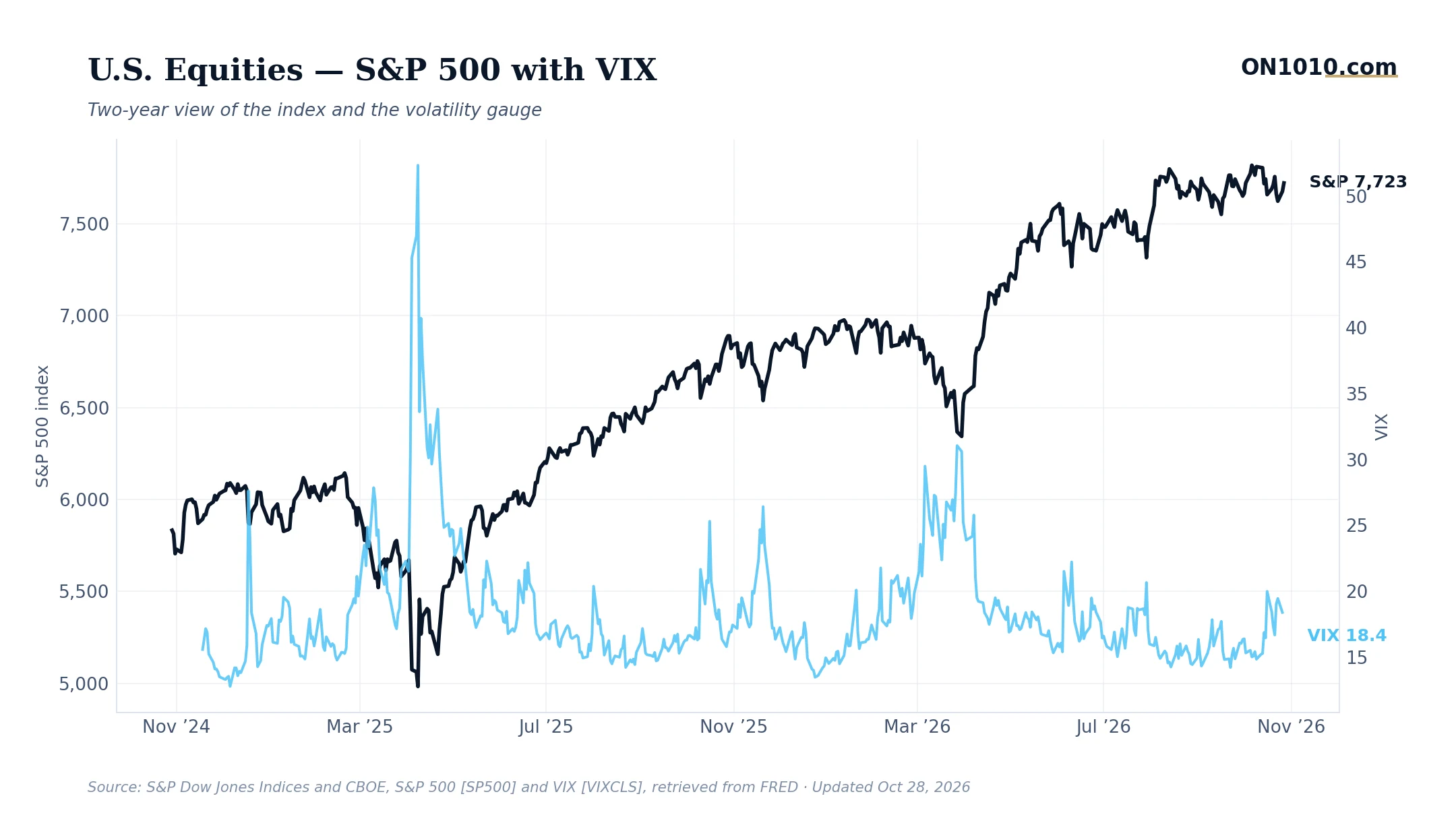
Equities climbed again Tuesday. The S&P 500 closed at 7,722.60, the Nasdaq gained 1.18%, and the VIX actually ticked down to 17.52. On paper, this looks like a clean, healthy rally.
The bond market tells a more complicated story.
The 10-year Treasury yield sits at 5.0%, exactly 100 basis points above the top of the Fed’s target range of 3.75% to 4.0%. Markets are pricing in long-term rates that are well above the Fed’s own policy setting, which means bond investors are demanding a significant premium to lend money for a decade. At the same time, credit spreads are historically wide, sitting in the upper quarter of their long-run range. Businesses that need to borrow are paying up for it. The stock market is celebrating; the credit market is charging a higher cover charge at the door.
There is one more wrinkle worth watching. Sector rotation data shows defensive sectors outperforming offensive sectors by 7.3 percentage points over the past month. Utilities are up 8.6% relative to the broader market. Communication services are down 7.4%. Money is quietly moving toward safety, even as the headline index climbs.
On deck: The Fed wraps its two-day meeting today. No rate move is expected, but the statement language and press conference will set the tone for how long rates stay where they are.
Why it matters: When long-term rates are historically elevated and credit spreads are wide, the cost of capital rises for businesses that need to invest, hire, or refinance. Historically, from setups with long-term rates in this range, a recession began within 12 months about 20% of the time. That is not a forecast; it is a base rate worth knowing as you watch the Fed’s words today.
Sunday’s Long View goes deeper on what the defensive rotation signal is actually saying. It is free, and it is worth your time.
ON1010 Research is an independent publisher of economic education and is not a registered investment adviser, broker-dealer, or investment company. This content is for educational and informational purposes only and is not investment advice or a recommendation to buy, sell, or hold any security. Published under the publisher exemption recognized by Section 202(a)(11)(D) of the Investment Advisers Act of 1940 (Lowe v. SEC). Always consult a qualified financial professional before making any financial decision.
Free Research
The economy moves fast. We make sure you move faster.
Economic data, policy shifts, and market signals — delivered to your inbox.
Subscribe Free