
The Yield Curve Is Back in Positive Territory. The Bond Market Isn’t Celebrating.
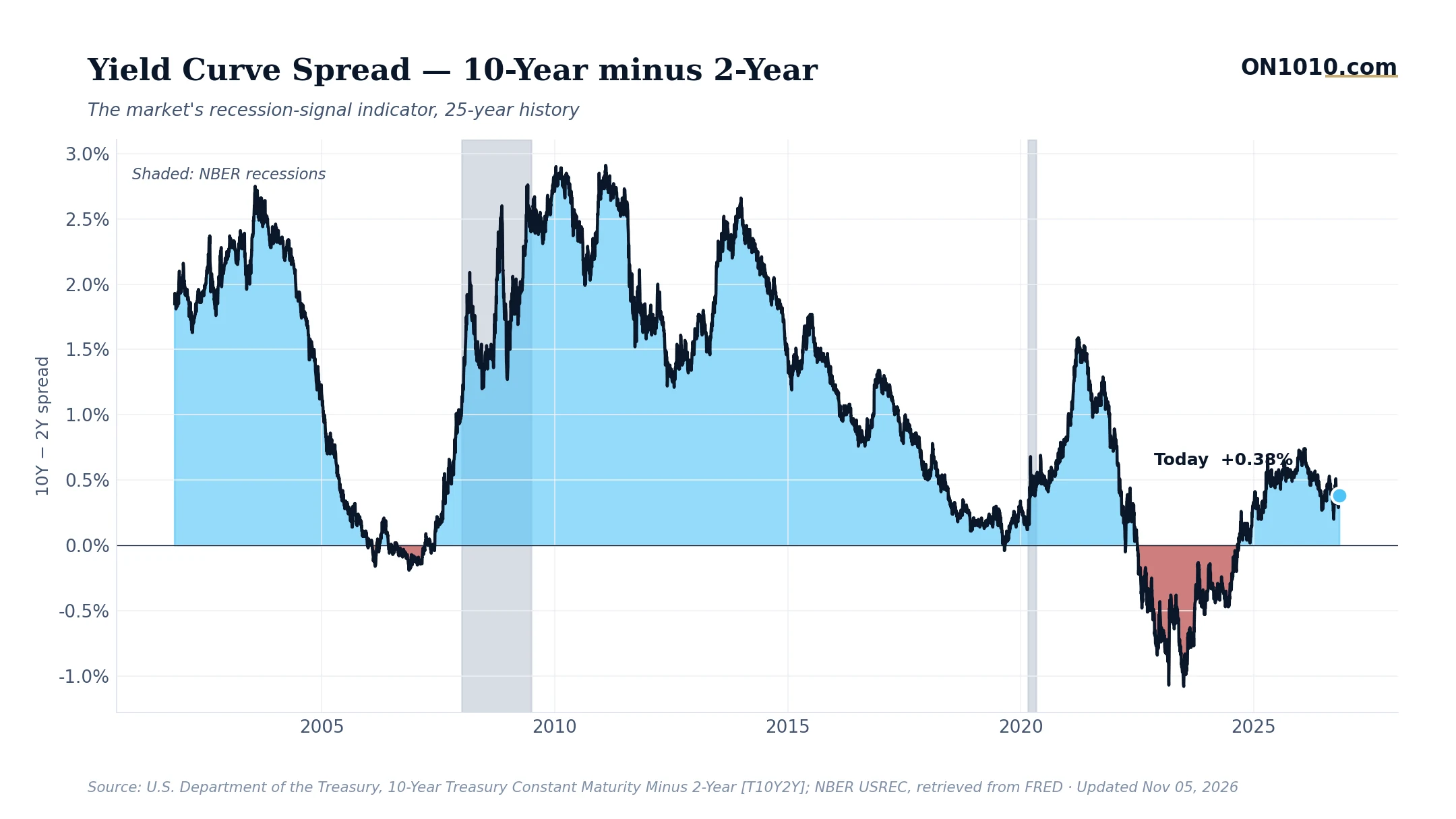
The 10-year/2-year Treasury spread widened to 0.38% on November 5, up from 0.32% the day before. That keeps the curve in positive territory, which sounds like good news. The puzzle is what else the bond market is signaling at the same time.
A positive yield curve means longer-term borrowing costs are higher than short-term ones, the normal state of affairs that rewards lending and encourages banks to extend credit. The curve spent much of 2022 through 2024 inverted, which historically has been one of the most reliable recession warnings in the economist’s toolkit. So a return to positive territory should feel like relief. But at 0.38%, the buffer is thin, and the broader picture around it is complicated.
Long-term rates remain high relative to most of their historical range, and credit spreads have been widening, which means the bond market is demanding more compensation for lending risk. Those two signals together suggest the curve’s positive tilt is being driven partly by stress, not just optimism about growth. When both long rates and credit spreads are elevated simultaneously, it often reflects a market that is uncertain about the path ahead rather than confident in it. Sector rotation in equities is reinforcing that read: defensive sectors like health care and consumer staples have sharply outperformed technology and communication services over the past month, a pattern that tends to appear when institutional money is growing cautious.
Historically, when monetary policy has been this restrictive relative to history, a new recession began within the following year about 18% of the time. When long-term rates have been this elevated, that figure rises to roughly 20%. Neither is the most likely outcome, but both are worth knowing as a base rate.
Bottom Line: The yield curve has normalized, but normalization after a deep inversion has sometimes been a warning sign in its own right: in past cycles, the recession often arrived after the curve re-steepened, not while it was still inverted. The question worth watching is whether this re-steepening reflects genuine growth confidence or a bond market repricing risk in both directions at once.
Source: Federal Reserve Economic Data (FRED)
ON1010 Research is an independent publisher of economic education and is not a registered investment adviser, broker-dealer, or investment company. This content is for educational and informational purposes only and is not investment advice or a recommendation to buy, sell, or hold any security. Published under the publisher exemption recognized by Section 202(a)(11)(D) of the Investment Advisers Act of 1940 (Lowe v. SEC). Always consult a qualified financial professional before making any financial decision.
Free Research
The economy moves fast. We make sure you move faster.
Economic data, policy shifts, and market signals — delivered to your inbox.
Subscribe Free