
The Yield Curve Just Sent a Quiet Warning Nobody’s Talking About
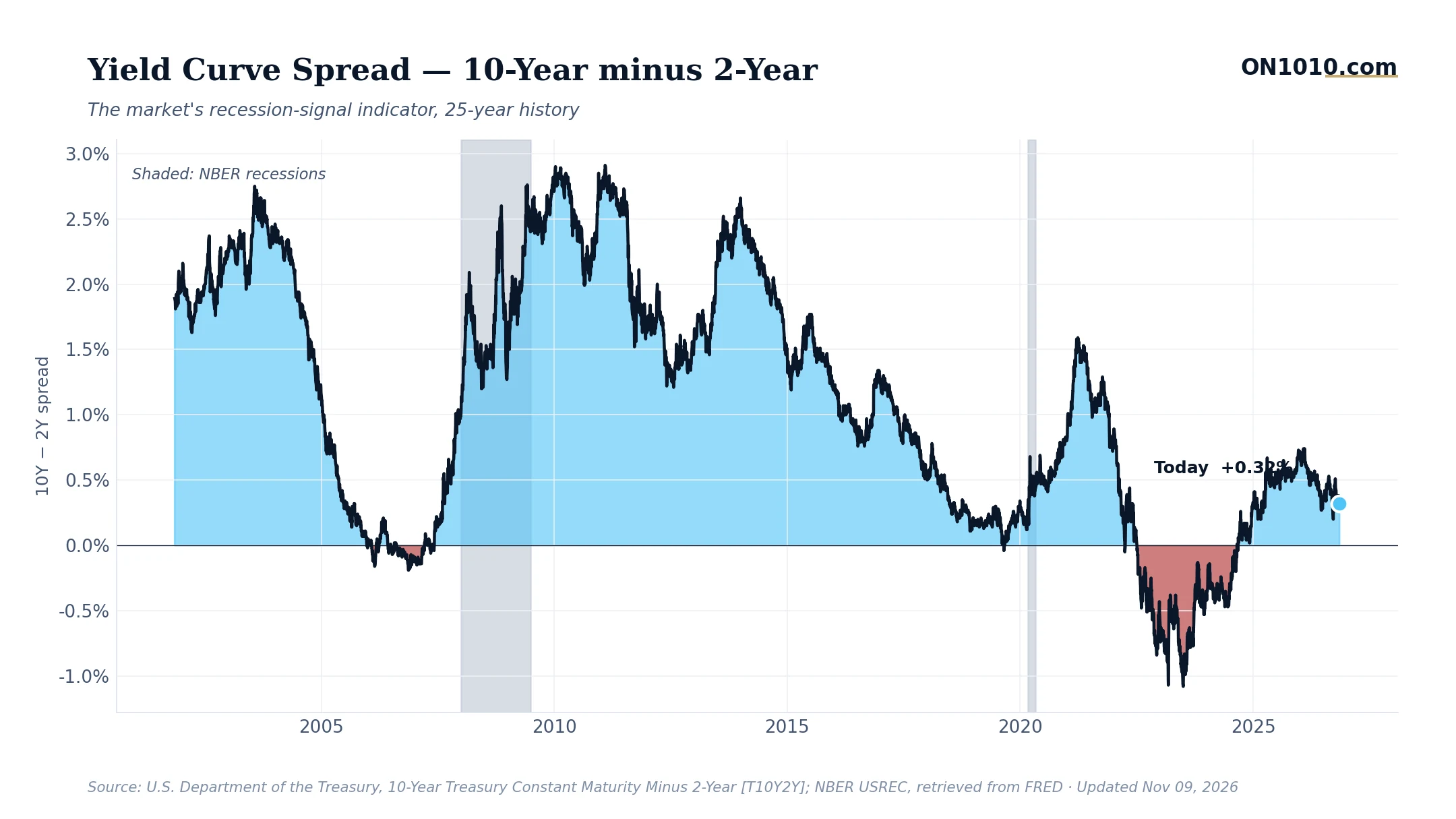
The 10-year/2-year Treasury spread tightened to 0.32% on November 9, down from 0.38% just four days earlier. That three-day slide is small in raw numbers. The direction is what matters.
The yield curve spent most of 2023 and 2024 deeply inverted, with short-term rates running well above long-term ones. The re-steepening that followed looked like a recovery signal. But the curve has stalled in a narrow band, hovering between 0.32% and 0.38% for the past week, unable to push further positive. When re-steepening stalls, it raises a question: is the economy normalizing, or is the bond market starting to price in something softer ahead?
The broader backdrop adds weight to that question. Credit spreads are wide and rising, sitting near the high end of their historical range. Long-term rates are elevated by historical standards and ticking lower, which often reflects growth expectations cooling rather than any policy easing. Consumer sentiment is near multi-decade lows. Meanwhile, sector rotation in equities has been sharply defensive over the past month, with health care, consumer staples, and real estate all running well ahead of technology and growth. When bond markets and equity positioning tell the same story, it pays to listen.
Historically, a yield curve that re-steepens after inversion has sometimes marked the early stages of recovery, and sometimes marked the moment just before economic conditions deteriorated further. The re-steepening has historically been the more dangerous phase, not the inversion itself. In past cycles, business owners and capital allocators have used this window to pressure-test their refinancing timelines, credit access, and demand assumptions, because conditions that look manageable at 0.32% can shift quickly.
Bottom Line: The curve isn’t inverted, but it’s not cleanly positive either. With credit stress rising and growth expectations softening, the question isn’t whether the warning light is on. The question is whether anyone is reading it.
Source: Federal Reserve Economic Data (FRED)
ON1010 Research is an independent publisher of economic education and is not a registered investment adviser, broker-dealer, or investment company. This content is for educational and informational purposes only and is not investment advice or a recommendation to buy, sell, or hold any security. Published under the publisher exemption recognized by Section 202(a)(11)(D) of the Investment Advisers Act of 1940 (Lowe v. SEC). Always consult a qualified financial professional before making any financial decision.
Free Research
The economy moves fast. We make sure you move faster.
Economic data, policy shifts, and market signals — delivered to your inbox.
Subscribe Free