
Oil Is the Headline. Growth Is the Question Nobody’s Asking.
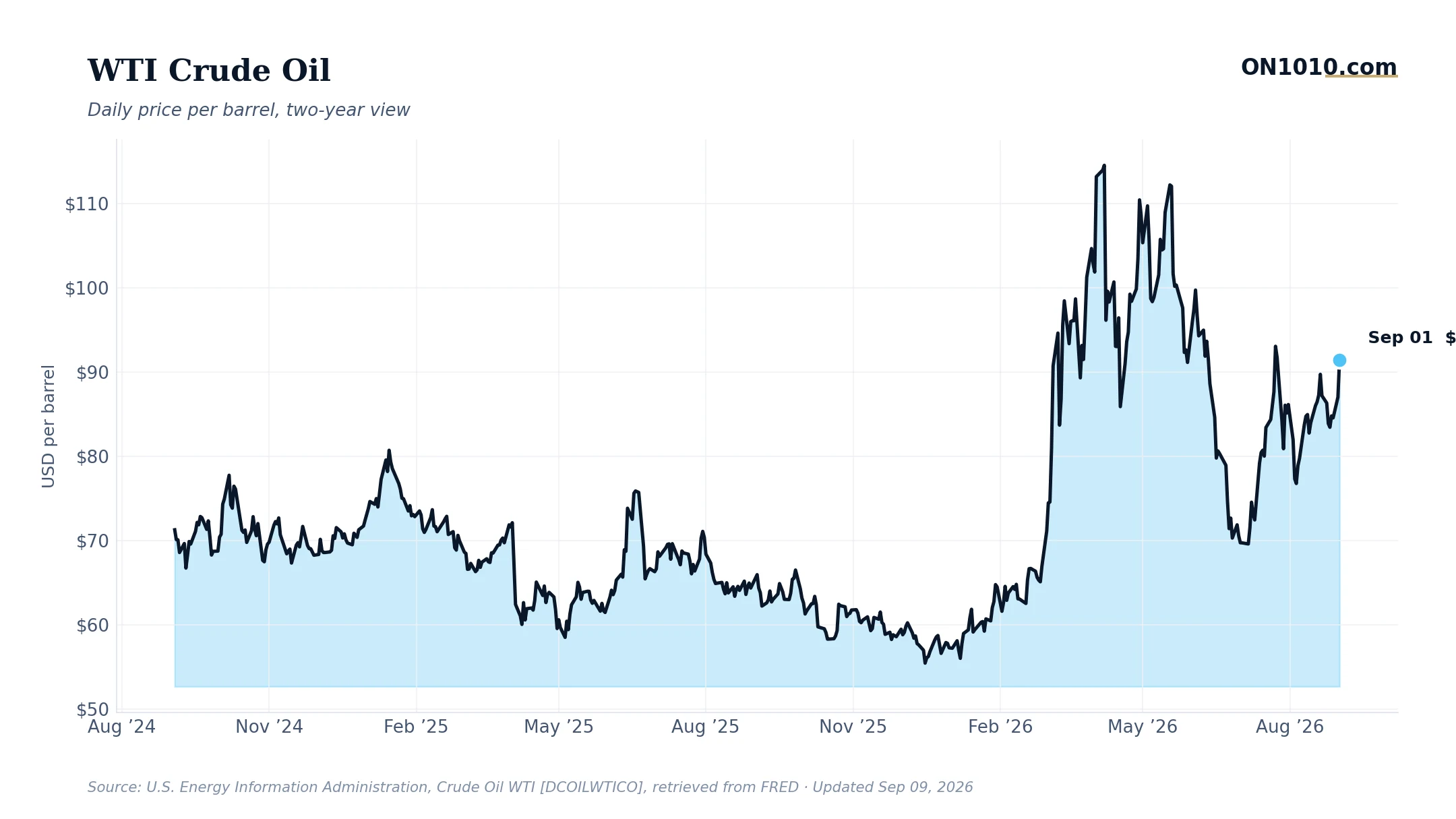
Crude is closing in on $100 a barrel, stocks are sliding, and the financial news cycle is locked onto the Strait of Hormuz. That’s the visible story. The one getting less attention: what does a world of $95 oil, Canadian trade retaliation, and still-elevated rates actually do to the growth trajectory underneath all of it?
What moved. WTI crude closed at $95.04, up $2.01 on the session, as U.S.-Iran exchanges near the Strait of Hormuz continued. Brent crude topped $100, according to recent news reports. The S&P 500 lost 45 points to 7,673, and the Dow dropped 628 points. Gold slipped to $4,437 from $4,515 earlier in the month. The 10-year Treasury yield sits at 4.78%, more than a full percentage point above the top of the Fed’s target range at 3.75%. That gap means the bond market is doing some tightening on its own, independent of anything the Fed decides.
On deck today. No marquee data release is flagged for Wednesday, which makes it a good morning to step back and read the dashboard. Growth gauges are sitting near their historical midpoint and edging lower, while consumer sentiment is near historical lows, credit spreads remain tight, and core inflation is still running hotter than roughly nine of every ten months on record.
Why it matters. When energy costs rise, corporate margins compress from the cost side. When rates stay elevated and consumer sentiment stays weak, revenue growth softens from the demand side. That’s a margin squeeze from both directions, and margins lead employment and investment decisions.
Sunday’s Long View is already digging into the wage-inflation gap and what it means for those same margins. That read is free, and it lands this weekend.
ON1010 Research is an independent publisher of economic education and is not a registered investment adviser, broker-dealer, or investment company. This content is for educational and informational purposes only and is not investment advice or a recommendation to buy, sell, or hold any security. Published under the publisher exemption recognized by Section 202(a)(11)(D) of the Investment Advisers Act of 1940 (Lowe v. SEC). Always consult a qualified financial professional before making any financial decision.
Free Research
The economy moves fast. We make sure you move faster.
Economic data, policy shifts, and market signals — delivered to your inbox.
Subscribe Free