
Factory Output Is Rising. The Speed Is the Problem.
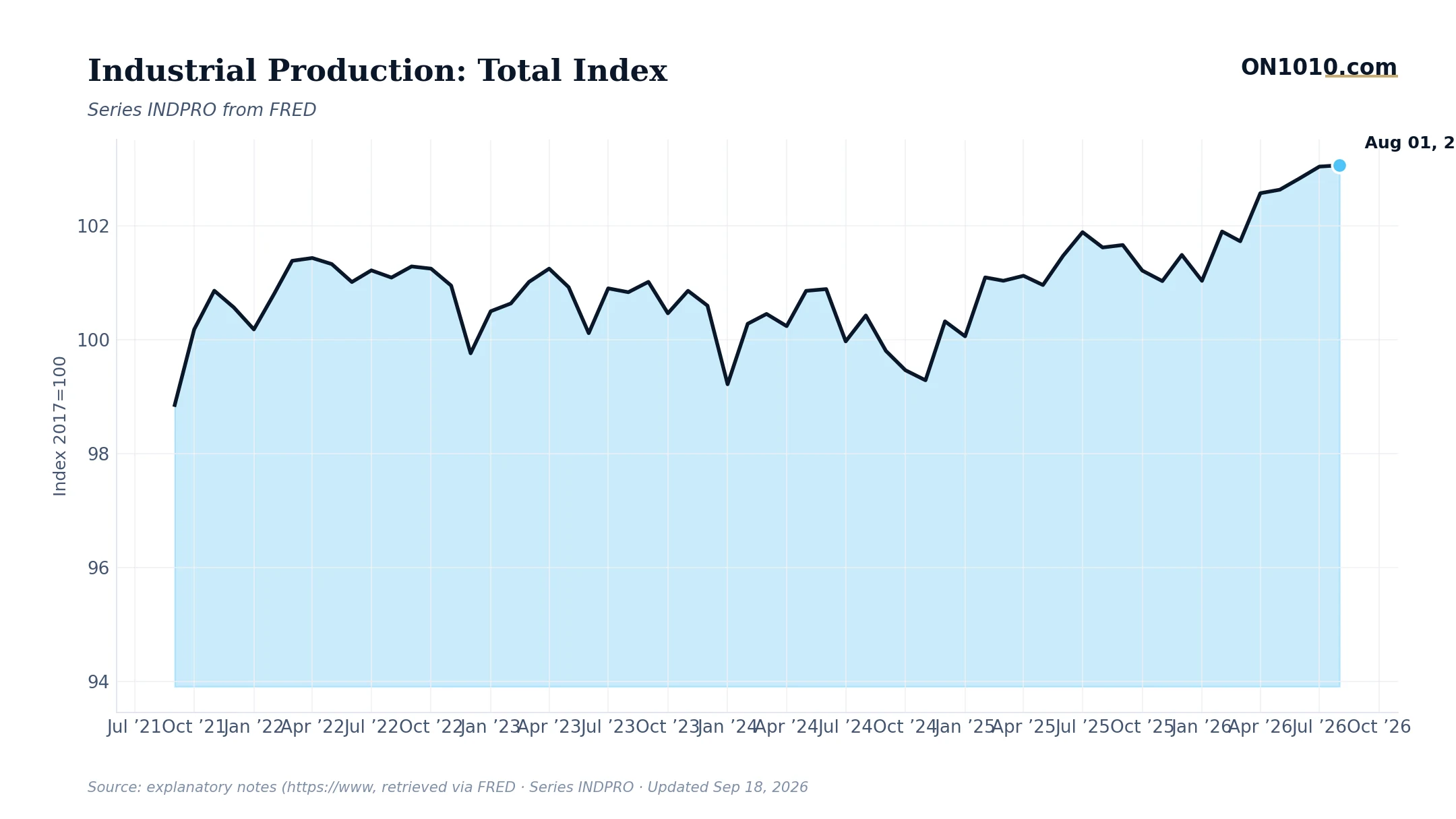
Industrial production edged up 0.02% in August, keeping the index at 103.1 (on a 2017=100 base). The headline looks fine until you zoom out: the U.S. industrial sector has gained only about 1.5 index points over the past six months, a pace that is historically sluggish for an economy that is not in recession.
The broader picture is quietly contradictory. Year over year, industrial output is up 1.83%, which sounds respectable, but it is a slow crawl compared to the productivity gains showing up elsewhere in the economy. Manufacturing is not collapsing. It is grinding. And grinding matters when you consider the backdrop: long-term interest rates are historically high, consumer sentiment is near multi-decade lows even as it ticks upward, and credit spreads remain unusually tight. Businesses can borrow without a credit panic, but the cost of that borrowing is eating into the margin calculations that drive investment decisions. When capital is expensive and demand signals are murky, factory managers tend to hold output steady rather than commit to expansion.
Historically, this kind of slow-drift industrial production, sustained growth that barely moves the needle month to month, has often appeared in the middle innings of a cycle, past the early recovery burst but before either a genuine acceleration or a contraction. In past cycles, investors and capital allocators have watched industrial production alongside new orders and capacity utilization to judge whether the flat pace reflects deliberate inventory management or a genuine lack of demand pulling output forward. The distinction matters enormously for anyone thinking about equipment spending or supply chain commitments.
Bottom Line: The factory sector is holding on, not breaking out. With high interest rates still squeezing the investment calculus and consumer sentiment weak, the question worth asking is what changes the incentive for businesses to finally push output higher, and whether demand catches up before fatigue sets in.
Source: Federal Reserve Economic Data (FRED)
ON1010 Research is an independent publisher of economic education and is not a registered investment adviser, broker-dealer, or investment company. This content is for educational and informational purposes only and is not investment advice or a recommendation to buy, sell, or hold any security. Published under the publisher exemption recognized by Section 202(a)(11)(D) of the Investment Advisers Act of 1940 (Lowe v. SEC). Always consult a qualified financial professional before making any financial decision.
Free Research
The economy moves fast. We make sure you move faster.
Economic data, policy shifts, and market signals — delivered to your inbox.
Subscribe Free