
THE 10-YEAR YIELD IS STUCK IN THE 5% NEIGHBORHOOD.
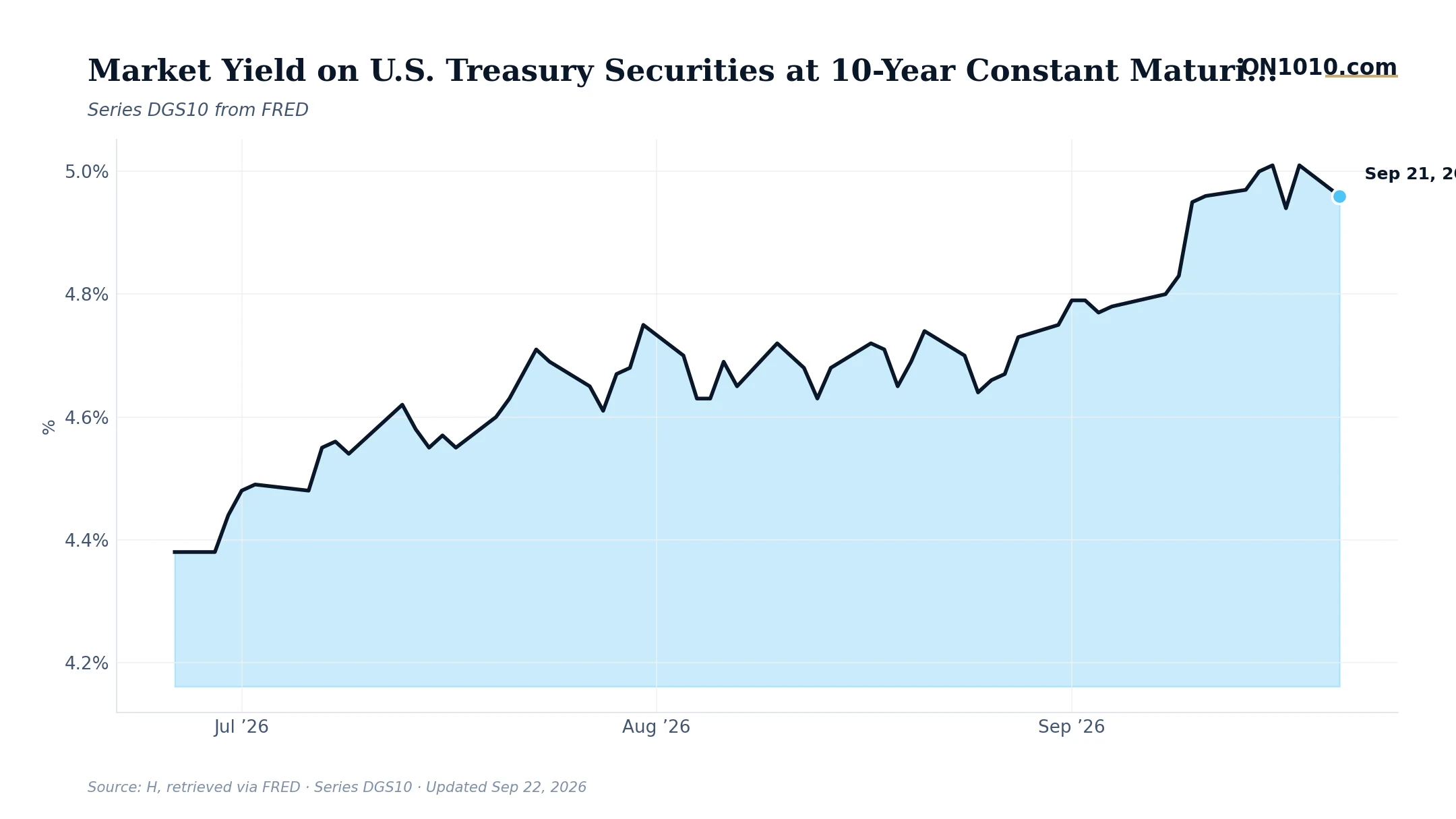
The 10-year Treasury yield closed at 4.96% on September 21, slipping from 5.01% two sessions earlier. But zoom out for a moment: this yield has now traded between 4.94% and 5.01% for the entire past week. The back-and-forth isn’t drift. It’s a market wrestling with whether to commit to a new regime.
Five percent isn’t just a round number psychologically. Historically, it’s where the cost of long-term borrowing starts to visibly alter business behavior. Corporate finance teams running spreadsheets on new projects, warehouse expansions, or acquisitions are working with a benchmark rate that sits in the upper quarter of everything recorded in modern economic history. At the same time, credit spreads across the broader bond market remain unusually tight, meaning companies aren’t being punished with a default premium on top of that base rate. The market is pricing calm, even as the underlying rate environment is historically elevated.
That combination is worth examining carefully. Historically, when long-term rates run this high, a new recession has followed within 12 months roughly 19% of the time. Historically, too, the rate has typically moved lower a year later from this zone. Neither of those is a forecast, just a base rate worth knowing as you think about the environment. With inflation gauges still running hot relative to the historical record, the Fed has limited runway to bring rates down quickly, which means this elevated borrowing cost could be a feature of the landscape for longer than many expect.
For business operators and capital allocators, the practical question is duration. When rates are high and potentially persistent, the gap between short-term and long-term financing decisions widens considerably. In past cycles, companies that locked in long-term debt near rate peaks fared differently than those that rolled short-term paper. A qualified financial professional is the right partner for thinking through how that applies to any specific situation.
Bottom Line: The 10-year yield spent an entire week orbiting 5%, and inflation is still running hot enough that the Fed has real constraints on its ability to pull that rate lower. The question isn’t whether 5% is painful. It’s whether it stays long enough to change how businesses behave at scale.
Source: Federal Reserve Economic Data (FRED)
ON1010 Research is an independent publisher of economic education and is not a registered investment adviser, broker-dealer, or investment company. This content is for educational and informational purposes only and is not investment advice or a recommendation to buy, sell, or hold any security. Published under the publisher exemption recognized by Section 202(a)(11)(D) of the Investment Advisers Act of 1940 (Lowe v. SEC). Always consult a qualified financial professional before making any financial decision.
Free Research
The economy moves fast. We make sure you move faster.
Economic data, policy shifts, and market signals — delivered to your inbox.
Subscribe Free