
The Bond Market’s Inflation Forecast Has Barely Moved in a Week. That Stability Is the Story.
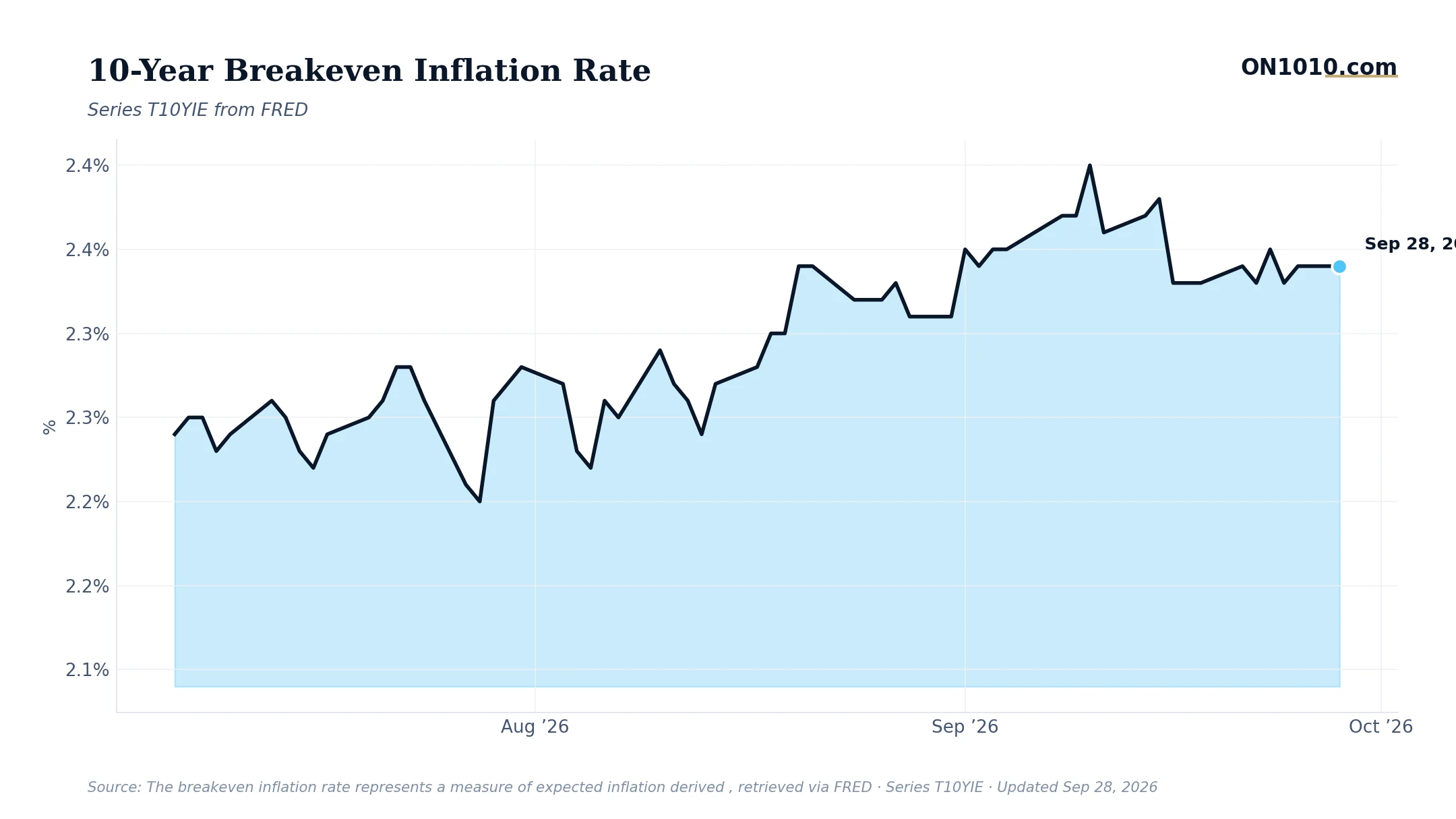
The 10-year breakeven inflation rate has sat at 2.33% to 2.35% all week, closing at 2.34% on September 28. In a world full of tariff headlines, geopolitical noise, and daily market drama, the bond market’s inflation forecast is essentially frozen. That flatness deserves more attention than it gets.
The breakeven rate is what you get when you subtract the yield on inflation-protected Treasuries (TIPS) from the yield on regular Treasuries. It represents what bond investors collectively believe average inflation will run over the next decade. At 2.34%, that number sits just above the Fed’s 2% target, meaning markets aren’t pricing in an inflation problem, but they aren’t fully buying the “mission accomplished” story either.
Here’s where it gets interesting. Core inflation is running well above its historical norm right now. Consumer sentiment is near the bottom of its historical range. Long-term interest rates are sitting in the upper tier of their history, keeping real borrowing costs elevated. Yet the market’s long-run inflation expectation is anchored at 2.34%, barely budging. Either bond investors are confident inflation will normalize, or the signal hasn’t broken yet.
Historically, when breakeven rates hold steady in the 2.3% to 2.5% range while actual inflation remains elevated, it reflects a bet that the forces pushing prices up are temporary. In past cycles, capital allocators have watched whether that bet holds through sustained data surprises. If actual inflation stays hot and breakevens start drifting toward 2.6% or higher, the math on longer-duration financing changes meaningfully, because lenders demand more compensation.
Bottom Line: The bond market is telling you it still believes in the inflation landing. The question is whether incoming data over the next few months gives it a reason to think otherwise.
Source: Federal Reserve Economic Data (FRED)
ON1010 Research is an independent publisher of economic education and is not a registered investment adviser, broker-dealer, or investment company. This content is for educational and informational purposes only and is not investment advice or a recommendation to buy, sell, or hold any security. Published under the publisher exemption recognized by Section 202(a)(11)(D) of the Investment Advisers Act of 1940 (Lowe v. SEC). Always consult a qualified financial professional before making any financial decision.
Free Research
The economy moves fast. We make sure you move faster.
Economic data, policy shifts, and market signals — delivered to your inbox.
Subscribe Free