
The Yield Curve Keeps Narrowing. Here’s Why That’s Worth Watching.
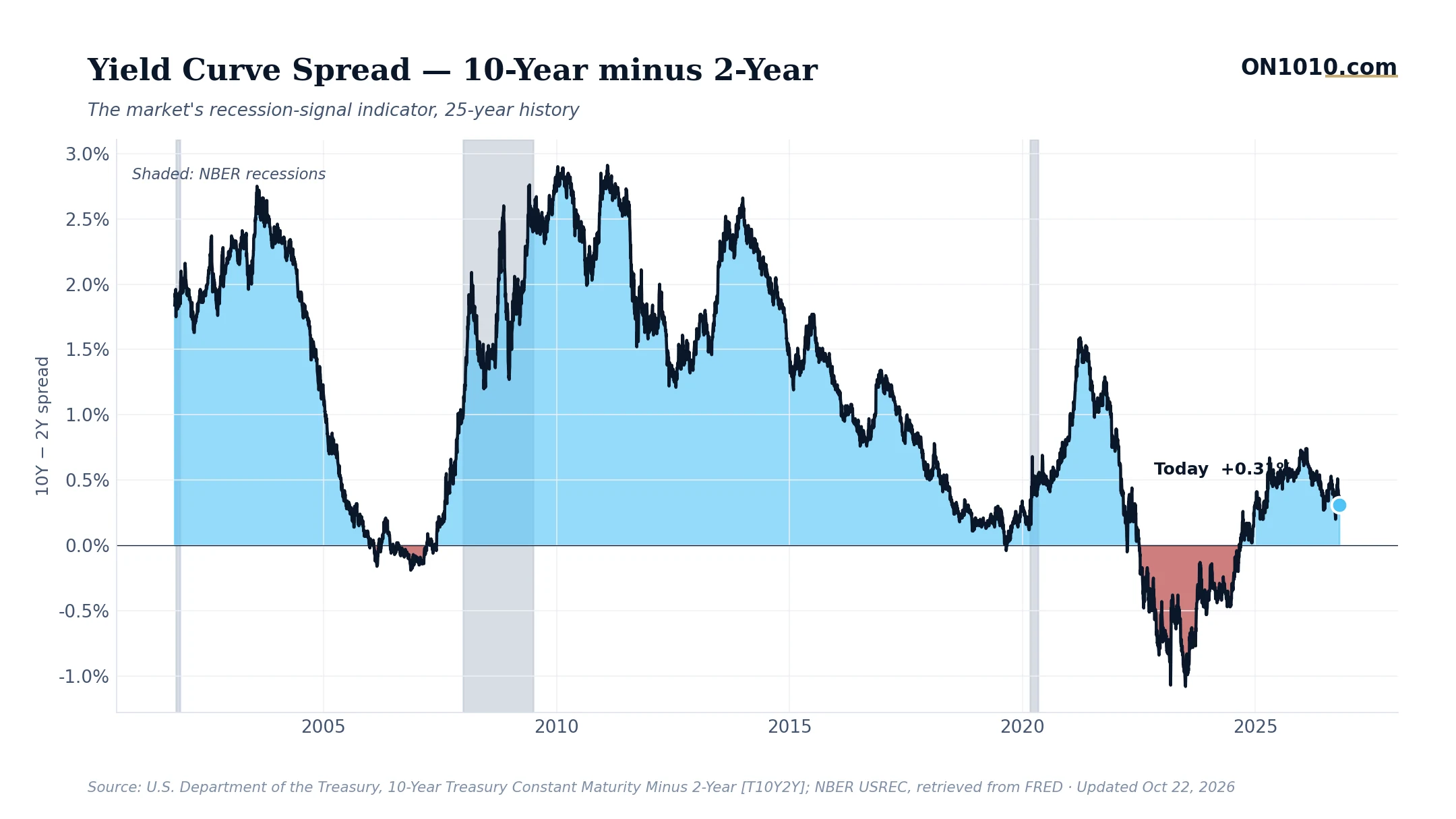
The 10-year minus 2-year Treasury spread ticked down to 0.31% on October 22, from 0.32% the day before. A one-basis-point move sounds trivial. The direction over the past week is less so: the spread has drifted down from 0.38% just six days ago, a quiet but steady narrowing that deserves attention given everything else happening in the background.
The yield curve re-inverted deeply through 2022 and 2023, a historic warning signal. It spent much of 2024 and 2025 climbing back toward positive territory, which historically coincides with the economy absorbing the Fed’s rate hikes. Sitting at 0.31% positive, the spread has technically “un-inverted,” but that corridor is thin. At the same time, credit spreads are widening, consumer sentiment sits near the bottom of its historical range, and monetary policy remains restrictive by historical standards. The bond market is telling a cautious story even as the long-term trend in equities stays technically intact.
One piece of context matters here. Historically, the most economically damaging period has often come not during the inversion itself, but after the curve returns to positive territory, when the lagged effects of tight credit conditions begin to show up in hiring and investment decisions. In past cycles, capital allocators and business planners have used this phase to pressure-test their assumptions about refinancing costs, credit availability, and demand durability.
The sector rotation data reinforces the caution: consumer staples and health care are leading the market, while technology and communication services are lagging. Institutional money is quietly repositioning toward defense. Markets reprice before the economy does.
Bottom Line: A positive yield curve is healthier than a negative one, but 0.31% with a narrowing trend and widening credit spreads is not the same as a wide, confident positive spread. The question worth asking is whether this re-steepening is a clean all-clear, or the early stage of the next phase of the credit cycle.
Source: Federal Reserve Economic Data (FRED)
ON1010 Research is an independent publisher of economic education and is not a registered investment adviser, broker-dealer, or investment company. This content is for educational and informational purposes only and is not investment advice or a recommendation to buy, sell, or hold any security. Published under the publisher exemption recognized by Section 202(a)(11)(D) of the Investment Advisers Act of 1940 (Lowe v. SEC). Always consult a qualified financial professional before making any financial decision.
Free Research
The economy moves fast. We make sure you move faster.
Economic data, policy shifts, and market signals — delivered to your inbox.
Subscribe Free