
The Bond Market’s Inflation Forecast Has Barely Moved in a Week. Here’s Why That’s Telling.
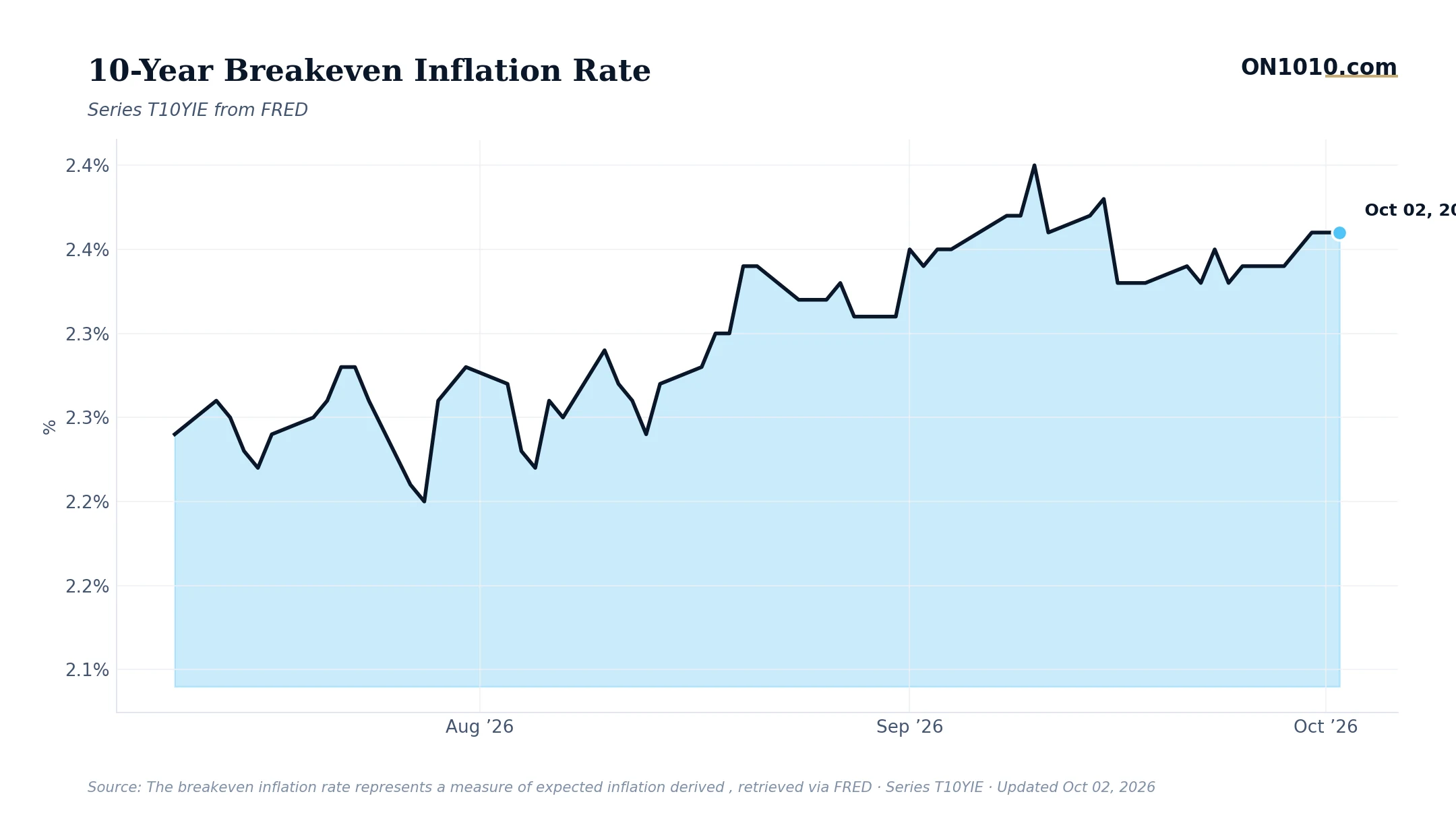
The 10-year breakeven inflation rate has sat at exactly 2.36% for three straight days, after ticking up from 2.34% last week. At first glance, that looks like nothing. But in a week where long-term interest rates are historically elevated and consumer sentiment sits near historical lows, “nothing” is worth examining closely.
The breakeven rate is derived by comparing regular Treasury yields to TIPS (Treasury Inflation-Protected Securities) yields. The gap between them reflects what the bond market collectively expects inflation to average over the next decade. Right now, that number is 2.36%, just above the Fed’s 2% target but not dramatically so. Bond investors, who tend to be less excitable than equity markets, are essentially saying: we believe the Fed will keep inflation close to its goal over the long run. That’s a vote of confidence in the Fed’s credibility, even while core inflation remains hot relative to its own history.
The interesting tension is the backdrop. Monetary policy is running restrictive. Long-term rates are in the upper range of their historical record. And yet the bond market’s long-run inflation expectations have barely budged. In past cycles, when real policy rates ran this high alongside anchored breakevens, it typically meant the market believed the Fed had done enough heavy lifting. Historically, this combination has preceded a drift lower in both short-term rates and inflation. That is the base rate. It is worth knowing, not treating as a guarantee.
For business leaders thinking about long-term financing costs or capital allocation timelines, the breakeven rate is one of the cleaner signals available. When it stays anchored near 2.3% to 2.4% despite tariff uncertainty and fiscal pressures, it suggests the market sees inflation as a solved problem, not an ongoing one. Whether the data eventually proves that right or wrong is a separate question entirely, and one worth revisiting regularly.
Bottom Line: The bond market’s inflation expectations are remarkably calm given how much is happening around them. The question is whether that calm reflects genuine confidence in the Fed, or a market that hasn’t fully priced in what sticky core inflation and elevated rates might mean for the years ahead.
Source: Federal Reserve Economic Data (FRED)
ON1010 Research is an independent publisher of economic education and is not a registered investment adviser, broker-dealer, or investment company. This content is for educational and informational purposes only and is not investment advice or a recommendation to buy, sell, or hold any security. Published under the publisher exemption recognized by Section 202(a)(11)(D) of the Investment Advisers Act of 1940 (Lowe v. SEC). Always consult a qualified financial professional before making any financial decision.
Free Research
The economy moves fast. We make sure you move faster.
Economic data, policy shifts, and market signals — delivered to your inbox.
Subscribe Free