
The 10-Year Treasury Won’t Quit 5%
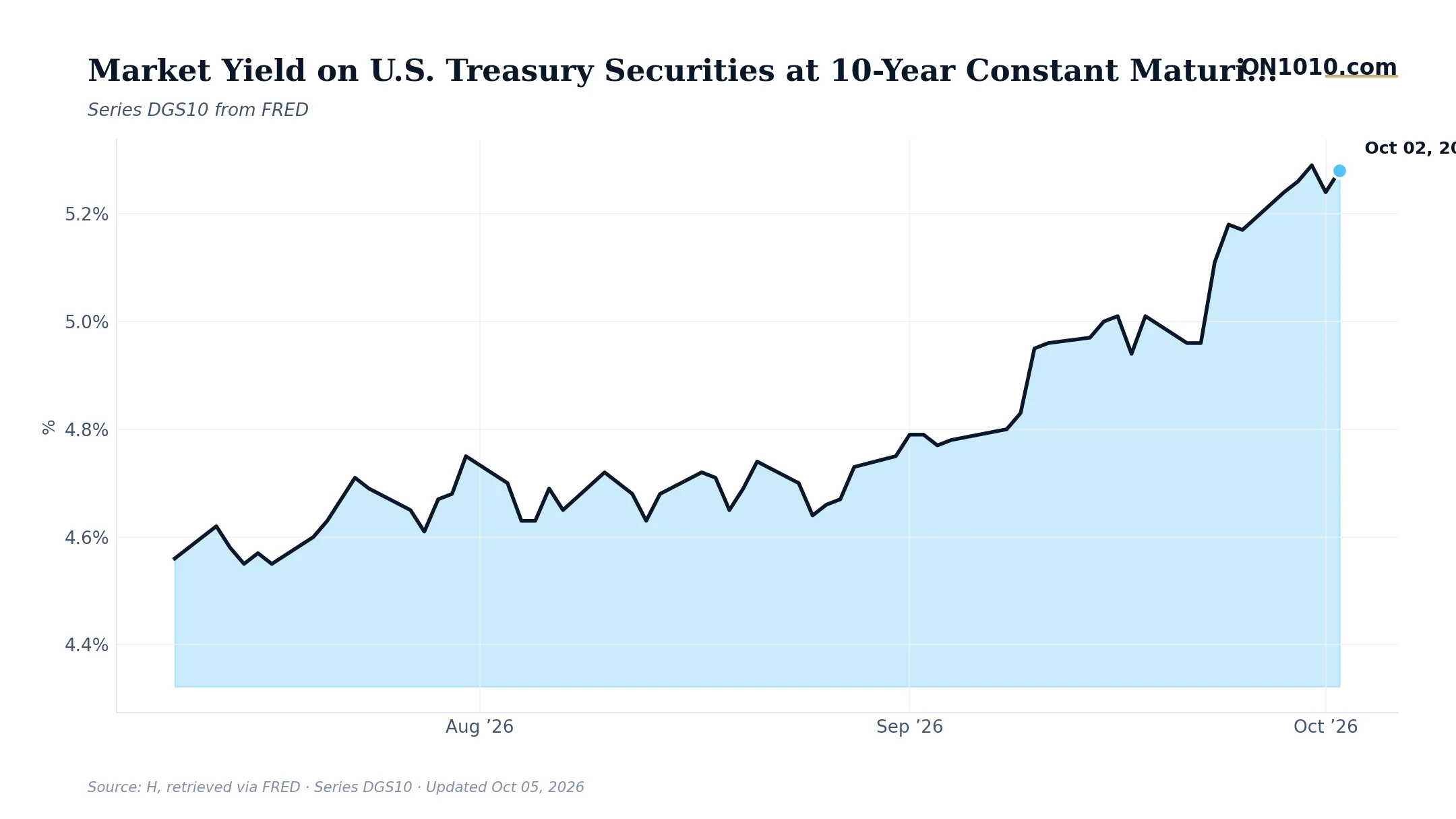
The 10-year Treasury yield rose to 5.28% on October 2, up from 5.24% the day before, and has now held above 5% for a sustained stretch. This isn’t a spike. It’s a floor.
Look at the past week: 5.17%, 5.24%, 5.26%, 5.29%, 5.24%, 5.28%. The range is tight, but the level is stubbornly high. Yields briefly touched 5.29% on September 30, pulled back, and then climbed again. The bond market keeps testing whether 5% is a ceiling or a foundation, and so far the answer keeps coming back the same way.
Here’s the broader context that makes this worth watching. Long-term interest rates are sitting in the upper quarter of their entire historical range. Monetary policy is already restrictive, with the real policy rate elevated against history. Inflation remains hot relative to its own history, even as it edges lower. When you add widening credit spreads on top of that stack, the picture is a financial environment that rewards caution among borrowers and raises the bar for new investment. The economy’s growth gauge sits near its historical midpoint, meaning underlying activity isn’t collapsing, but it also isn’t growing fast enough to easily absorb this cost of capital.
Historically, when long-term rates have held in this zone, a new recession began within the following 12 months about 14% of the time. That is one in seven, not inevitable, but not a footnote either. In past cycles, business operators and capital allocators have paid close attention to how long elevated rates persist, because the damage from high borrowing costs is cumulative. A company that refinances debt at 5%-plus today carries that cost for years. The question isn’t whether this level breaks something immediately. The question is how many balance sheets are quietly absorbing pressure that only shows up later.
Bottom Line: The 10-year yield holding above 5% week after week isn’t dramatic on any given day, but duration compounds. The longer this level persists, the more refinancing decisions, capital projects, and hiring plans get quietly repriced around it.
Source: Federal Reserve Economic Data (FRED)
ON1010 Research is an independent publisher of economic education and is not a registered investment adviser, broker-dealer, or investment company. This content is for educational and informational purposes only and is not investment advice or a recommendation to buy, sell, or hold any security. Published under the publisher exemption recognized by Section 202(a)(11)(D) of the Investment Advisers Act of 1940 (Lowe v. SEC). Always consult a qualified financial professional before making any financial decision.
Free Research
The economy moves fast. We make sure you move faster.
Economic data, policy shifts, and market signals — delivered to your inbox.
Subscribe Free