
The Yield Curve Just Crossed Back Into Positive Territory. Now What?
THE HOOK
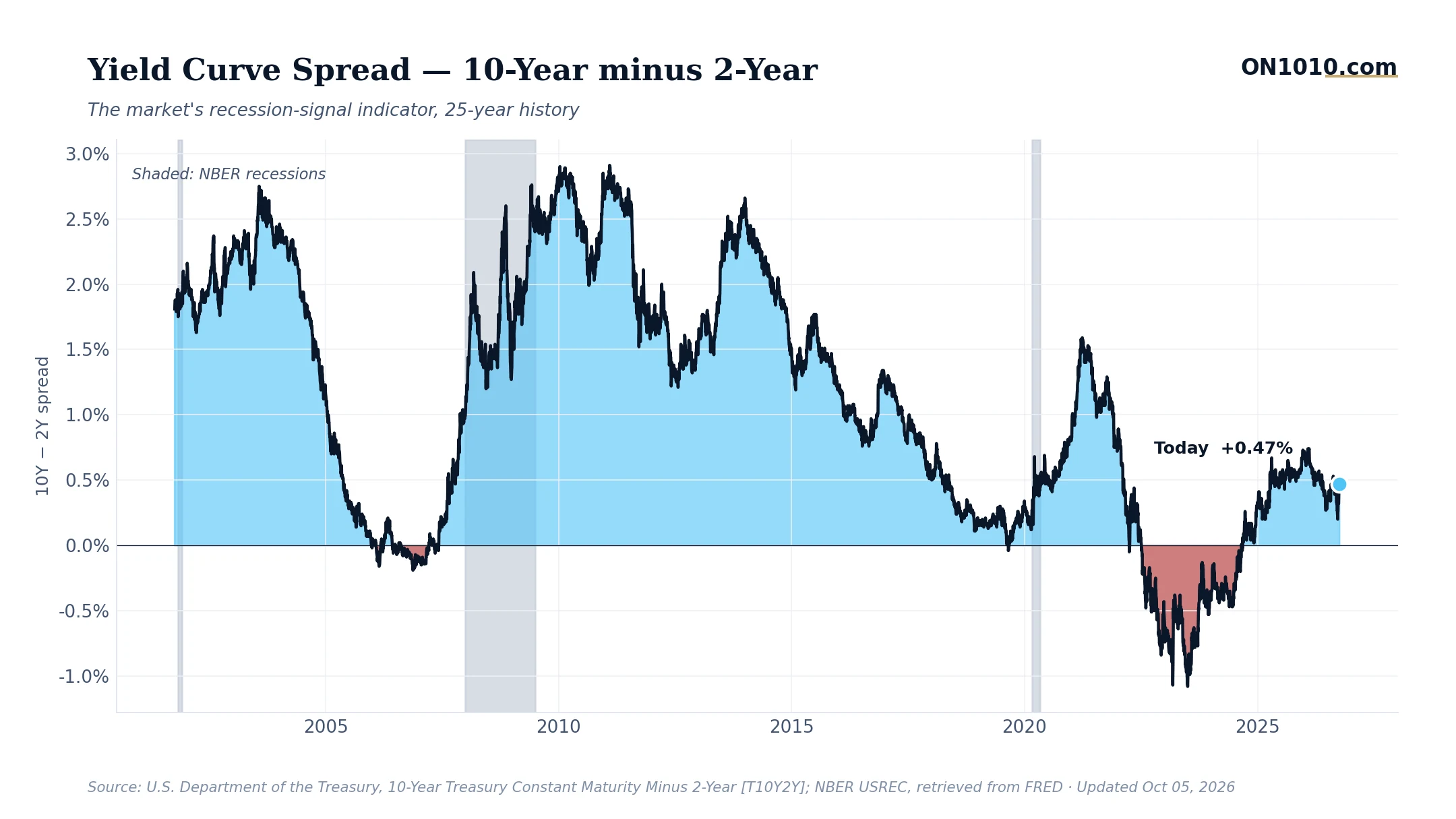
The 10-year minus 2-year Treasury spread hit 0.47% on October 5, its widest reading in over a week and a sharp reversal from just 0.32% on September 28. A move of 15 basis points in seven days is not noise. The curve is steepening fast, and that raises a question worth asking carefully: is this a signal of recovery, or something more complicated?
THE BIGGER PICTURE
The yield curve spent most of 2022 through 2024 inverted, with short-term rates above long-term ones, a configuration that has preceded every U.S. recession since the 1970s. The re-steepening back into positive territory sounds like good news, and sometimes it is. But history adds a catch: the curve often steepens most aggressively right before a recession actually begins, when the Fed starts cutting short-term rates in response to emerging economic weakness. The shape of the move matters as much as the direction.
Today’s broader backdrop makes this harder to read cleanly. Monetary policy is still restrictive by historical standards, long-term rates are sitting in the upper range of their historical norm, credit spreads are wide and rising, and consumer sentiment is near its historical floor. Growth, for now, looks roughly average. That combination puts the steepening curve in a more ambiguous light.
WHY IT MATTERS
Historically, a steepening curve after a prolonged inversion has meant two very different things depending on what drove it. When long-term rates rise because investors expect stronger growth and inflation ahead, the steepening tends to be followed by expanding margins and rising business investment. When short-term rates fall because the Fed is easing into weakness, the steepening has sometimes preceded the most painful part of the cycle. In past cycles, business leaders and capital allocators have paid close attention to which dynamic is driving the move before drawing any conclusions about financing conditions or investment timing.
Bottom Line: The curve’s rapid steepening since late September deserves attention, but direction alone does not tell the story. The question worth tracking: are long rates rising because the economy looks stronger, or are short rates about to fall because it doesn’t?
Source: Federal Reserve Economic Data (FRED)
ON1010 Research is an independent publisher of economic education and is not a registered investment adviser, broker-dealer, or investment company. This content is for educational and informational purposes only and is not investment advice or a recommendation to buy, sell, or hold any security. Published under the publisher exemption recognized by Section 202(a)(11)(D) of the Investment Advisers Act of 1940 (Lowe v. SEC). Always consult a qualified financial professional before making any financial decision.
Free Research
The economy moves fast. We make sure you move faster.
Economic data, policy shifts, and market signals — delivered to your inbox.
Subscribe Free