
The Yield Curve Just Turned Positive Again. Here’s Why That’s More Complicated Than It Sounds.
THE HOOK
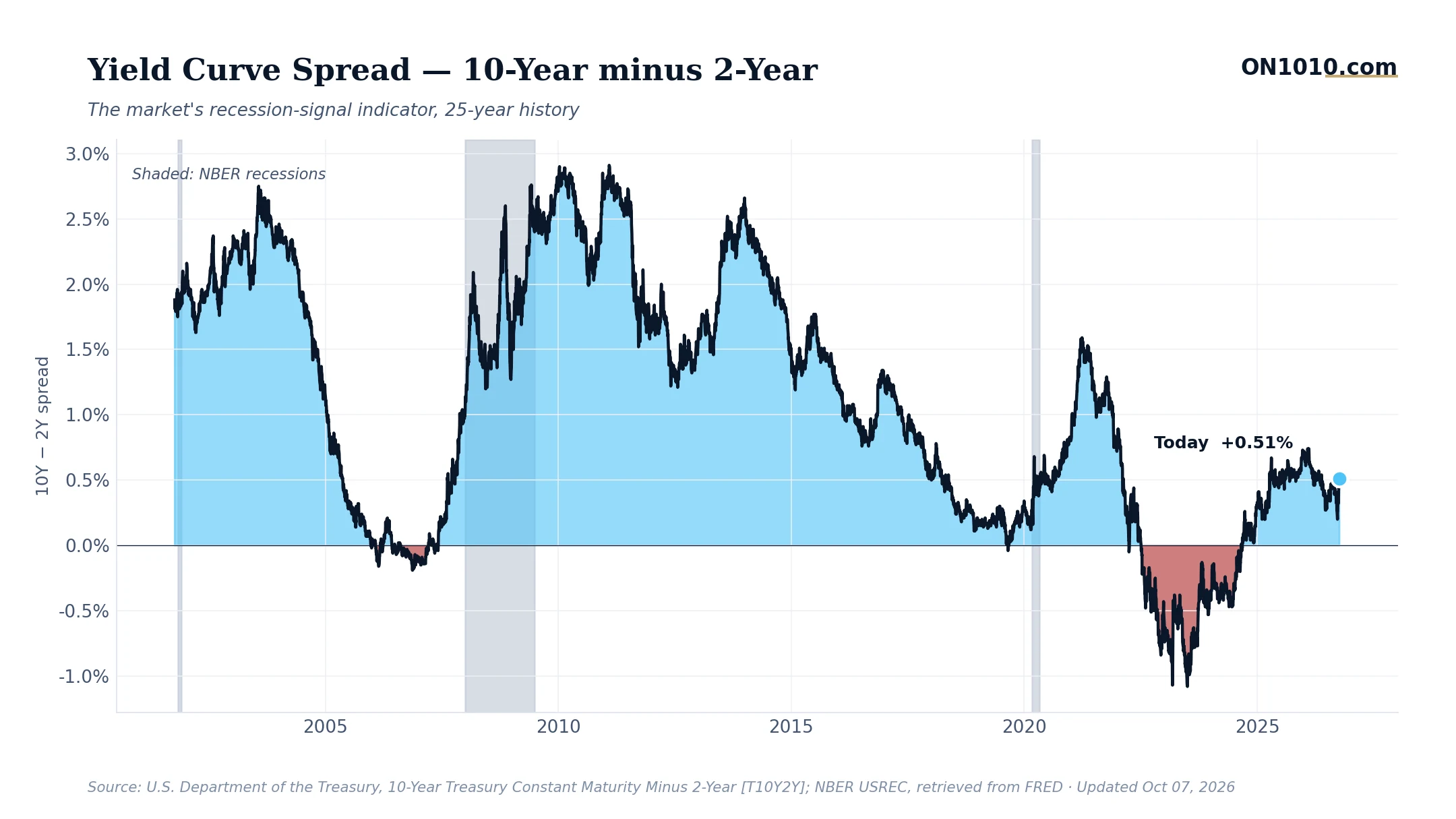
The 10-year minus 2-year Treasury spread hit 0.51% on October 7, its widest positive gap in this recent stretch, up from 0.41% just a week ago. On the surface, that looks like good news. A positive spread means the curve is no longer inverted, which historically has been associated with recession risk. The complication is that the return to positive territory has its own troubling track record.
THE BIGGER PICTURE
The yield curve spent much of 2022 through 2024 deeply inverted, with short-term rates running well above long-term rates. That inversion reflected a Fed that was aggressively raising rates to fight inflation. Now that the spread has climbed back into positive territory, many observers are calling it an all-clear. History pushes back on that read. In past cycles, the curve often steepened sharply right before recessions began, as the Fed started cutting short-term rates in response to a weakening economy. The steepening itself was the warning sign, not the relief signal. Add to that: the economy’s gauges show monetary policy still running restrictive relative to history, inflation still running hot, and consumer sentiment near historic lows. That is not the profile of an economy that just cleared the hurdle.
WHY IT MATTERS
In past cycles, investors and business operators have paid close attention to how the curve steepened, not just whether it did. A curve that steepens because long-term growth expectations are rising feels very different from one steepening because short rates are falling on recession fears. The mechanism matters enormously for how capital costs behave. Historically, when monetary policy was running restrictive and the curve was re-steepening simultaneously, businesses extending long-duration commitments (equipment, real estate, debt refinancing) faced meaningful repricing risk if the economic picture shifted.
Bottom Line: The yield curve returning to positive territory is a milestone, but the question worth carrying forward is this: is this spread widening because the economy is getting stronger, or because the bond market is pricing in rate cuts it expects the Fed will need to make?
Source: Federal Reserve Economic Data (FRED)
ON1010 Research is an independent publisher of economic education and is not a registered investment adviser, broker-dealer, or investment company. This content is for educational and informational purposes only and is not investment advice or a recommendation to buy, sell, or hold any security. Published under the publisher exemption recognized by Section 202(a)(11)(D) of the Investment Advisers Act of 1940 (Lowe v. SEC). Always consult a qualified financial professional before making any financial decision.
Free Research
The economy moves fast. We make sure you move faster.
Economic data, policy shifts, and market signals — delivered to your inbox.
Subscribe Free