
THE Job Market’s Quiet Strength Is Starting to Look Loud
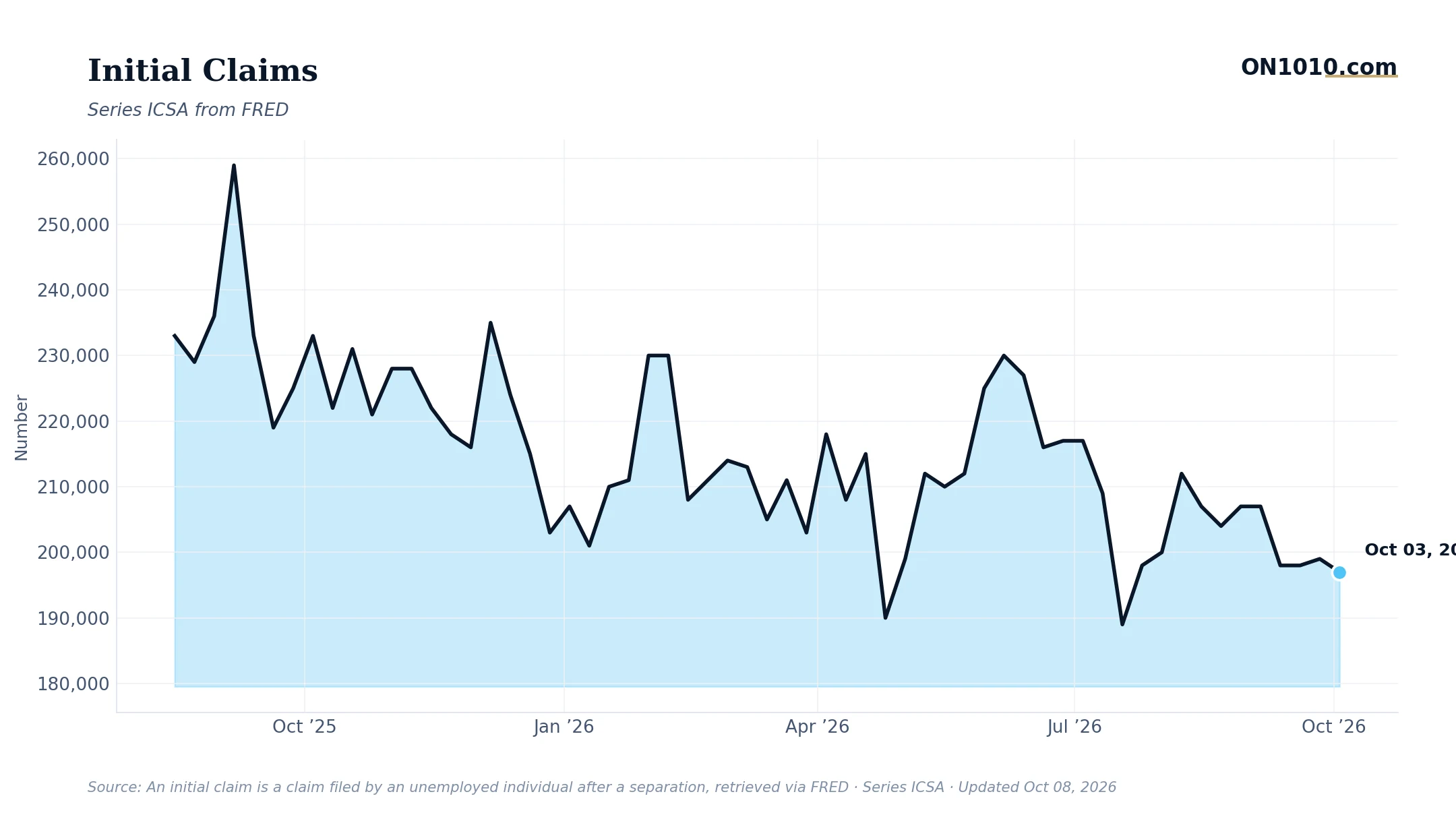
Initial jobless claims fell to 197,000 for the week ending October 3, the lowest reading in this recent stretch and the third consecutive week below 200,000. The number people keep waiting to crack hasn’t cracked.
Six weeks ago, claims were running at 207,000. They’ve since dropped 10,000 and appear to be settling into a tighter range. When you smooth the last three weeks together, you get roughly 198,000 claims per week. That’s a labor market where layoffs are genuinely scarce by any historical comparison.
Here’s the tension: consumer sentiment is near its weakest levels in history, long-term interest rates are historically high, and monetary policy is restrictive by the measure of what’s come before. Yet employers are holding onto workers as if they expect the next contract to be their best one. These signals don’t usually point in the same direction at once. When they diverge this sharply, one of them is typically early.
Historically, when layoffs stay this low while borrowing costs are elevated, it often means corporate margins haven’t compressed enough to force the hard decisions yet. Companies cut costs in a specific order: first they freeze hiring, then they let go of contractors, then they start touching the permanent workforce. Low claims tell us that third stage hasn’t arrived. The question for business operators and capital allocators is whether margins can hold long enough to avoid it. That answer lives in Q3 earnings season, which is arriving now.
Worth noting: credit conditions, which had been steady, are now showing a falling reading. Tightening credit alongside strong employment is a combination that has historically resolved in one of two directions. Growth holds and credit stabilizes, or credit tightens further and the labor market eventually follows.
Bottom Line: A labor market holding this firm against this much rate pressure is either a sign of unusual resilience or a sign the pressure just hasn’t landed yet. Earnings season will start telling us which story is true.
Source: Federal Reserve Economic Data (FRED)
ON1010 Research is an independent publisher of economic education and is not a registered investment adviser, broker-dealer, or investment company. This content is for educational and informational purposes only and is not investment advice or a recommendation to buy, sell, or hold any security. Published under the publisher exemption recognized by Section 202(a)(11)(D) of the Investment Advisers Act of 1940 (Lowe v. SEC). Always consult a qualified financial professional before making any financial decision.
Free Research
The economy moves fast. We make sure you move faster.
Economic data, policy shifts, and market signals — delivered to your inbox.
Subscribe Free