
The Yield Curve Just Gave Back a Week of Progress
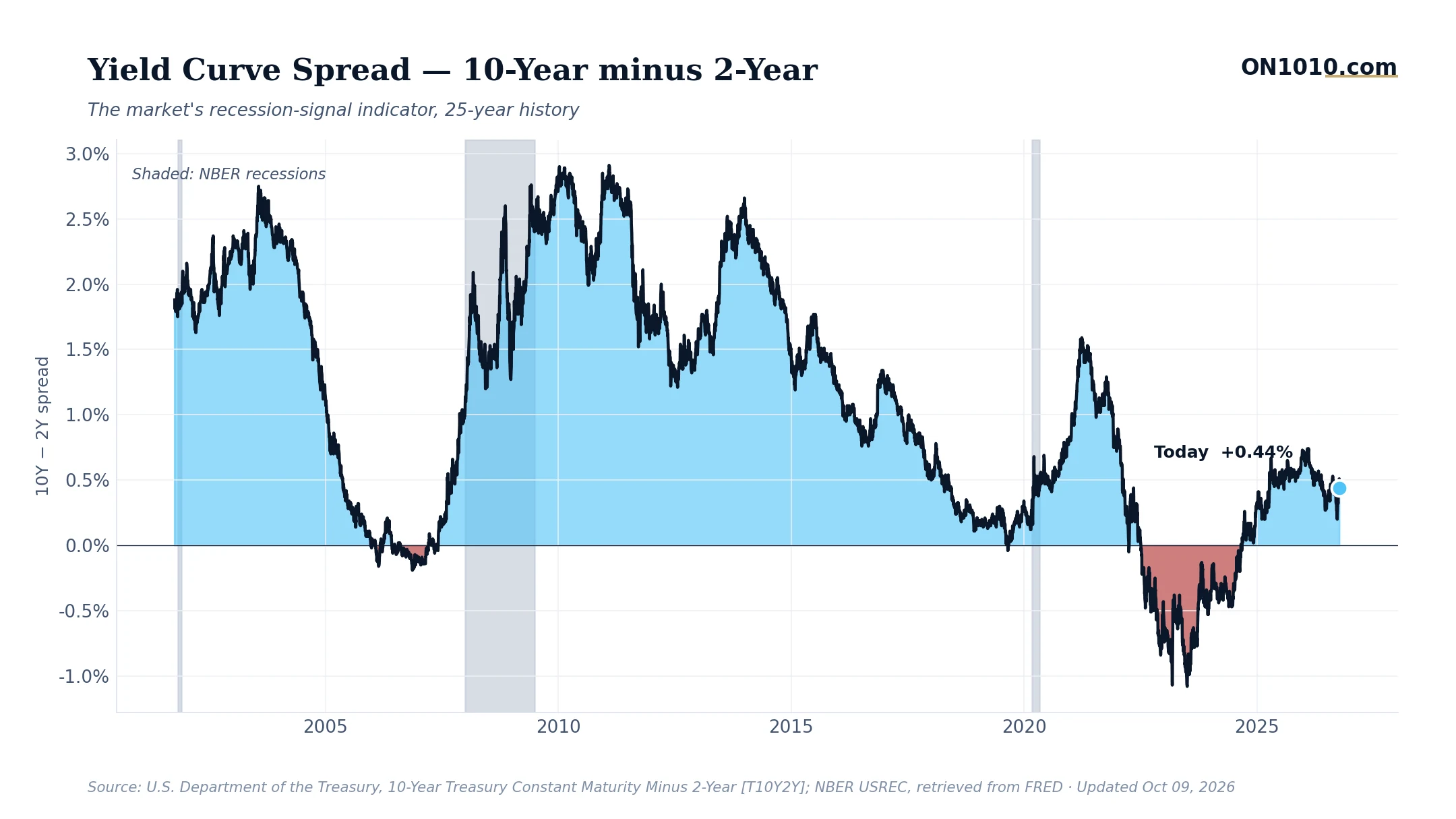
The 10-year/2-year Treasury spread slipped to 0.44% on Friday, down from 0.51% earlier in the week. A small move on paper, but directionally meaningful after months of slow, hard-won normalization.
The Bigger Picture
The spread spent most of 2023 and 2024 deeply inverted, with short-term rates running well above long-term ones. That inversion has since corrected, and the curve has been positive since mid-2025. But “positive” and “healthy” are not the same thing. At 0.44%, the gap between what the market expects in the short run versus the long run is still thin by historical standards, and this week’s drift lower is a reminder that re-steepening rarely runs in a straight line.
The broader backdrop matters here. Real policy rates are high versus history. Long-term rates are in the upper quarter of their historical range. Consumer sentiment is near historical lows. Put those together, and you have an economy where the yield curve’s slow normalization is doing real work, signaling that markets see some easing ahead, but the path is bumpy and the spread remains fragile.
Why It Matters
Historically, when the curve re-steepens after a deep inversion, business and lending conditions tend to improve with a lag, sometimes 6 to 12 months behind the curve itself. In past cycles, business leaders and capital allocators have watched the speed and durability of that re-steepening as a signal of how much runway the expansion has. A spread that stalls or reverses before reaching more historically normal levels (typically 1.0% to 1.5%) has sometimes indicated that the recovery was shallower than expected. Past performance does not predict future results, but the direction of travel has mattered as much as the level.
Bottom Line: The yield curve’s normalization is intact but fragile. The question to keep asking is whether this re-steepening holds and builds, or whether it stalls here, where the cushion against renewed inversion is thinner than it looks.
Source: Federal Reserve Economic Data (FRED)
ON1010 Research is an independent publisher of economic education and is not a registered investment adviser, broker-dealer, or investment company. This content is for educational and informational purposes only and is not investment advice or a recommendation to buy, sell, or hold any security. Published under the publisher exemption recognized by Section 202(a)(11)(D) of the Investment Advisers Act of 1940 (Lowe v. SEC). Always consult a qualified financial professional before making any financial decision.
Free Research
The economy moves fast. We make sure you move faster.
Economic data, policy shifts, and market signals — delivered to your inbox.
Subscribe Free