
The Strait of Hormuz Is Choking Again. Here’s What That Does to Business Margins.
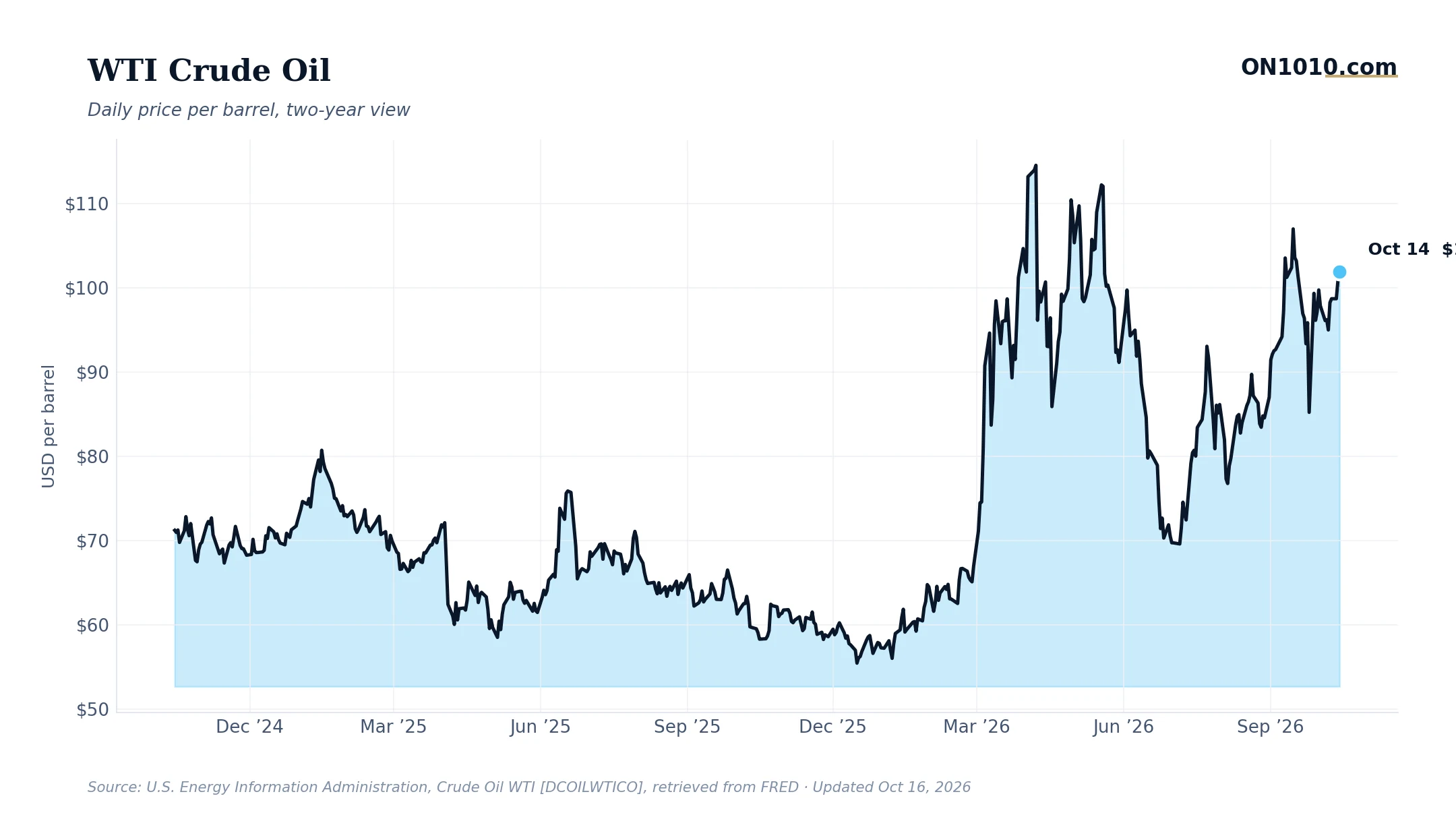
According to CNBC, Brent crude touched $110 a barrel Friday as Iran escalated attacks in the Strait of Hormuz while Ukraine separately vowed to strike Russian oil refineries. Two of the world’s most critical energy chokepoints are under pressure at the same time.
The Strait of Hormuz carries roughly 20% of global seaborne oil. When that corridor becomes unpredictable, tanker insurance costs spike, shipping routes lengthen, and the base cost of moving energy around the planet rises overnight. Higher energy costs are essentially a tax on every business that makes, moves, or heats anything. The question isn’t just what happens to the price at the pump. The question is what happens to corporate profit margins at a moment when they can least absorb the hit.
That timing matters. The economic backdrop already shows core inflation running in the upper range of its historical history, and monetary policy is restrictive, with the real policy rate sitting above its long-run average. Credit spreads have been widening. Consumer sentiment is near historical lows. An energy spike landing on top of this setup doesn’t have to be catastrophic to create real friction. Even a sustained move in oil from, say, $85 to $110 is enough to compress margins in transportation, manufacturing, chemicals, and retail simultaneously, which is exactly when companies start reconsidering hiring plans and capital expenditure budgets.
Historically, investors have treated oil shocks as a margin-compression signal first and a growth signal second. The sequence tends to run: energy costs rise, input costs follow, pricing power gets tested, and companies with thin margins blink first. In past geopolitical energy episodes, the severity of the economic effect correlated less with the headline price spike and more with how long elevated prices persisted. A one-week flare followed by de-escalation rarely moved the needle on corporate earnings. A sustained disruption that lasted a quarter or more did. The unanswered question right now is which scenario this becomes.
Sector rotation data from Friday shows defensive sectors, particularly health care and consumer staples, pulling ahead of the broader market. Credit conditions have tightened since the prior reading. These aren’t conclusions, but they are the kinds of signals worth watching alongside the oil price as this develops.
Bottom Line: Oil at $110 on a geopolitical shock is manageable if it’s brief. Layered on top of already restrictive monetary policy, widening credit spreads, and compressed consumer sentiment, a sustained energy disruption has a clear path to biting into the margins that drive hiring and investment decisions.
Read more: CNBC Top News
ON1010 Research is an independent publisher of economic education and is not a registered investment adviser, broker-dealer, or investment company. This content is for educational and informational purposes only and is not investment advice or a recommendation to buy, sell, or hold any security. Published under the publisher exemption recognized by Section 202(a)(11)(D) of the Investment Advisers Act of 1940 (Lowe v. SEC). Always consult a qualified financial professional before making any financial decision.
Free Research
The economy moves fast. We make sure you move faster.
Economic data, policy shifts, and market signals — delivered to your inbox.
Subscribe Free