
The Yield Curve Is Positive Again. That’s Actually the Complicated Part.
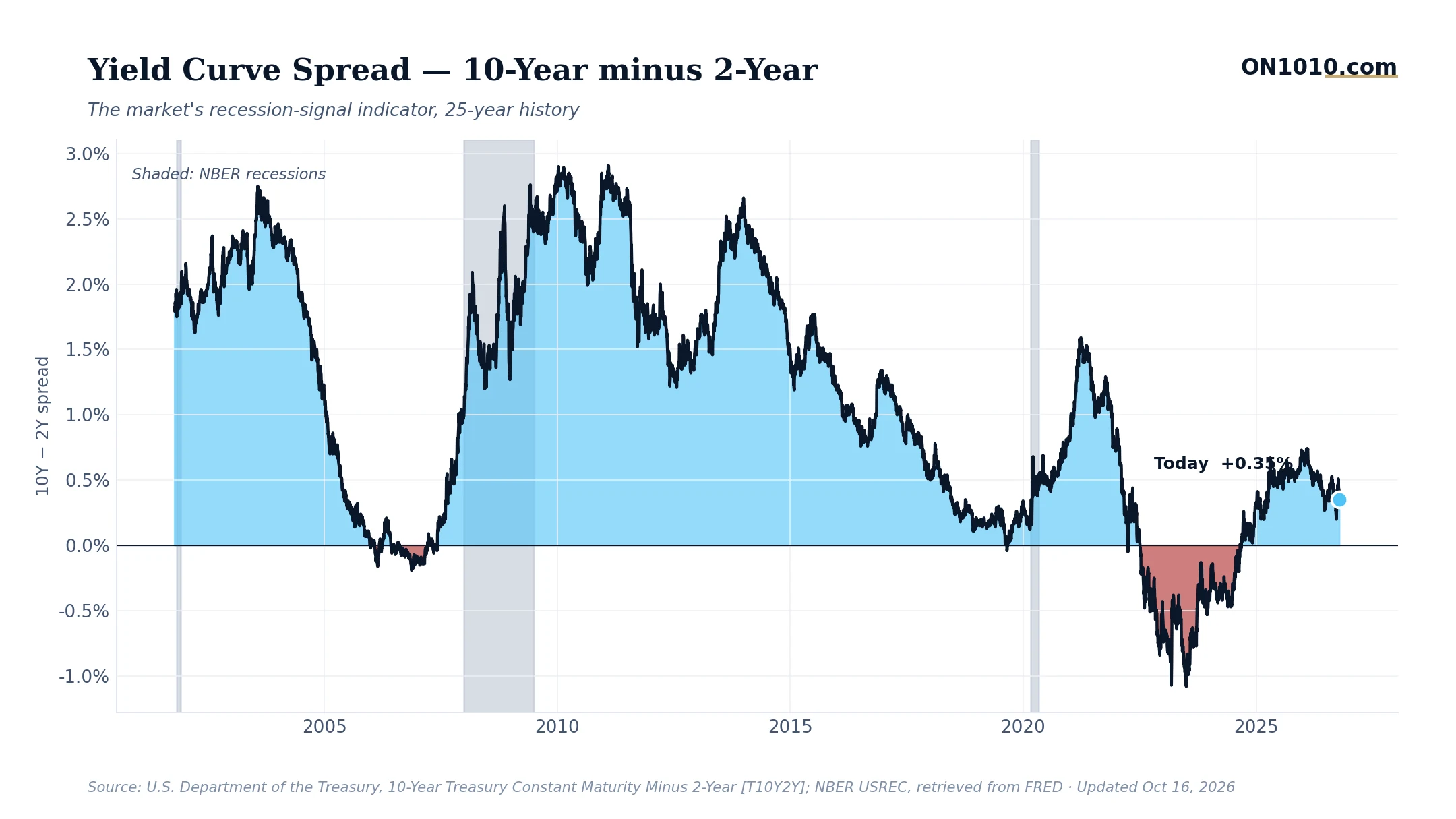
The 10-year/2-year Treasury spread sits at 0.35% as of October 16, a small uptick from 0.33% the day before. The curve has been positive for a while now, fully un-inverted after spending most of 2023 and 2024 deep in negative territory. But here’s what most coverage misses: a positive spread isn’t automatically a green light.
The yield curve’s return to positive slope has been read by many as an “all-clear.” History suggests more caution is warranted. The classic recession signal from an inverted yield curve fires not during the inversion itself, but after the curve steepens back toward zero and beyond. The economy tends to hit its roughest patch in the 6-to-18 months following re-steepening, as the delayed effects of tight monetary policy work their way through business lending, hiring decisions, and capital spending. This cycle’s inversion was deep and long. The lag effects may not be fully visible yet.
The surrounding signals reinforce that caution. Long-term interest rates sit near the upper end of their historical range, keeping financing costs elevated for businesses. Credit spreads have widened recently, a sign that lenders are asking for more compensation to take on risk. Consumer sentiment remains historically weak. And sector rotation data shows health care and consumer staples quietly outperforming the broader market, exactly the kind of defensive posture institutional money has historically adopted when uncertainty is building beneath the surface.
Historically, this type of setup, a recently re-steepened curve paired with restrictive monetary policy and widening credit spreads, has prompted business leaders to think carefully about the timing of long-term capital commitments and refinancing decisions. In past cycles, the period right after the curve turns positive has sometimes looked like recovery while credit stress was still accumulating. Past performance does not predict future results, and a qualified financial professional should be part of any decision involving capital allocation.
Bottom Line: A positive yield curve is better than a negative one, but the questions worth asking now are: where is credit stress building, and how much runway does this expansion actually have before the long inversion’s consequences fully arrive?
Source: Federal Reserve Economic Data (FRED)
ON1010 Research is an independent publisher of economic education and is not a registered investment adviser, broker-dealer, or investment company. This content is for educational and informational purposes only and is not investment advice or a recommendation to buy, sell, or hold any security. Published under the publisher exemption recognized by Section 202(a)(11)(D) of the Investment Advisers Act of 1940 (Lowe v. SEC). Always consult a qualified financial professional before making any financial decision.
Free Research
The economy moves fast. We make sure you move faster.
Economic data, policy shifts, and market signals — delivered to your inbox.
Subscribe Free