
The Bond Market’s Inflation Verdict: Steady at 2.35%
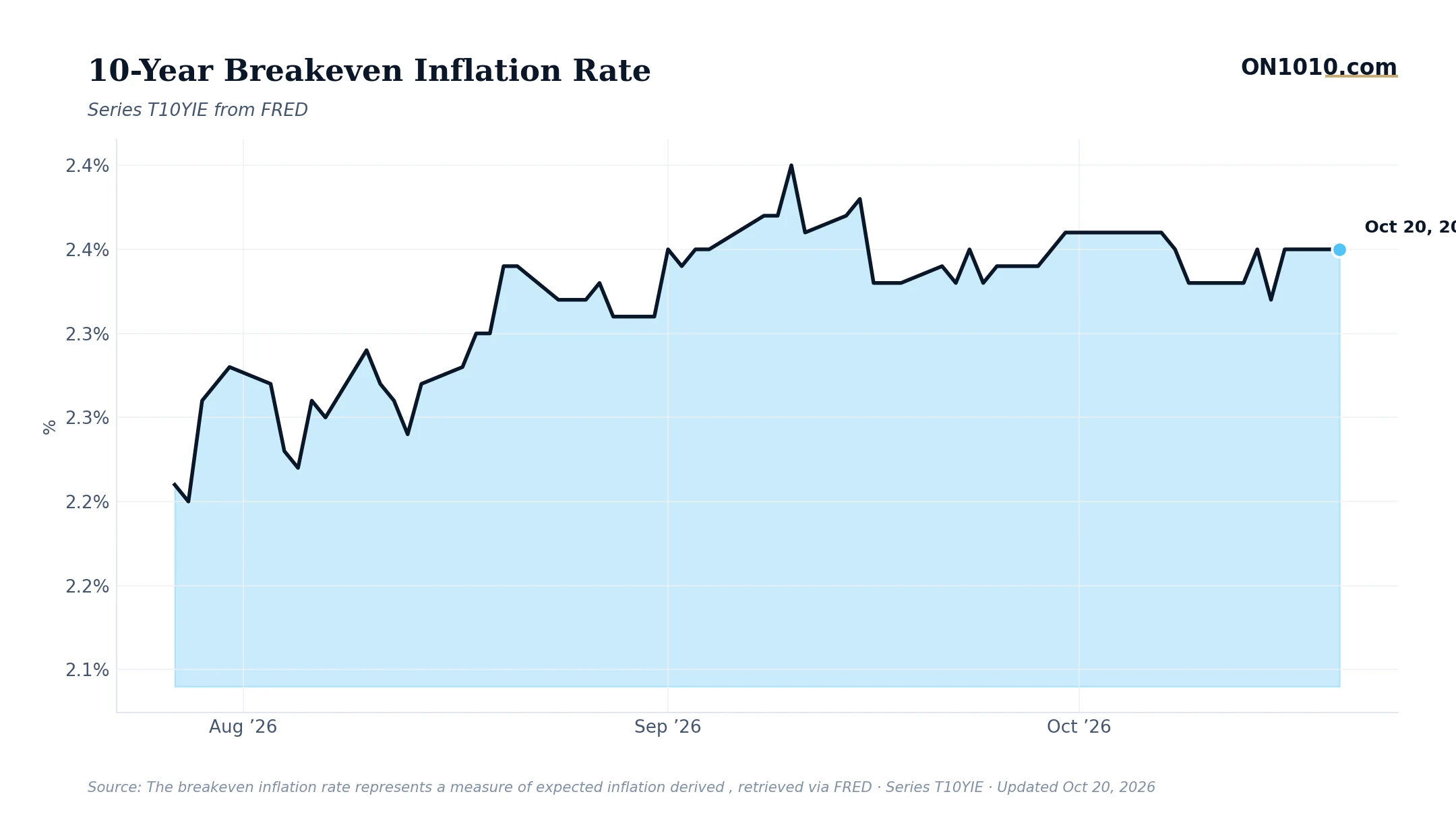
The 10-year breakeven inflation rate has barely moved in a week, holding at 2.35% for most of October. In a noisy economic environment, that kind of stillness is itself a signal worth examining.
Bond markets are pricing roughly 2.35% average annual inflation over the next decade. That sits just above the Fed’s 2% target, but not by enough to suggest panic. What makes this interesting is the backdrop: core inflation is running historically hot, credit spreads just widened from elevated to very high, and equity markets are rotating hard into defensive sectors like consumer staples and healthcare. The bond market’s inflation expectations haven’t flinched.
This divergence between calm inflation expectations and elevated stress signals elsewhere is worth tracking closely. Wide credit spreads historically reflect tightening financial conditions, which tend to cool demand and pull inflation lower over time. If that logic plays out, the breakeven’s current stability could prove prescient. But monetary policy remains restrictive by historical standards, and restrictive policy that lingers this long has preceded economic slowdowns about 18% of the time in similar past configurations. That is not a prediction. It is a base rate worth knowing.
In past cycles, when breakeven inflation held steady near 2.3% to 2.5% while credit stress was building, investors and business operators watched carefully for whether the calm in inflation expectations would hold or whether credit conditions would eventually force a reassessment. A breakeven that starts falling from here would signal markets are pricing in an economic slowdown. One that rises would suggest inflation is proving stickier than credit markets imply. Right now, the market is split between those two stories.
Bottom Line: The bond market’s inflation forecast is remarkably calm for a week when credit and equity signals are flashing caution. The question worth following is which signal breaks first: do credit conditions ease back toward the inflation picture, or does the inflation picture eventually reprice to match the credit stress?
Source: Federal Reserve Economic Data (FRED)
ON1010 Research is an independent publisher of economic education and is not a registered investment adviser, broker-dealer, or investment company. This content is for educational and informational purposes only and is not investment advice or a recommendation to buy, sell, or hold any security. Published under the publisher exemption recognized by Section 202(a)(11)(D) of the Investment Advisers Act of 1940 (Lowe v. SEC). Always consult a qualified financial professional before making any financial decision.
Free Research
The economy moves fast. We make sure you move faster.
Economic data, policy shifts, and market signals — delivered to your inbox.
Subscribe Free